Bushwalks


IMG_6275

Morning sun from Eastern Outlook Track

By: Michael Fox

Autumn is a wonderful time of year for a morning walk in Mt Gravatt Conservation Reserve. The air is fresh and cool and alive with the sound of birds.

Every morning is different. One day the morning sun is putting on a show peaking over the clouds while this morning I saw a new bird to photograph and identify. (Not always easy when you only catch one view of the bird.)

Unidentfied bird - 23 March 14

What bird is this? Ideas anyone?

Acacia Way - 23 Mar 14

Are we really in the middle of a city?

We also saw a Spangled Drongo Dicrurus bracteatus on the Eastern Outlook Track and another pair on the Farm Fire Trail.

We did not see any Wallabies, there have been three reliable sightings over the past twelve months, but we did have a pair of Galahs Eolophus roseicapillus fly past and saw two Black Faced Cuckoo Shrikes Coracina novaehollandiae.

Every track has different vegetation and a different feel depending on the time of day and position of the sun.

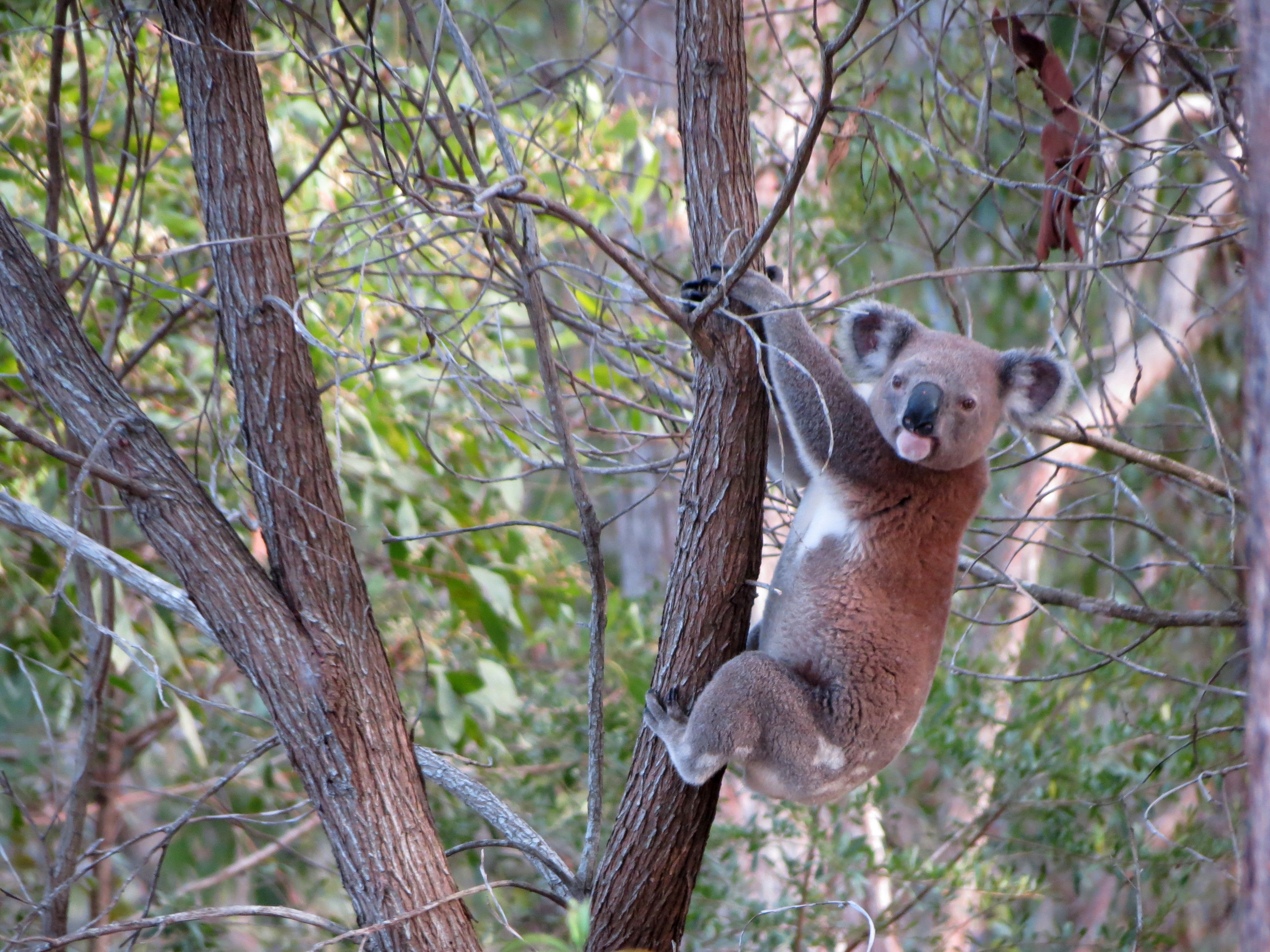
Koala - Fox Gully - 8 March 2014 - 7-01am

Koala with brown pelt? That is different.

By: Michael Fox

Saturday morning I was preparing to lead a guided walk for students from Griffith University and QIBT when my wife, Jude, calls to tell me there is a Koala in the tree behind our house. This is exciting because I can always find a tree with scratches to show people but if I can lead these students to a Koala in the wild right beside their university campus, that will be something special.

IMG_6243

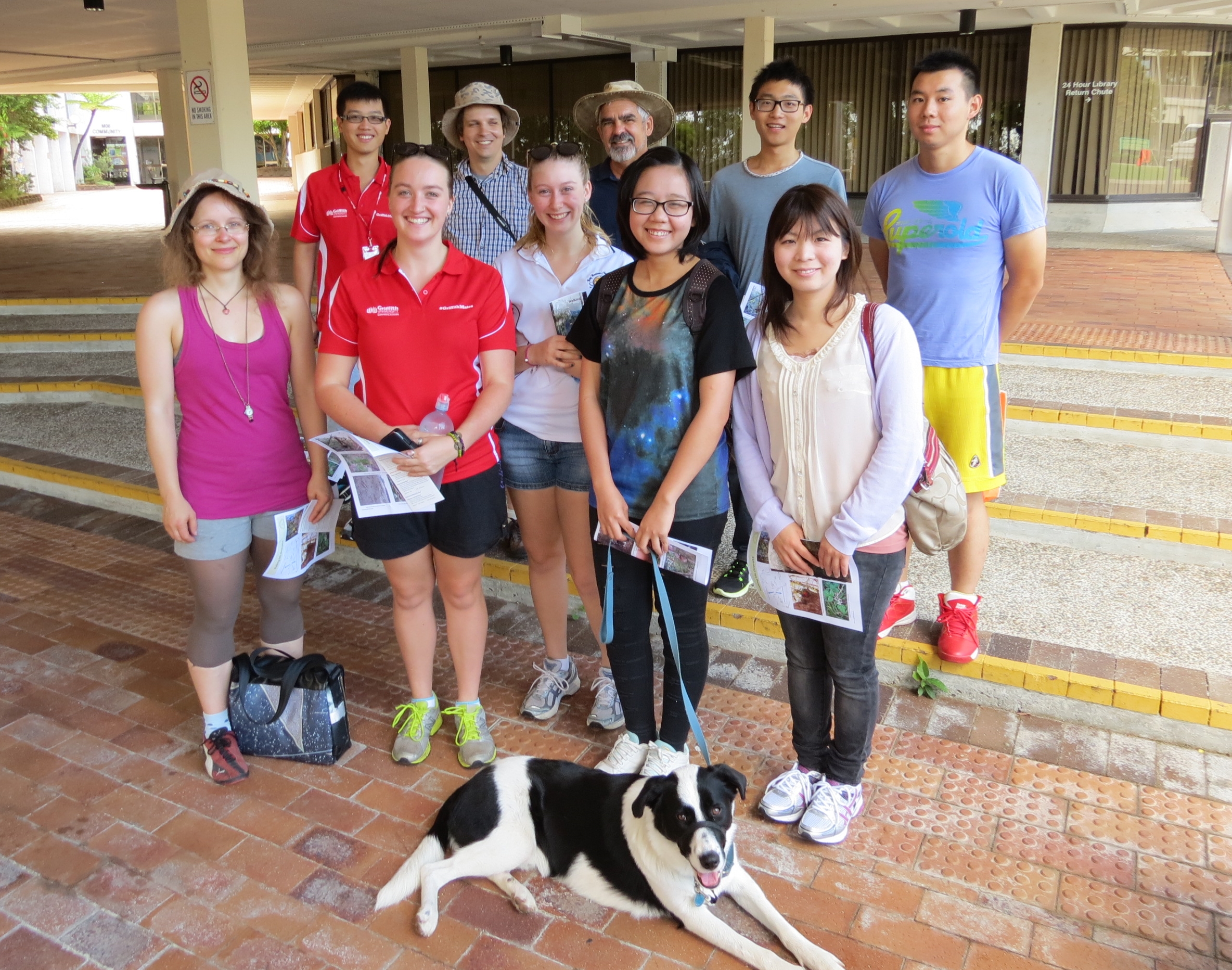
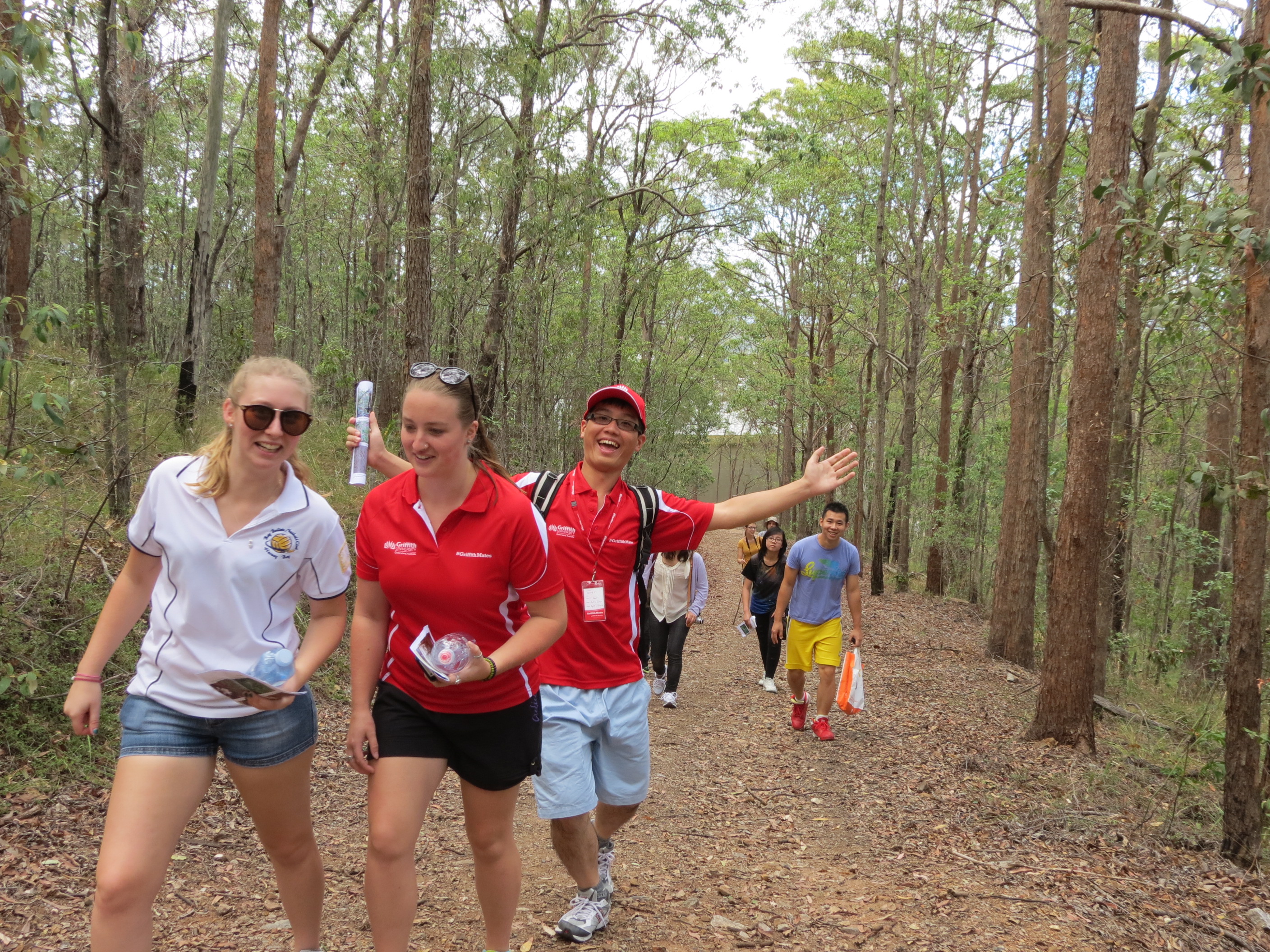
Griffith and QIBT student explorers

IMG_6093

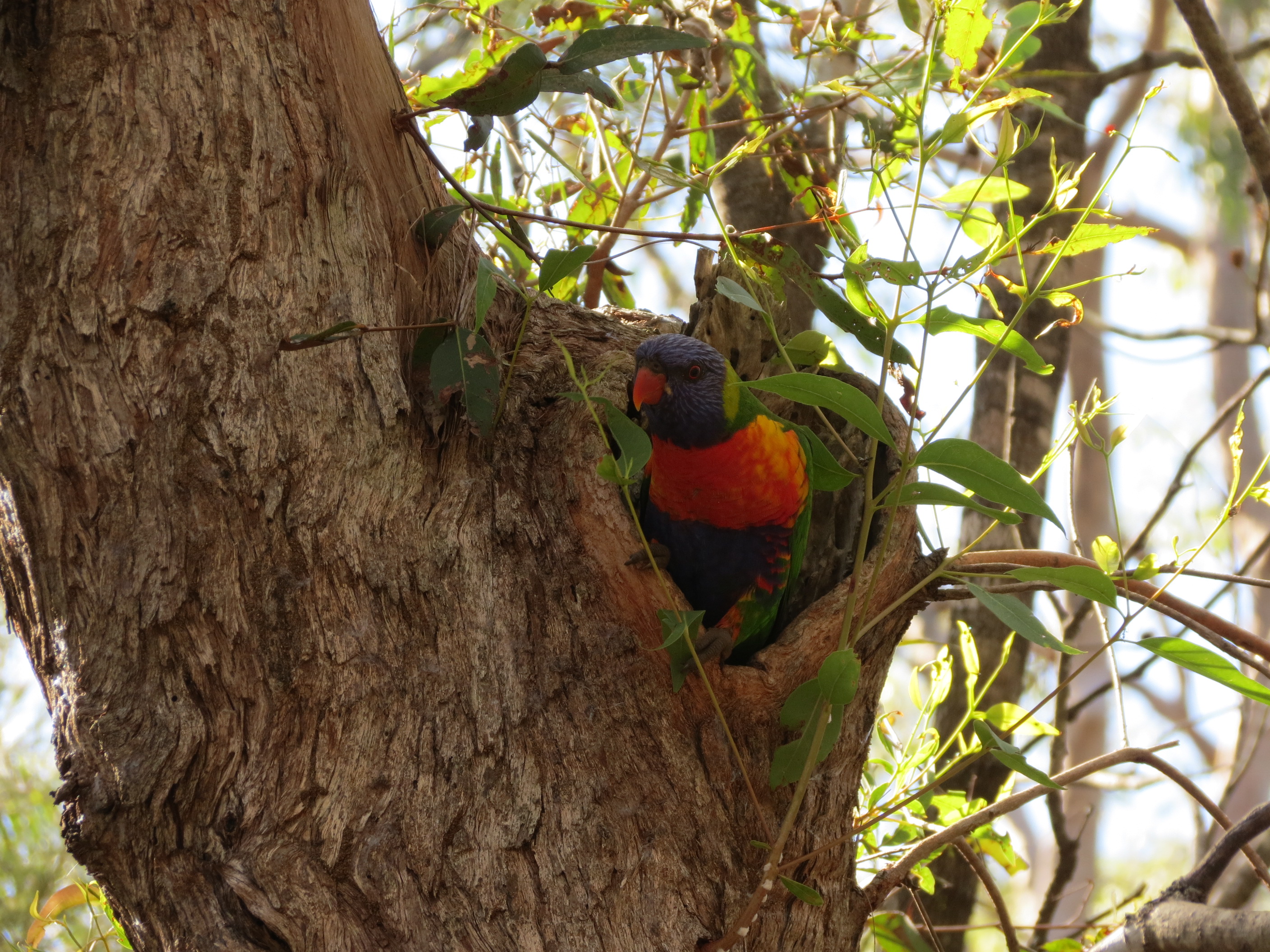
Rainbow Lorikeets

Laurie Deacon and I are joined by ten enthusiastic participants from all over the world – Europe, China, Japan, as well as country Victoria, all keen to explore Mt Gravatt walking tracks.

Acacia Way from Mt Gravatt Campus leads along the ridge that acts as the watershed between Ekibin/Norman Creek catchment and Mimosa/Bulimba Creek catchment passing a tree with a nest hollow being used by a pair of Rainbow Lorikeets Trichoglossus haematodus.

IMG_6232

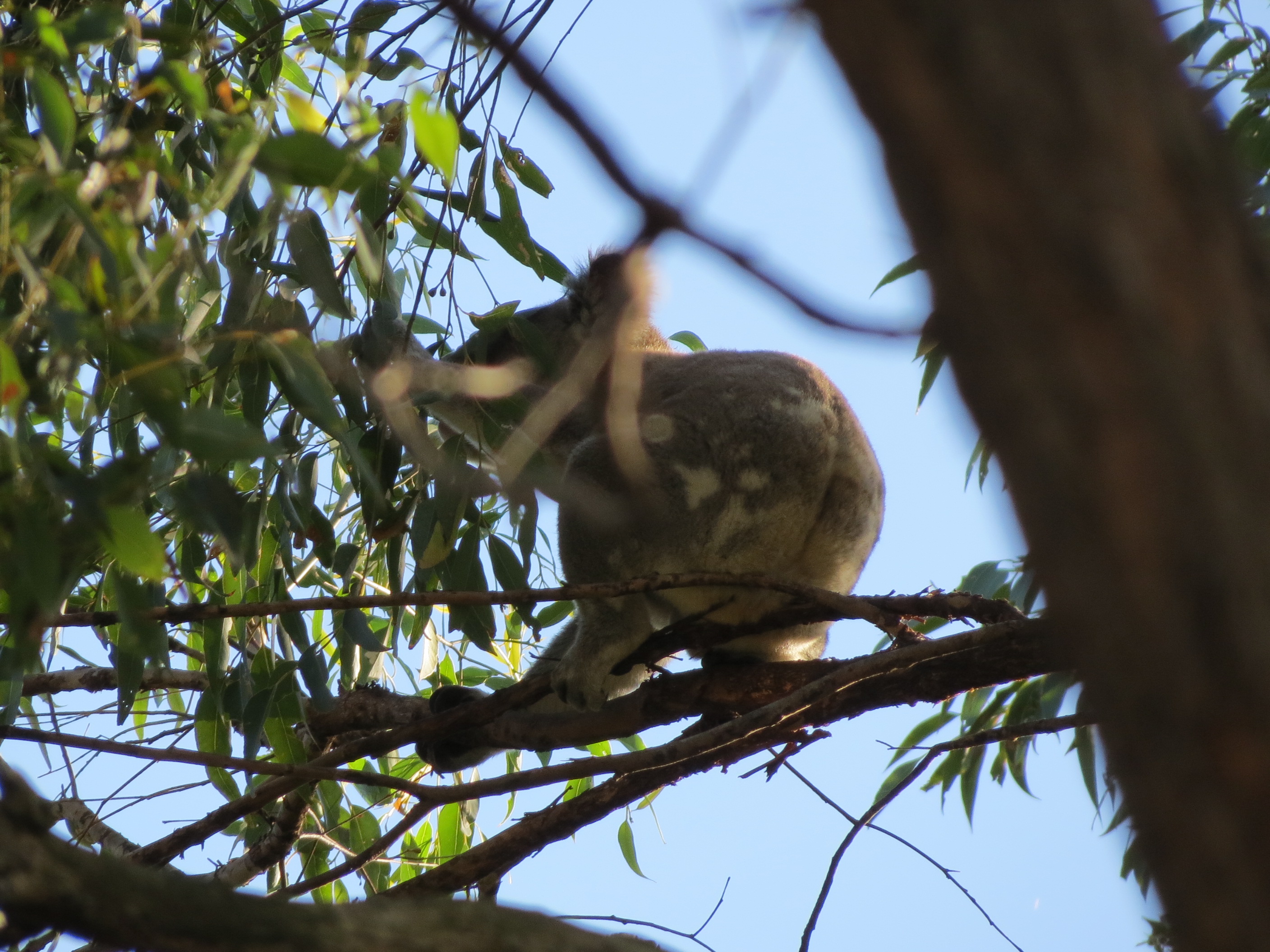
Koala Phascolarctos cinereus

I was able to introduce our visitors to bush food – Native Raspberry Rubus moluccanus, unfortunately not in fruit at the moment, and Settlers Flax Gymnostachys anceps with tough fibers used by aborigines to make fishing lines.

Joining the Geebung Track we continued onto the Fox Gully Bushcare site where I explained the nestbox project that is providing breeding habitat for Squirrel Gliders Petaurus norfolcensis and Kookaburras Dacelo novaeguineae.

IMG_6248

Mountain explorers powering up the hill

.

Our friendly Koala has moved high up into the branches, however, it was still a special opportunity to show visitors one of these amazing animals in the wild, not in a zoo, just 15 minutes from the city and right beside their campus.

.

.

.

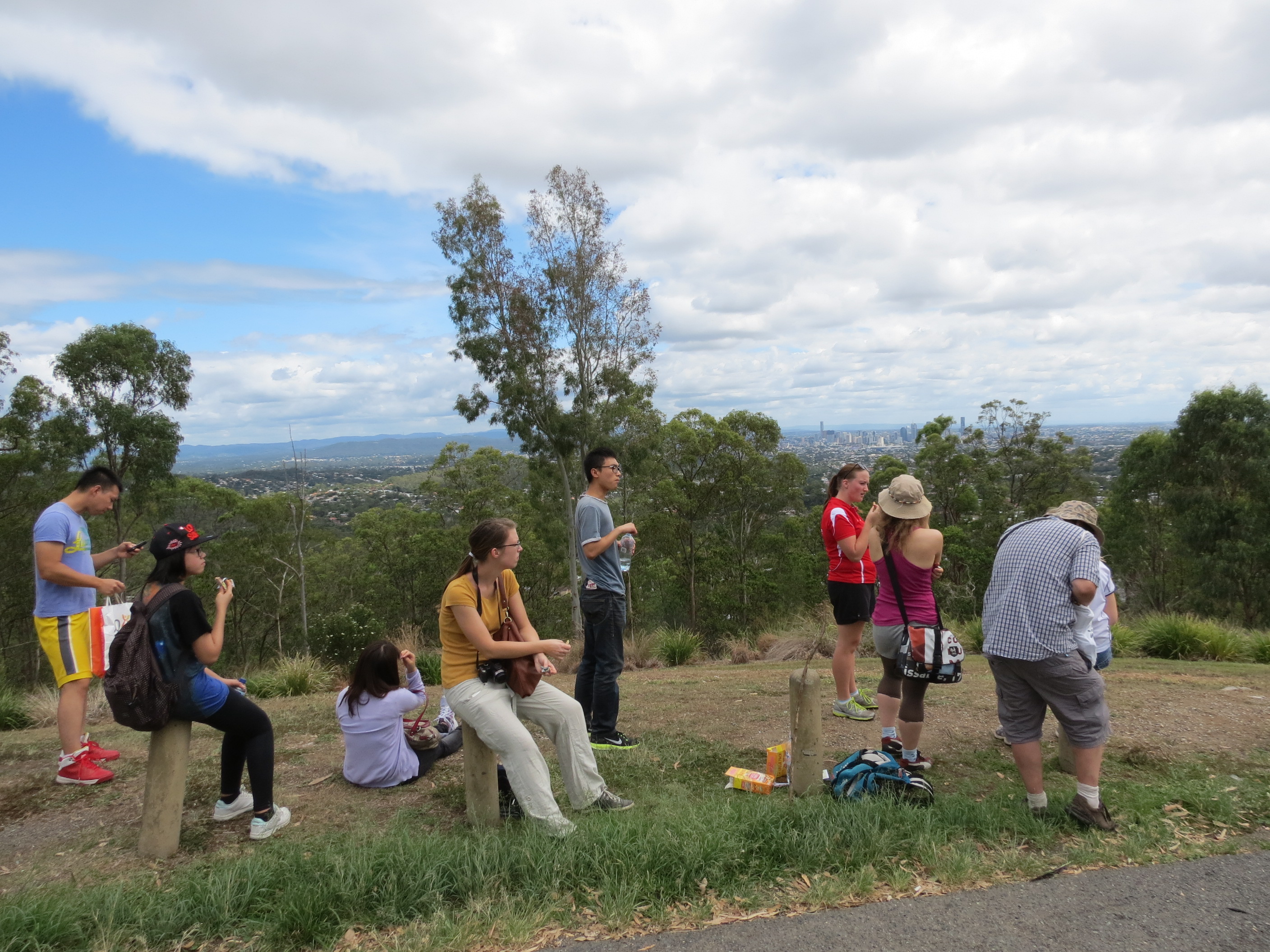
Re-energised our team powered on to Mt Gravatt Lookout for a break before returning to campus.

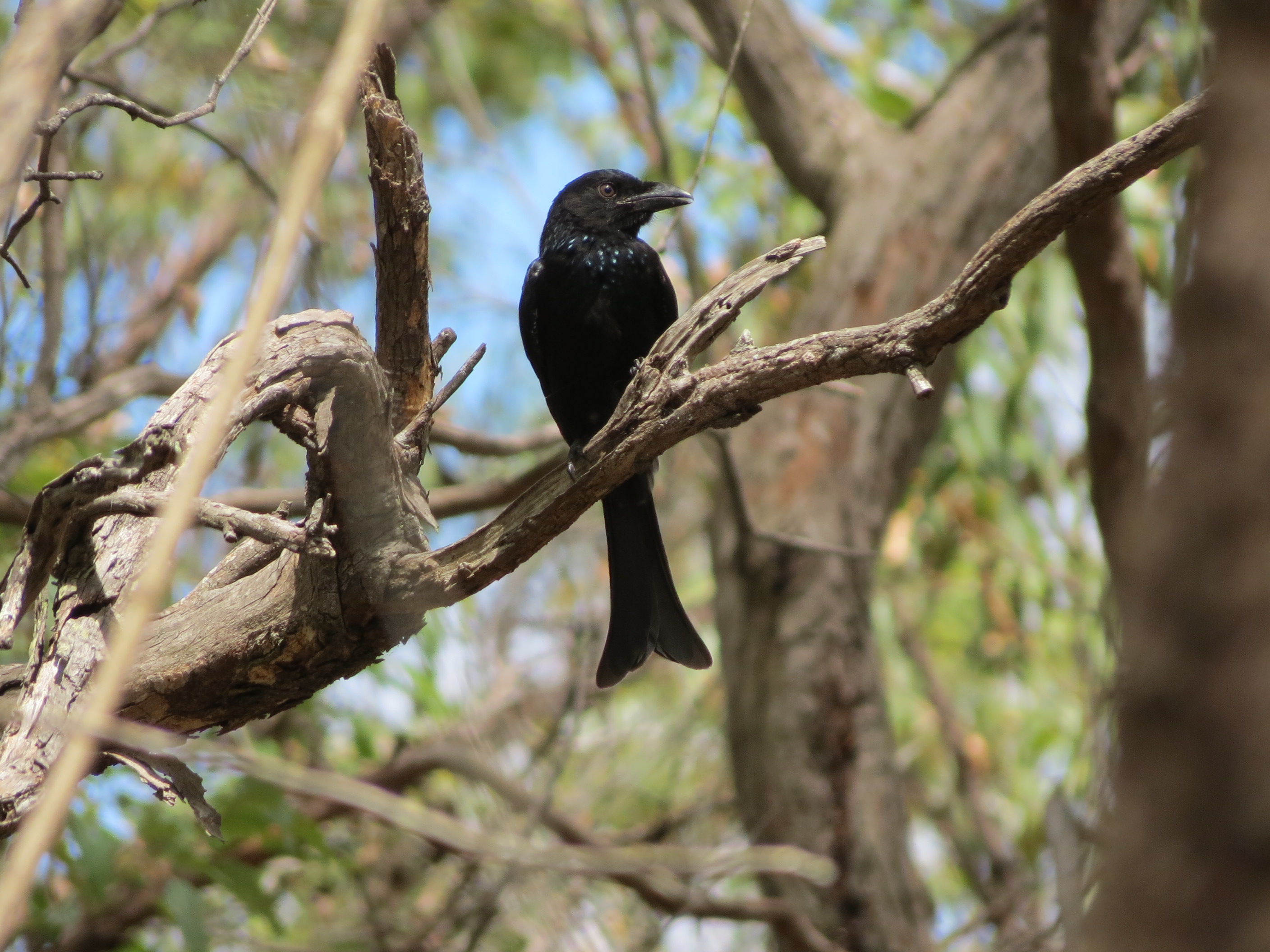
I was particularly pleased to photograph a Spangled Drongo on the way back. We had the Spangled Drongo on our species list but no photograph.

QIBT and Griffith students are invited to join us in our bush restoration work.See Griffith Mates for events. 

IMG_6250

Mt Gravatt Lookout

IMG_6258

Spangled Drongo Dicrurus bracteatus

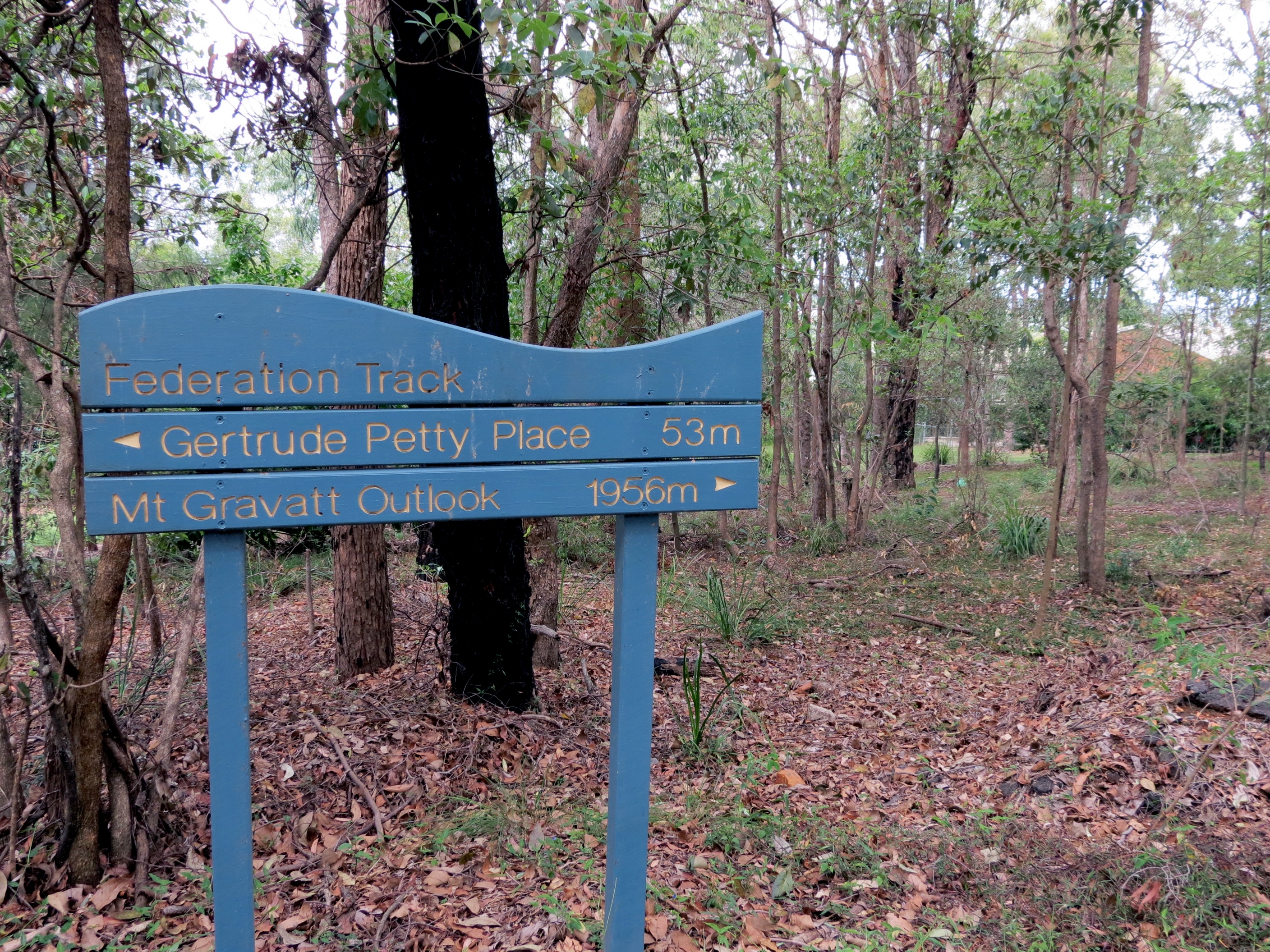
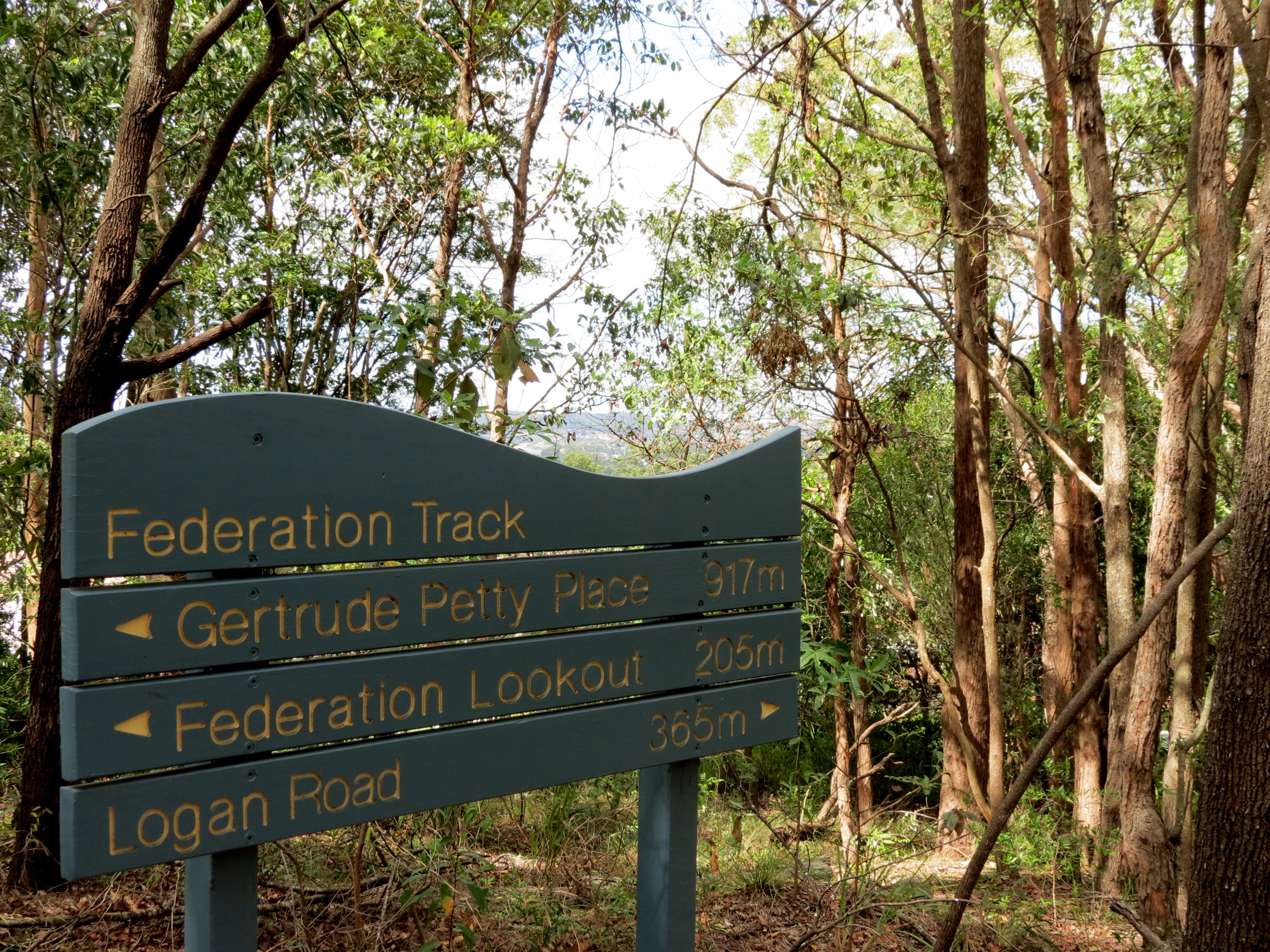
Federation Track sign 1 - 10 Feb 14

Federation Track – 1.9km to top of mountain

By: Michael Fox

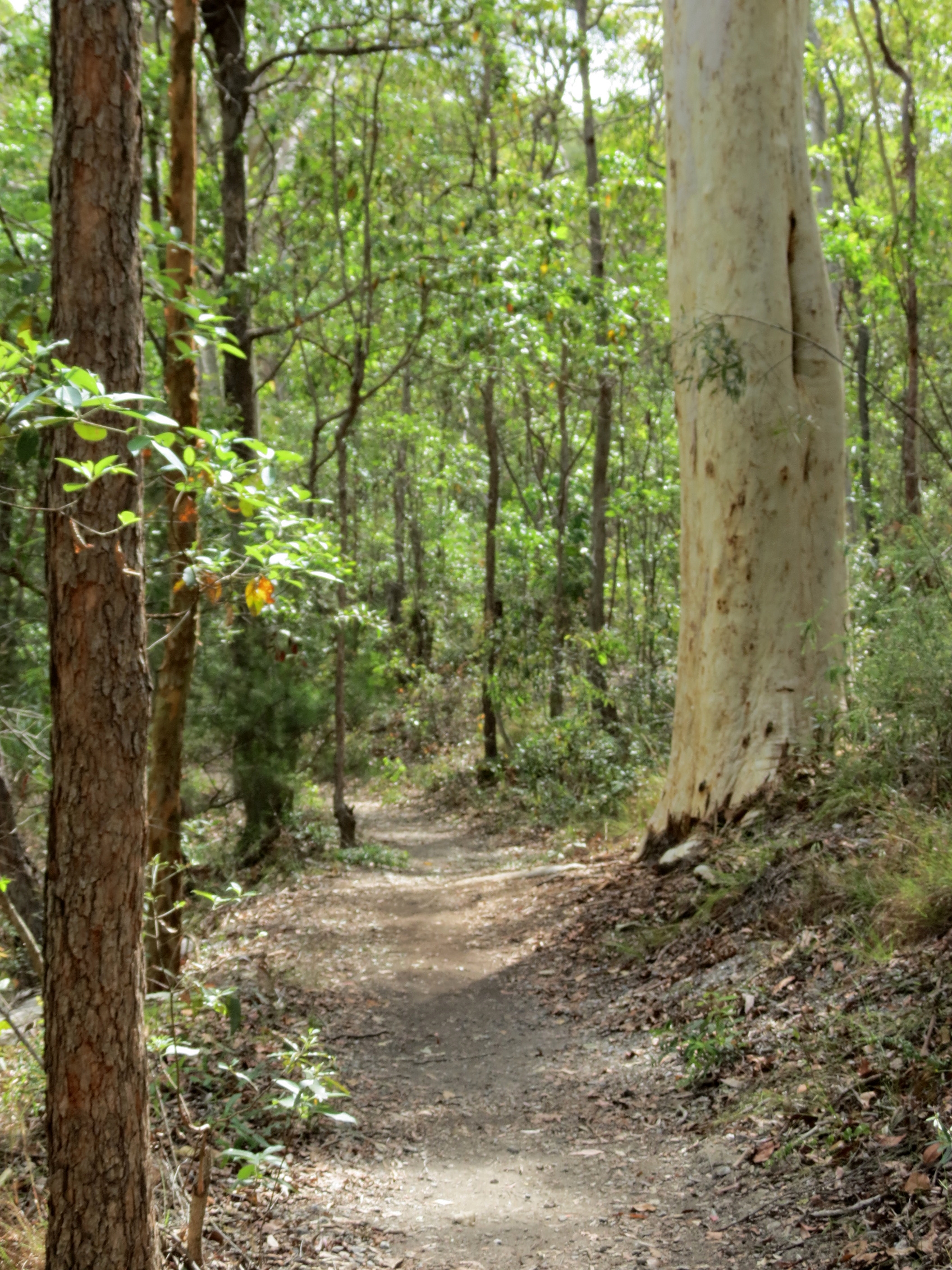
Part of preparing an accurate and useful map/walking guide for Mt Gravatt Conservation Reserve is actually walking all the tracks to check times and signs.

This week I walked the Mt Gravatt Lookout Look starting at Gertrude Petty Place I followed the Federation Track. The track leads through the Gertrude Petty Place Bushcare site where a group led by Sue Jones has been removing weeds and restoring native grasses, vines and trees.
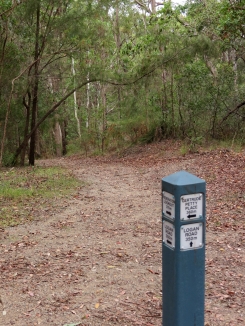
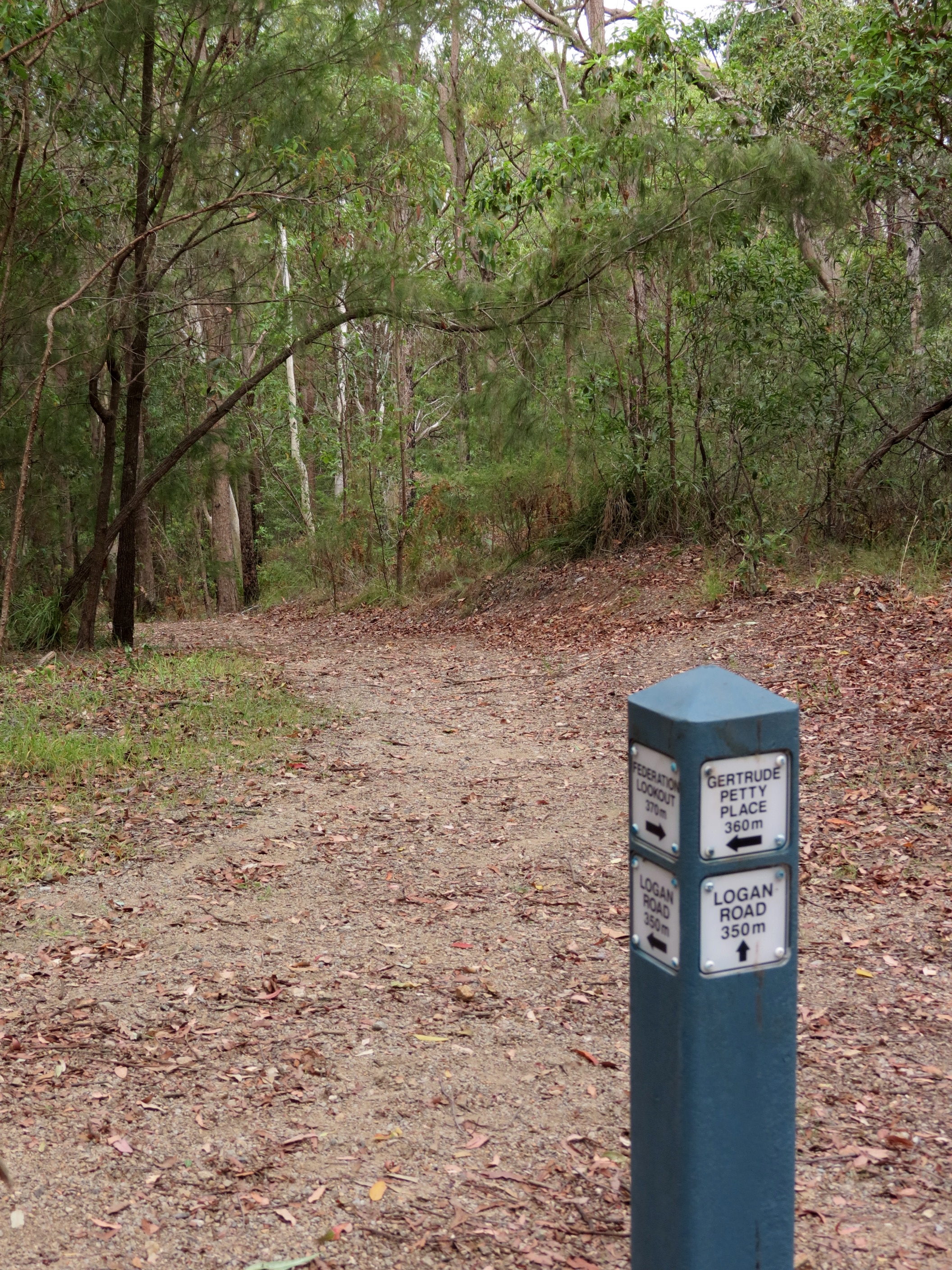
Ironbark Track junction - 10 Feb 2014

Ironbark Track junction – link to Logan Road

.

.

The section of the Federation Track through to the junction with Ironbark Track is very easy walking with no steps or steep climbs. The Ironbark Track currently connects through to Logan Road via the Hillsong Carpark off Rover Street. The long term plan is to bridge the gully at the Rover Street Bushcare site creating a wheelchair accessible track from Gertrude Petty Place through to Mt Gravatt Showgrounds.

.

.

.

.

.
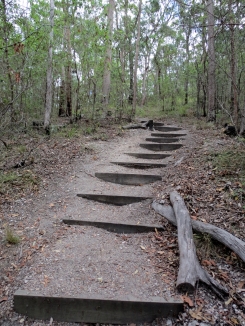
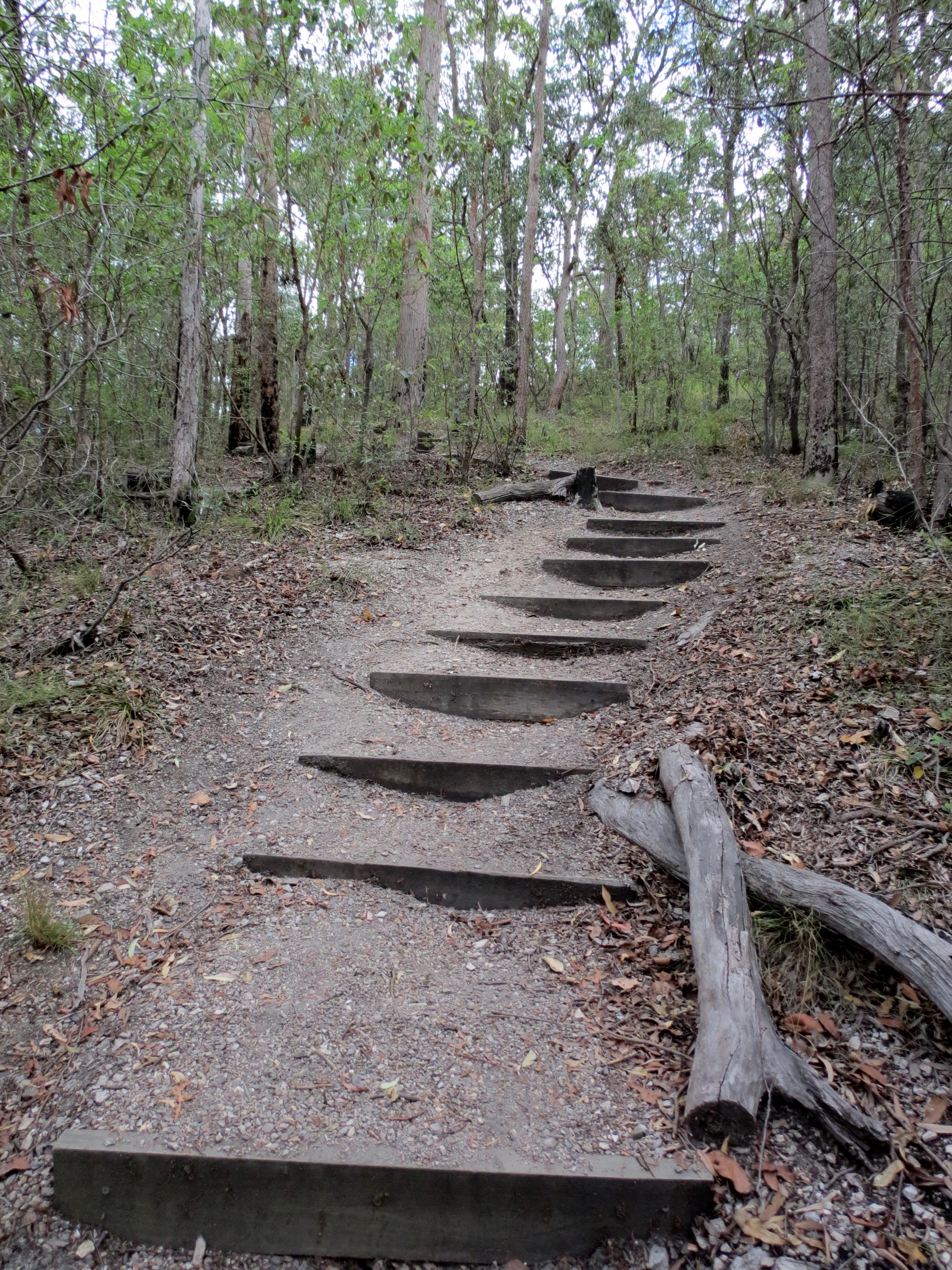
Federation Track steps past Ironbark junction - 10 Feb 2014

Track climbs to reach Federation Lookout

From the Ironbark Track junction the track starts climbing to reach Federation Lookout.

.

.

.

.
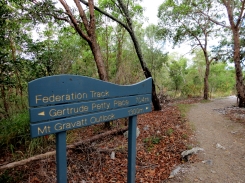
Federation Lookout junction - 10 Feb 2014

Federation Lookout junction

.

.

.

.

.
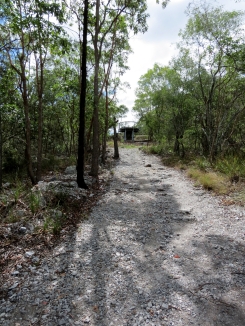
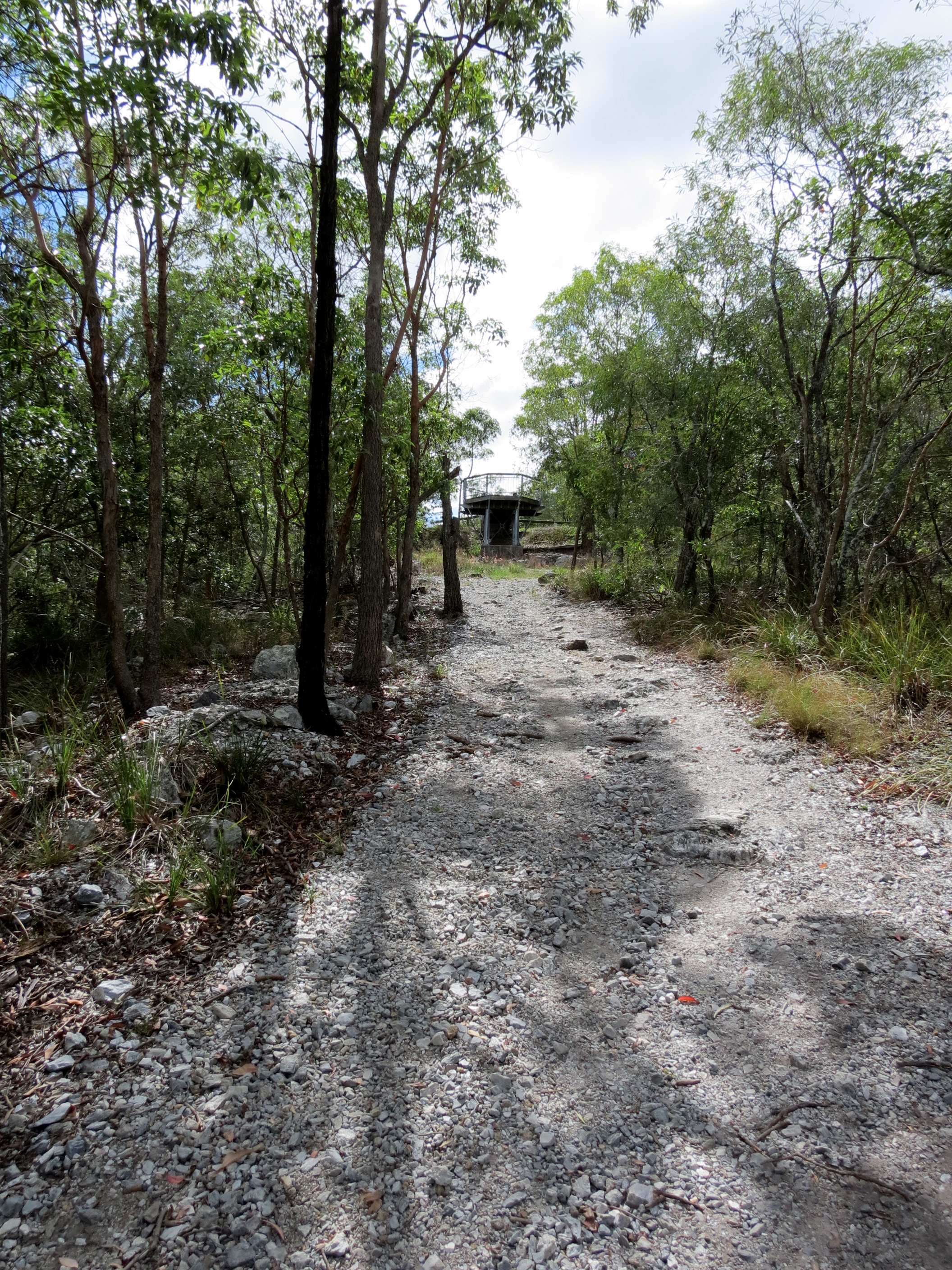
Federation Lookout - 10 Feb 2014

Looking back to Federation Lookout

.

.

A short side track to the right takes you Federation Lookout with excellent views over the city to the east..

.

.

.

.

.

From Federation Lookout the track goes downhill over grey-white quartzite. Large quartzite rocks scattered beside the track create some interesting photographic opportunities.
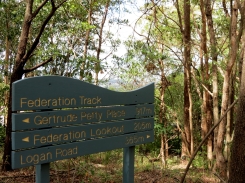
Scribbly Gum junction - 10 Feb 2014

Scribbly Gum Track junction – links to Logan Road at old Scout Hut

.

.

.

.

.

.

.

.

.

.

The Scribbly Gum Track links through to Logan Road at the old Scout Hut opposite Wishart Road. You can park at the Scout Hut to walk directly to Federation Lookout. The walk is quite interesting as it crosses Jo’s Creek before climbing towards the lookout..
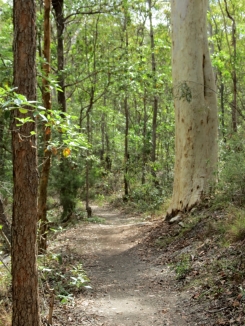
Scribbly Gums - 10 Feb 2014

Scribbly Gums

.

.

.

.

.

From the junction the track winds though Scribbly Gums Eucalyptus racemosa one of our iconic Australian trees that look like someone has been scribbling on the bark. “That can’t be scribbling, it is right up there metres above ground.” The scribbling is the work of moth larvae feeding on photosynthetic tissue just below the epidermal cells in the tree trunk.

.

.
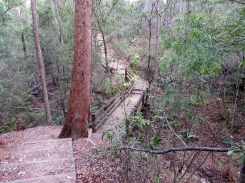
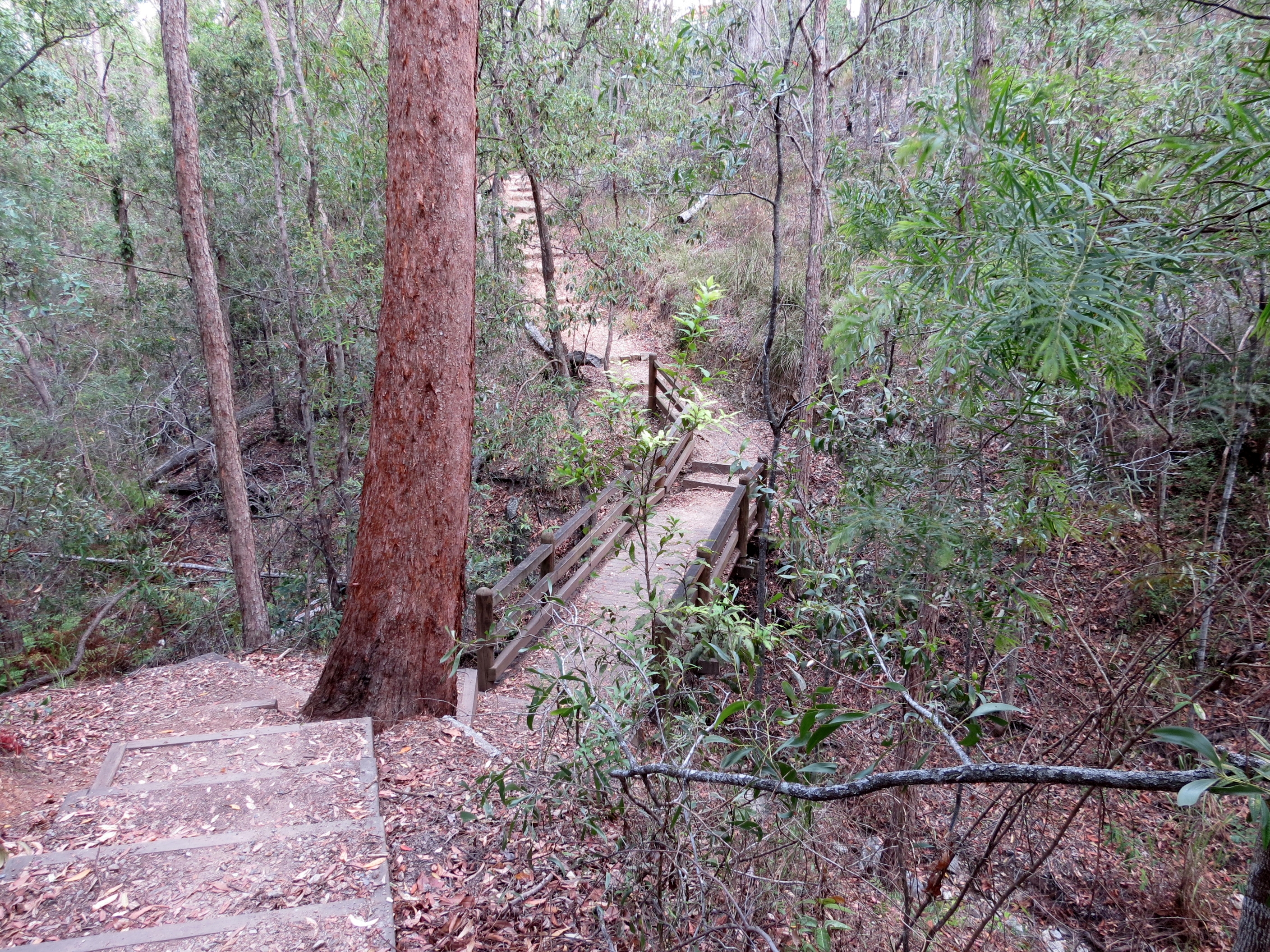
Bridge - 10 Feb 2014

Jo’s Creek Bridge

.

.

.

.

Pause on the timber bridge crossing Jo’s Creek and watch for small forest birds..
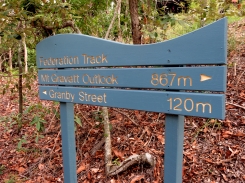
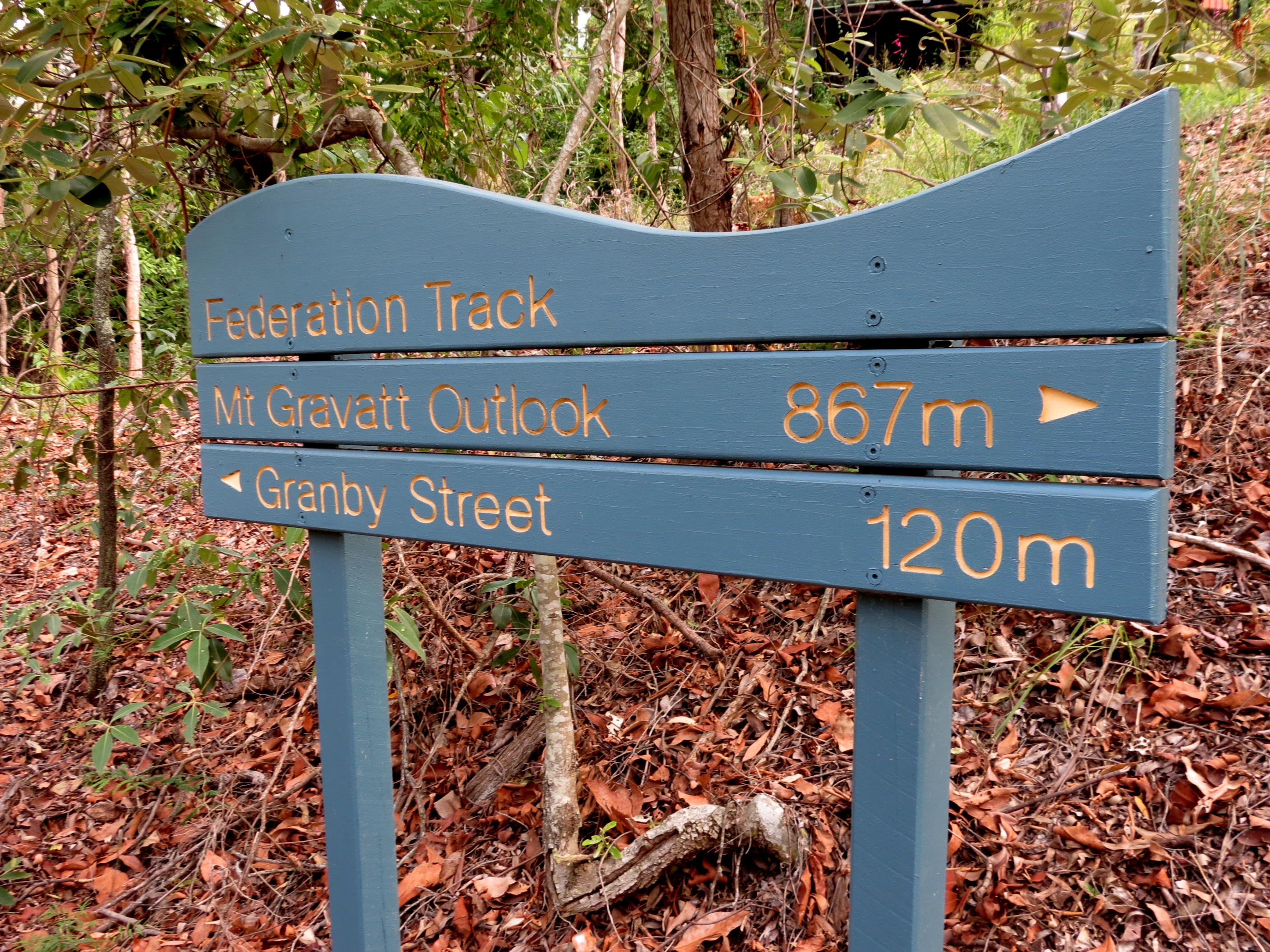
Granby Street sign - 10 Feb 2014

Granby Street junction

.

.

.

.

.

.

The Granby Street Track leads to Logan Road via Granby Street.
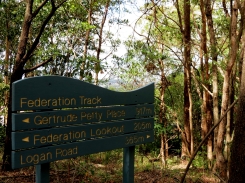
Federation Greebung junction - 10 Feb 2014

Federation Geebung Track junction

The track to Mt Gravatt Outlook is a solid climb gaining 55 metres in height over half a kilometre.

.

.

.

I stopped where the Federation Track joined the Geebung Track to check restoration work on the degraded weedy area beside the track.

.

.
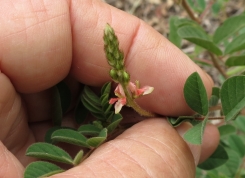
Indigofera hirsuta - flower close - 7 Feb 2014
Hairy Indigo – Indigofera hirsuta

I am always pleasantly surprised at the resilience of our native flora and fauna species that hang on despite massive disruption by man and weed invasion. Among the metre high Guinea Grass Panicum maximum v maximum, Cobblers Pegs Bidens pilosa and Red Natal Grass Melinis repens, I found Slender Flat-sedge Cyperus gracilis, Creeping Beard Grass Oplismenus aemulus, Scrambling Lily Geitonoplesium cymosum and a healthy stand of Hairy Indigo Indigofera hirsuta an attractive native shrub which is caterpillar food plant for the Long-tailed Pea-blue and Common Grass-blue butterflies.
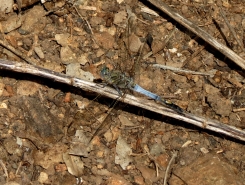
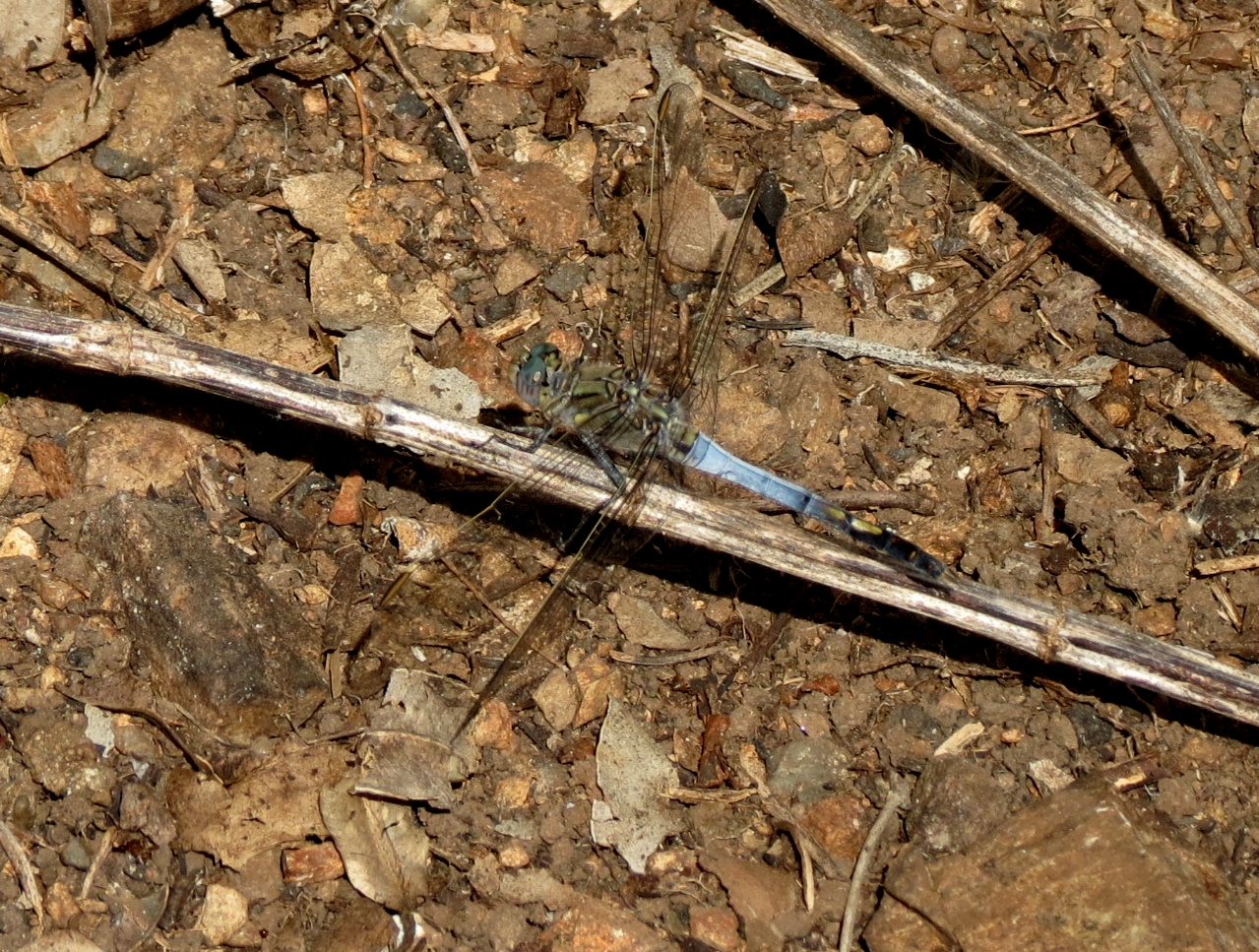
Blue Skimmer Dragonfly - close - 10 Feb 2014

Blue Skimmer Dragonfly

.

.

I also spotted a Blue Skimmer Dragonfly Orthetrum caledonicum resting in the sun.

.
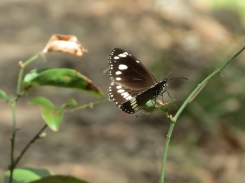
Common Crow - 10 Feb 2014

Common Crow butterfly

.

.

.

.

Following the Geebung Track to the Mt Gravatt Lookout I came across a number of Common Crow Euploea core butterflies performing mating flights.
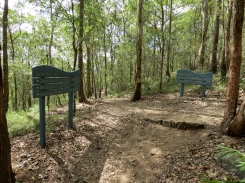
Geebung Summit Track junction 10 Feb 2014

Geebung Summit Track junction

.

.

.

.

.

The Geebung Track joins the Summit Track just short of the Lookout picnic area.

.

.

.
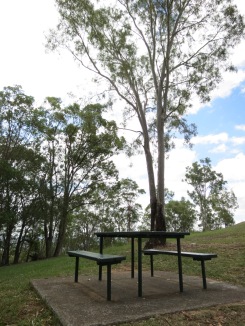
IMG_5979

Lookout picnic area

.

.

.

.

Have a picnic with the family …

.

.

.

.

.

.

.

.

IMG_5982

Echidna Magic

.

.

.

have lunch at Echidna Magic …

.

.

.

.

.

.

.

.

.

.
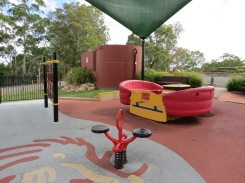
IMG_5984

Lookout playground

.

.

.

enjoy the playground …

.

.
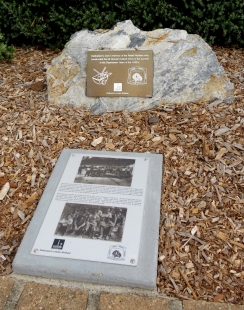
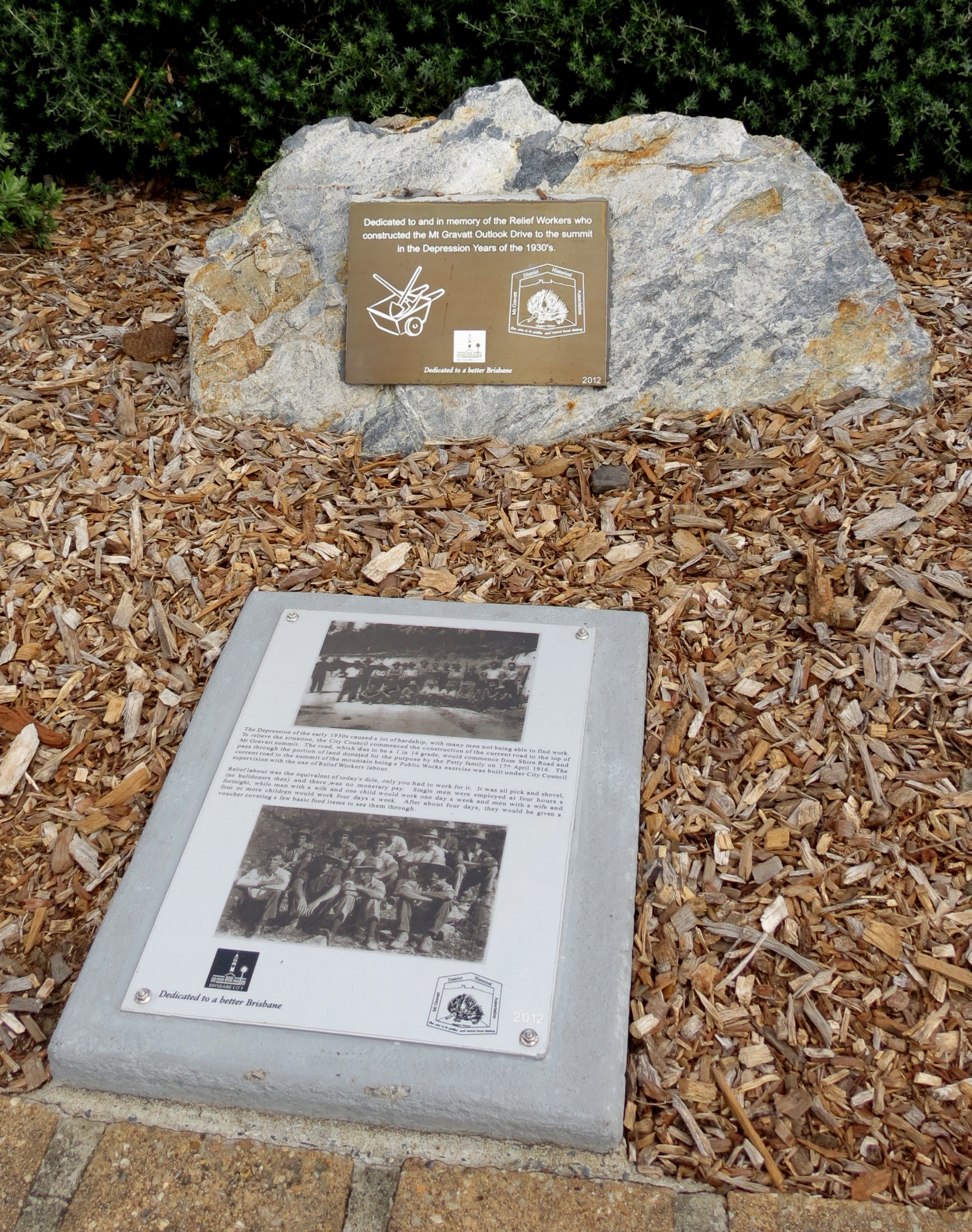
Historical Societ plaque - 10 Feb 2014

Story of road builders

.

.

.

.

or learn some local history.

.

.

.

.

.
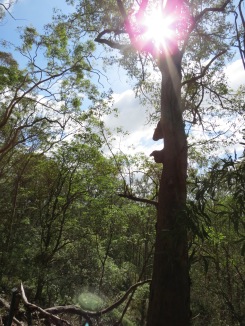
IMG_5997

Old growth trees on steep slope

.

.

.

.

.

.

After refilling my water bottle I returned to Gertrude Petty Place via the Summit Track which winds around the northern face of the mountain.

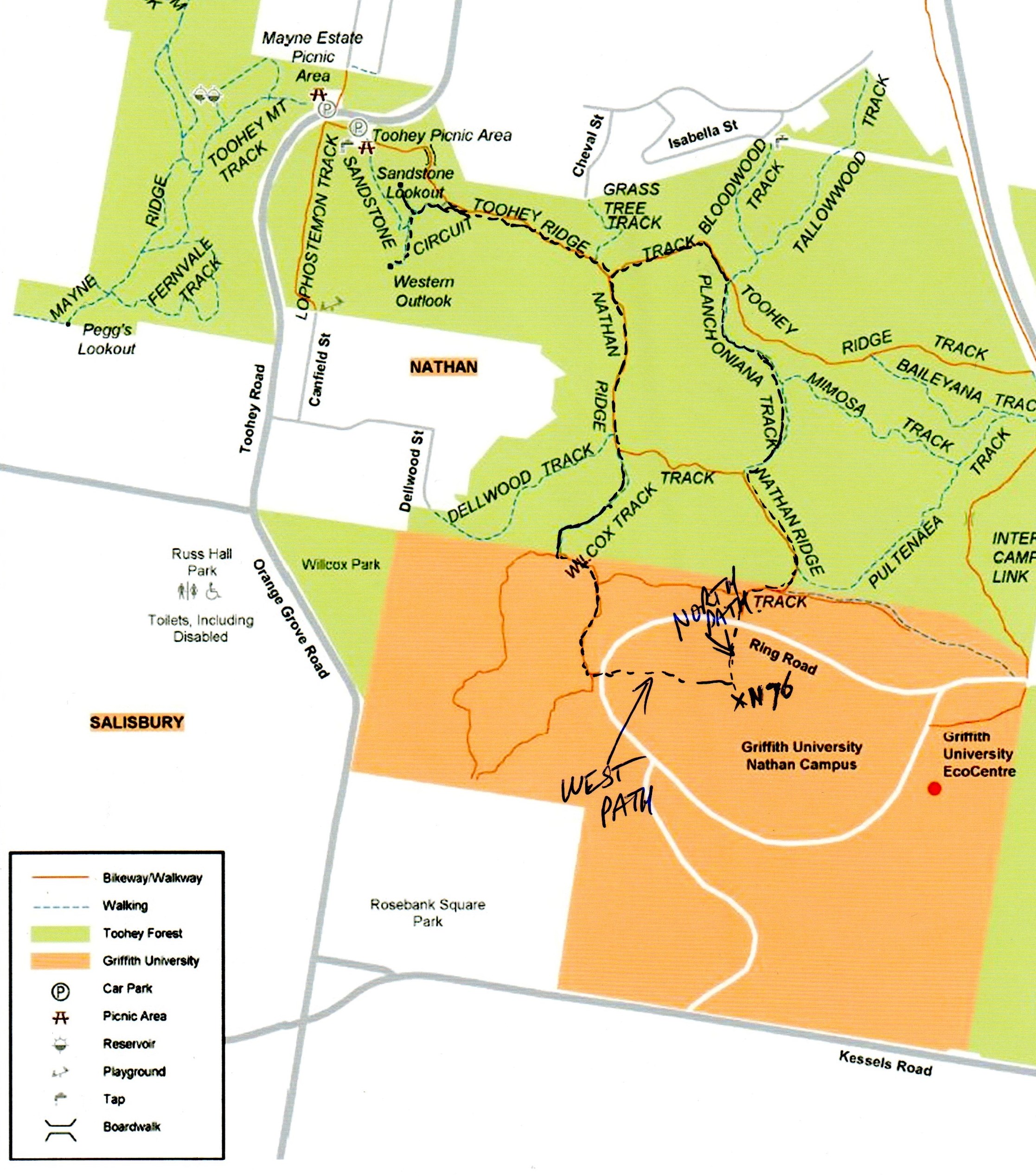
Griffith Mates Bushwalk - Map

Griffith Mates Bushwalk

By: Michael Fox

I joined neighbors Matt, Maya and Louie today for a walk to Sandstone Lookout, Toohey Forest.

As part of Orientation Week activities I am leading a walk-in-the-bush next Sunday for Griffith Mates. Griffith Mates are student volunteers who assist in orientation of  international by providing new students with a memorable first experience of life in Australia and at Griffith University.

IMG_4099

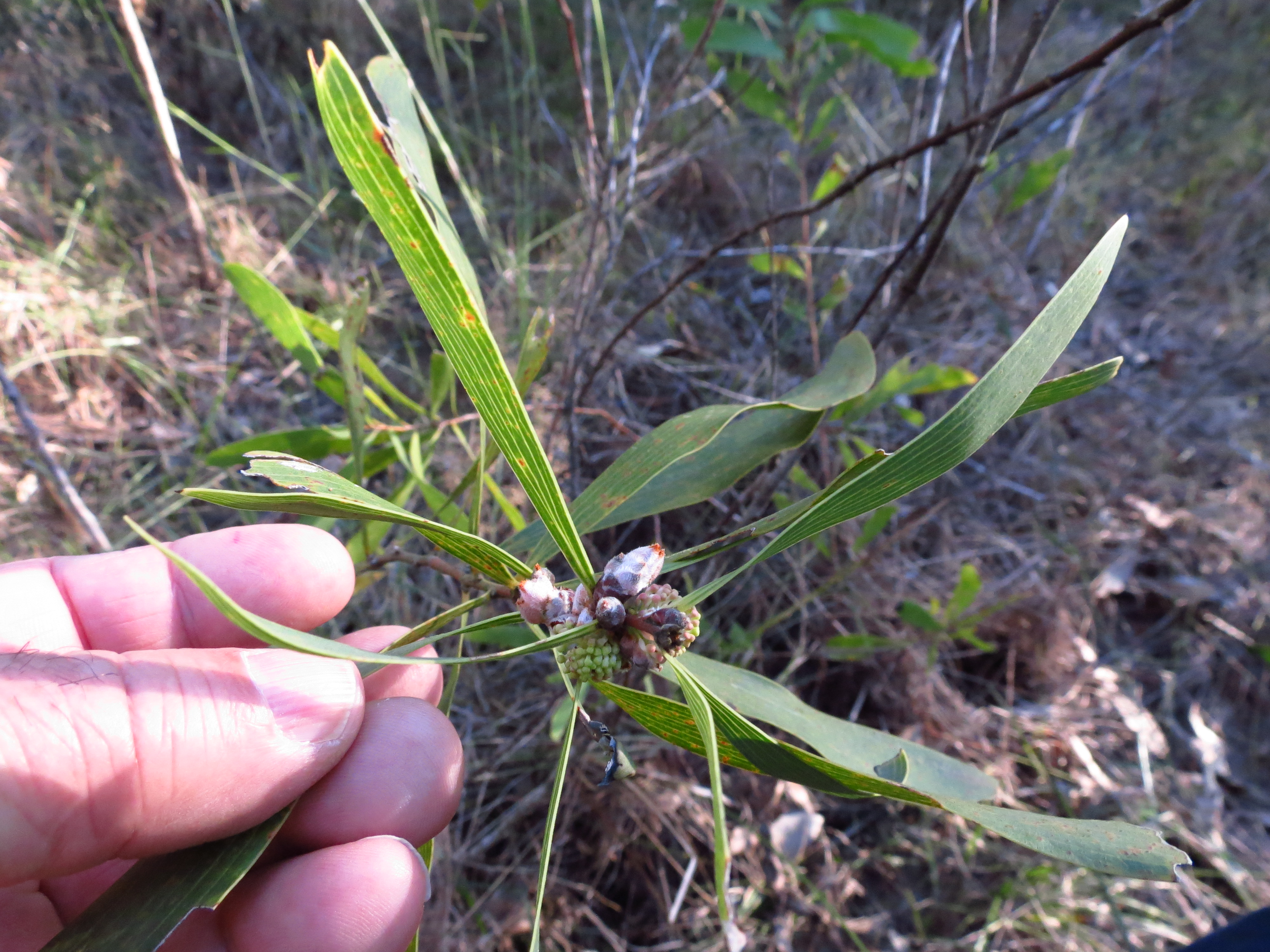
Hakea florulenta flower

The Nathan Ridge Track starts at the Ring Road opposite the North Path. The track has a high quality smooth bitumen surface ideal for young children on push-bikes.

d

IMG_4098

Hakea florulenta seed pods

d

We found an unexpected range of plants flowering even in mid-winter. An interesting example is the distinctive Hakea florulenta flowers, buds and seed pods. This species normally flowers in spring, around September/October so a winter flowering was unexpected.

d

d

d

The first time I found these plants I thought they must be wattles because of the leaf shape. However, the flowers and seed pods a very distinctive.

IMG_4078 close

Fan-tailed Cuckoo Cacomantis flabelliformis

d

d

d

d

We also saw a number of different bird species including Eastern Spinebill Acanthorhynchus tenuirostris and my first sighting of a very cute Fan-tailed Cuckoo Cacomantis flabelliformis.

d

s

s

IMG_4117

Koala scratches

s

s

s

The side track to Sandstone Lookout goes through a stand of eucalyptus with multiple Koala scratches.

d

d

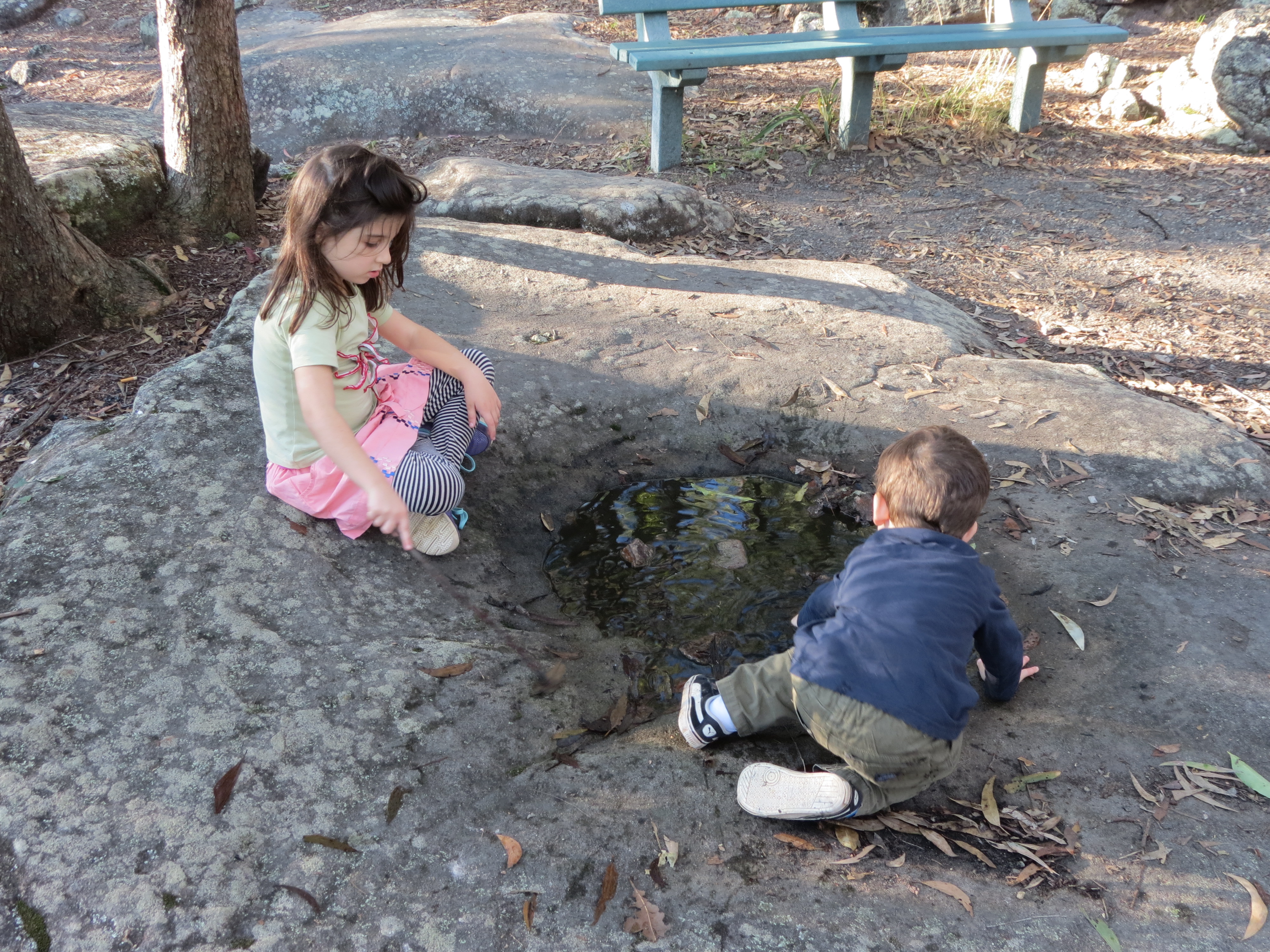
IMG_4111

Matt

IMG_4115

Maya and Louis – kids being kids

IMG_4120

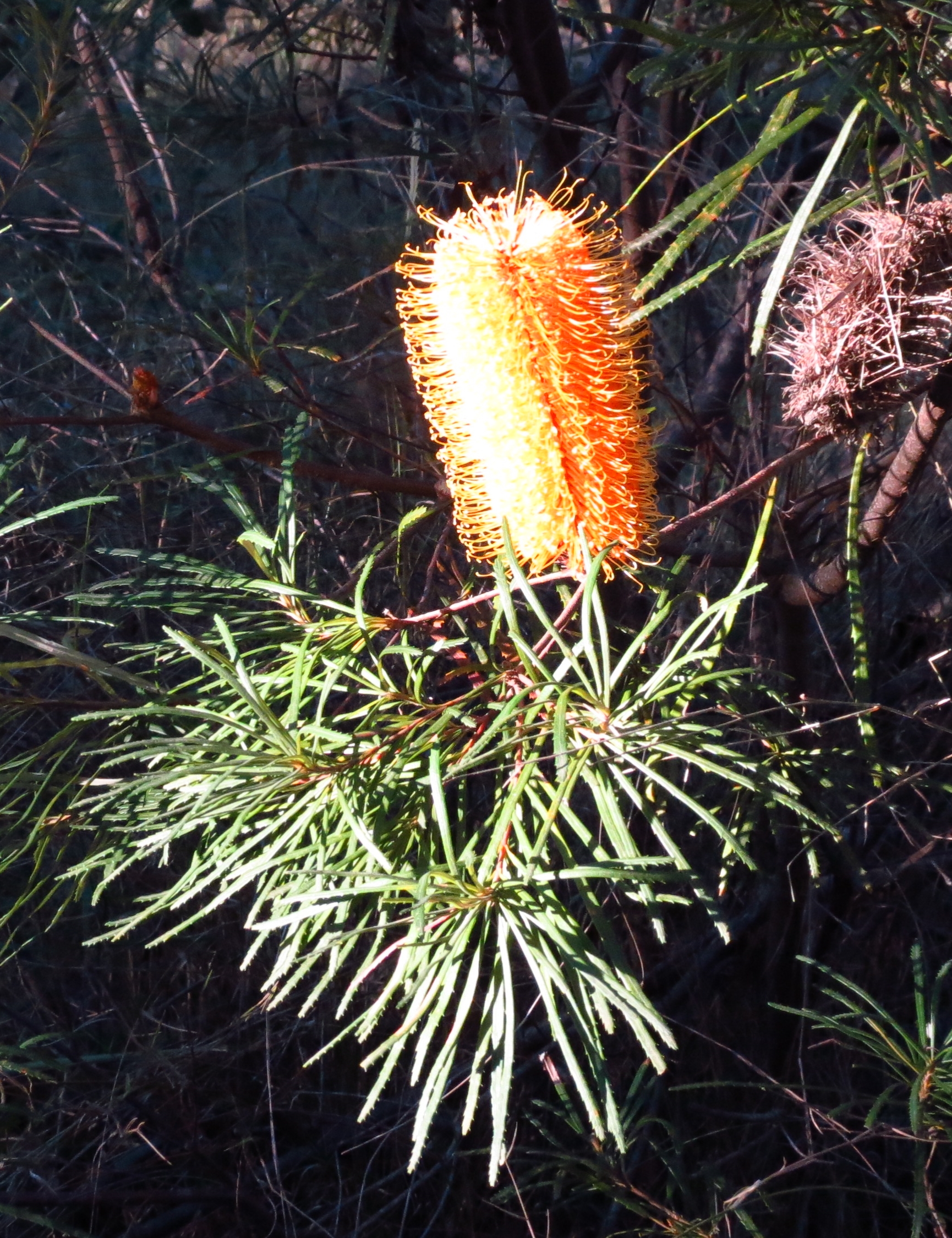
Hairpin Banksia Banksia spinulosa

d

a

a

Sandstone Lookout is one of my favorite places in Toohey Forest and an ideal place for kids to be kids.

d

c

c

c

c

c

c

c

c

c

c

c

c

c

c

c

d

On our return I could not pass up this photography opportunity presented when the afternoon light picked out this Hairpin Banksia Banksia spinulosa.

Echidna - front - Demmers - 24 June 2013

Echidna – Tachyglossus aculeatus

By: Michael Fox

“My wife says this Echidna was near our house in Mt Gravatt this morning. I am very jealous!! Apparently it bumbled around for ages.” Pieter emailed me today with these amazing photos.

I am jealous as well. I am yet to see an Echidna in the Reserve even though I have walked every track and spent hundreds of hours in bushcare and taking photos.

Early mornings and late afternoon is the time to look for Echidnas as they tend to avoid the hotter times of day.


Echidna - Demmers - 24 June 2013

Termite exterminator at work

If you spot an Echidna you can report the sighting to Wildlife Queensland’s Echidna Watch program which is gathering information on the distribution and abundance of Echidnas.

These unique animals are not just another interesting native animal they are are also valuable urban pest controllers protecting our homes by eating termites as well as ants and, apparently, dirt.

Restoration work at our Bushcare sites is improving habitat. However all mountain neighbours can help by not dumping garden waste/lawn clippings in the bushland and not removing fallen timber for firewood.

j

img137

Click on image to enlarge for reading

d

The 2011 report Mimosa Creek Precinct – Flora, Fauna and Fauna Corridor Assessment,  by Biodiversity Assessment & Management Pty Ltd, identified a lack of fallen timber as a key weakness in the mountain habitat. Fallen logs create ideal food sources for Echidnas as they attract termites and ants. These logs also provide protection as Echidnas avoid extremes in temperature by sheltering in hollow logs, rock crevices and vegetation.

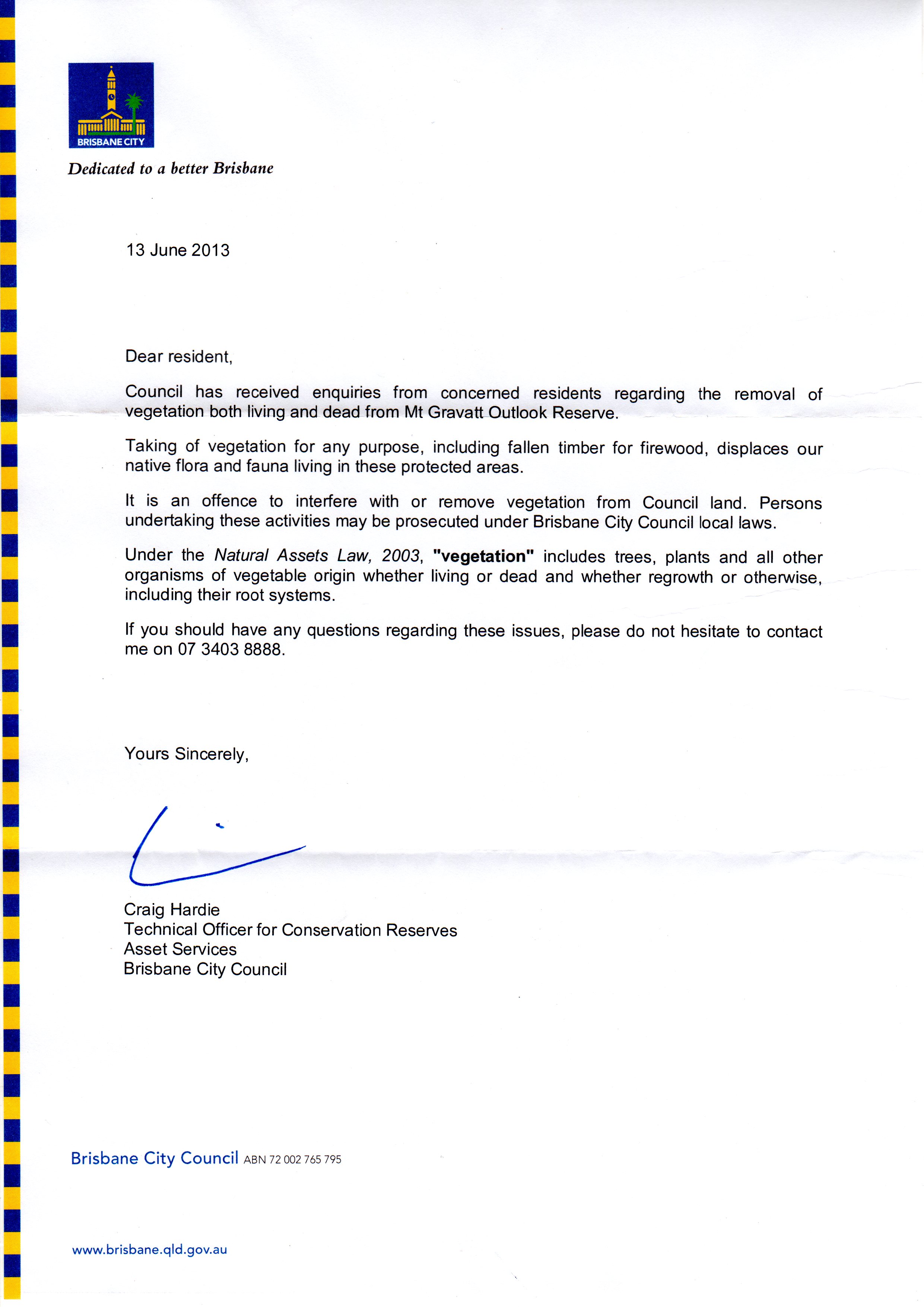
Local Council Ranger, Craig Hardie, has recently distributed letters to properties adjoining the Reserve to highlight the importance of not removing vegetation including fallen logs.

We are lucky to have such a unique habitat right in at our backdoor. I often have people ask amazed: “Koalas are just roaming free?” Therefore, as a community, we have a responsibility to protect this valuable asset by:

  • not dumping rubbish or garden waste; and
  • keeping dog’s on leash within the Reserve.

Like Koalas, the main threats to Echidnas are cars and dogs. If you are walking in the Reserve please keep your dog on a leash.

Multinational volunteer team

By: Susan Jones

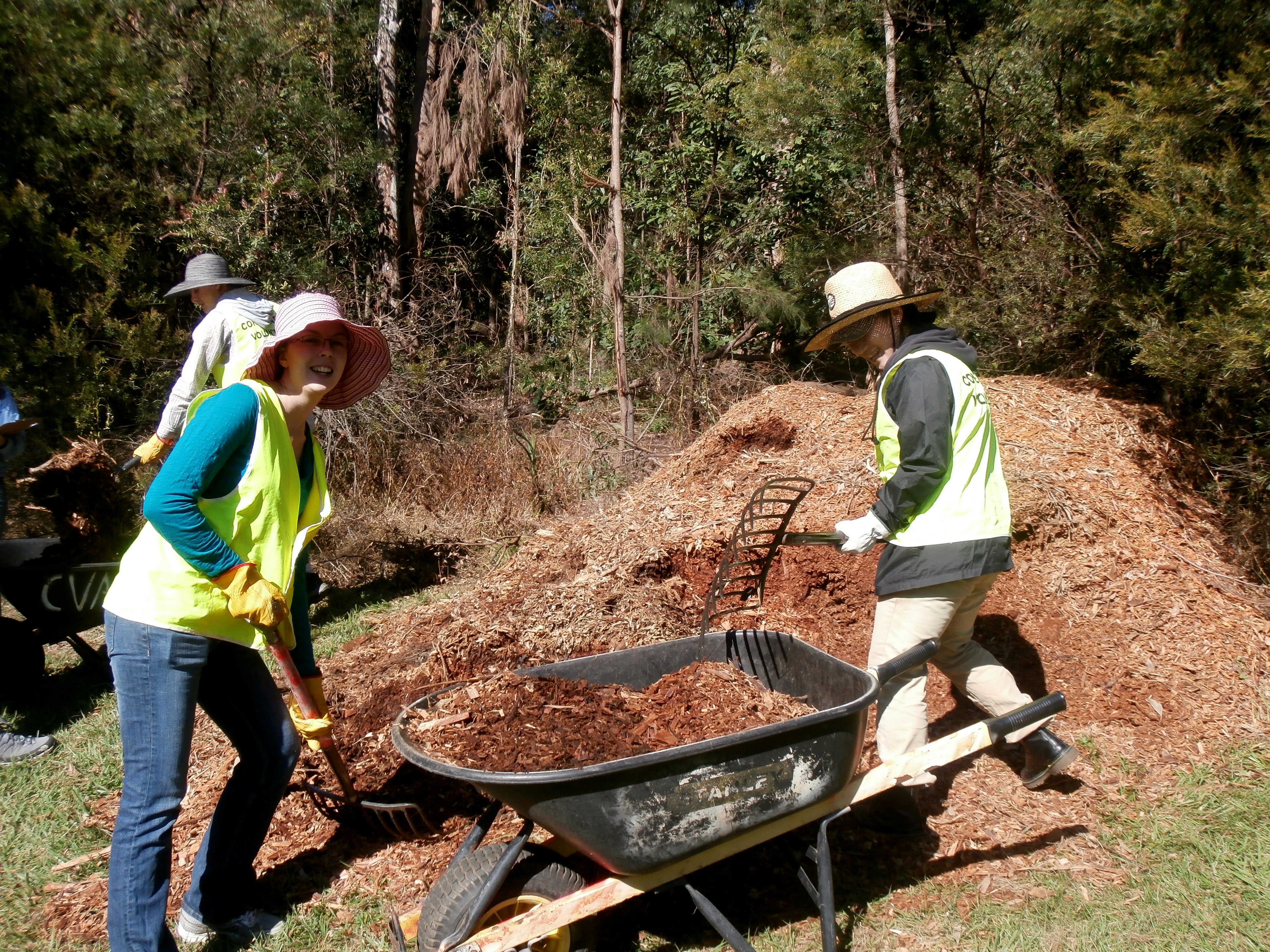
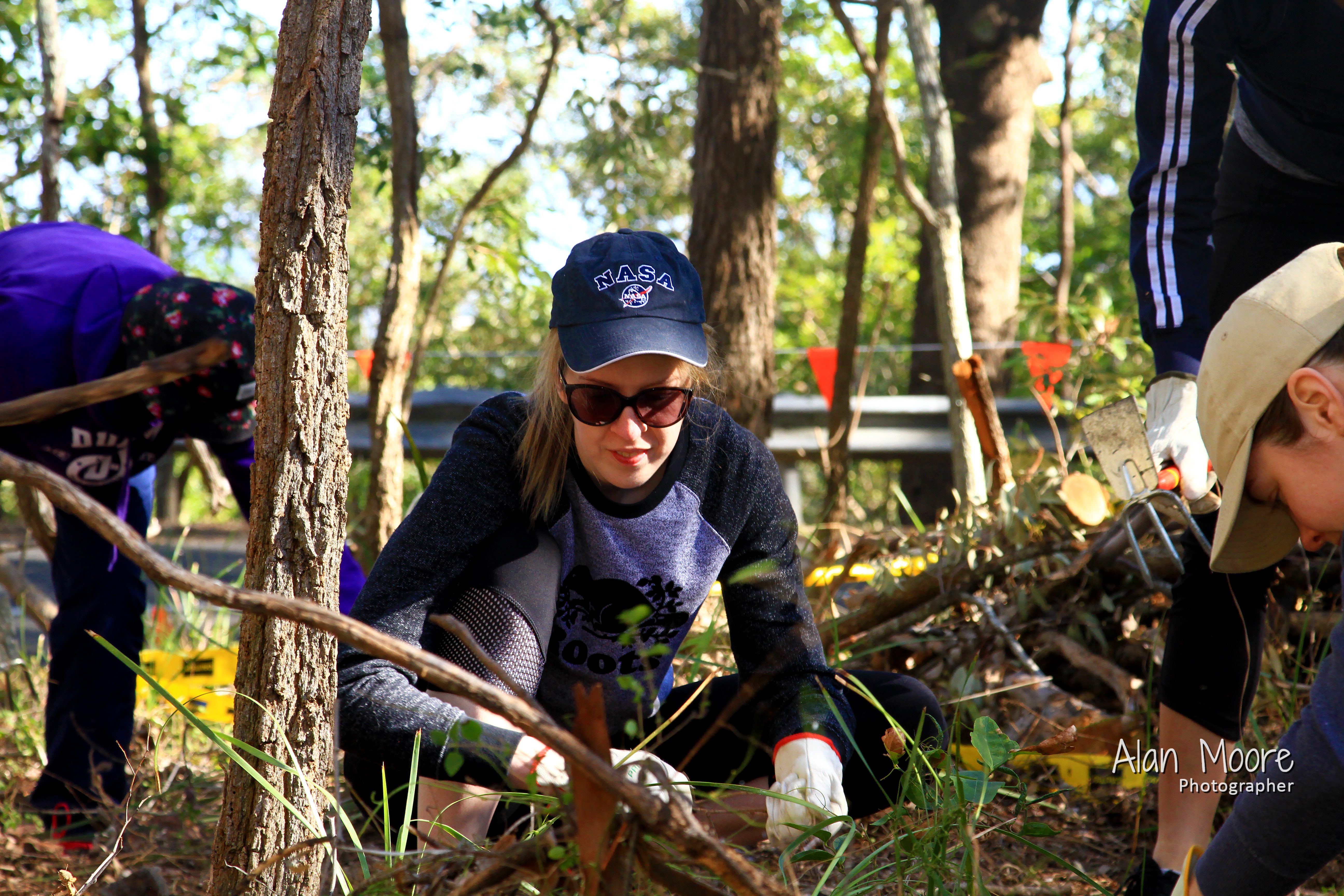
We were fortunate to have a multinational group of eleven Conservation Volunteers Australia (CVA) volunteers at Gertrude Petty Place today to clear a large garden bed of Cobblers Pegs Bidens pilosa and lay mulch.

d

d

CVA Mulch Team

d

One team removed the weeds, whilst the other barrowed in mulch sourced from trees blown down in the March 20 storm.

We were unable to finish the job as we had to stop work when a nest of Green-Head Ants Rhytidoponera metallica swarmed out of a nest in the mulch, threatening volunteers with painful stings.

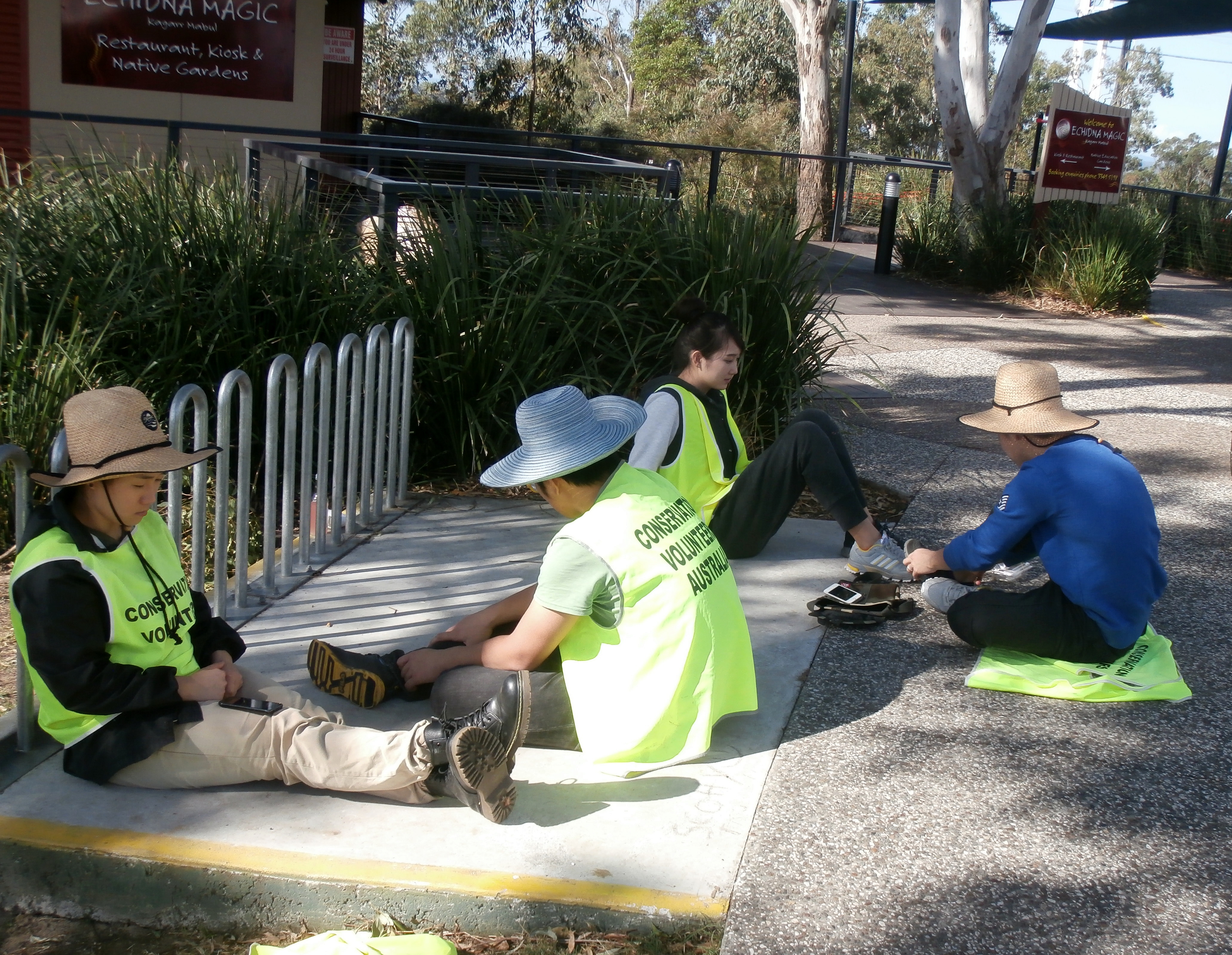
Well earned break at Summit

d

d

d

We stopped for lunch at the summit, which proved a real treat for everyone.   Our international friends were amazed at the expansive views and the locals declared it better than that from Mt Coot-tha.

Removing Creeping Lantana

d


Afterwards, we returned to clear Creeping Lantana Lantana montevidensis at the entrance to the Summit Walk, where we found a hive of Sugarbag native bees Trigona carbonaria.

Our day concluded with a tour of the Mt Gravatt High School National Tree Day Planting site, and a look at an old termite’s nest in an Ironbark gum,  which has provided a breeding site over many years for our local Laughing Kookaburras Dacelo novaeguineae.

A heartfelt thanks to these delightful volunteers who worked so hard to strengthen the environmental values of our Reserve.

By: Laurie Deacon

Hawkeye, Rama, Malia and Lorikeet get prepared like all good Cub Scout leaders!!

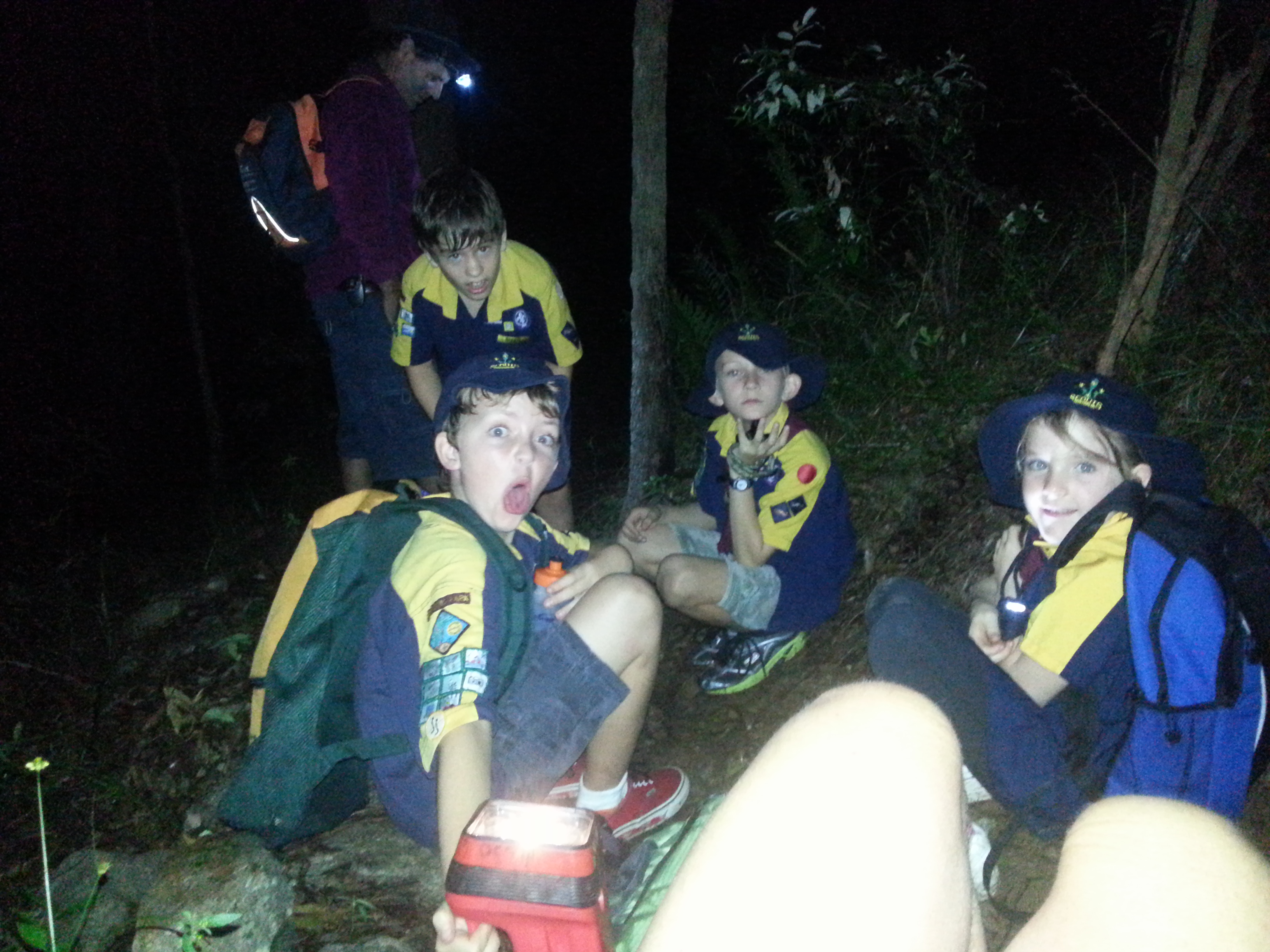
We are taking forty little Cubs with Mums and Dads up Mt Gravatt for a bit of night spotting in the Conservation Reserve.

Walk on your wild side

Mt Gravatt night creatures

Now night spotting for shy furry creatures or sleeping birds with forty noisy Cubs sounds like a optimist’s nightmare….and it was!  Every self respecting Koala, Glider, Possum or bird would have heard the happy sounds of children squealing with joy at being out in the night time … in the dark in the bush … on an adventure! Torch lights waving everywhere but on the trees, usually in little Mary’s face, by accident of course!

We stopped many times along the track, all in single file with Cub leaders and parents interspersed between the badge wearing “baby elephants” to keep them on task and on the track! “Now, no going off the track as you’ll trash the sensitive bush plants and you may crush a flowering orchid” , yells Lorikeet one of the Cub leaders! “Let’s stop and  Listen to the sounds of the bush at night and see what we can hear?” yells Lorikeet again to all the Cubs …. muffled joy was heard, and a few mysterious animal sounds.

Then we all reached the top of the Mountain, had a wonderful Mountain top ceremony for a few Cubs receiving awards for jobs well done, then back we plunge into the deep dark forest and back down the mountain track!

Malia a leader says she will go ahead with a few Cubs and the rest of us follow behind.  Ooops!  Then as the rest of us all come to the fork in the track there is no sign of Malias foot prints and her Pack following the correct route!

So the next adventure starts (with the aid of a mobile phone) we call in the renegade Pack who had gone off in the wrong direction and send a search party to “bring them home”! Some became heroes out of the story and  some became legends!  At the bottom of the Mount all Cubs and Leaders had hot chocolate and piled back into their suburban cars and lives … and beds. WHAT AN ADVENTURE THEY HAD … and all in suburbia!

So I reflect on the Mountain walk that Thursday night (only a few hours and home to bed by 8pm), and think how forty young minds would be changed for life after that night. The wildness around them, the confidence gained within them; the uncertainty felt, the competencies gained; the seemingly insurmountable walk for some, the caring and  sharing offered from others; the uniqueness of the mountain at night, and the humility and familiarity that bred caring in their souls for the bush.

AND THAT WAS ONLY THE PARENTS THAT CAME ALONG ! 🙂

Fond regards

The Wood Sprites

By: Sharyn Kann

One of the local orchids my bushwalking friend has been telling me about, is the Pterostylus nutans or Nodding Greenhood, a terrestrial orchid I have been keen to see.  Finally, a phone call confirmed that they are out in flower and he was happy to take Len and me on a walk to see them.

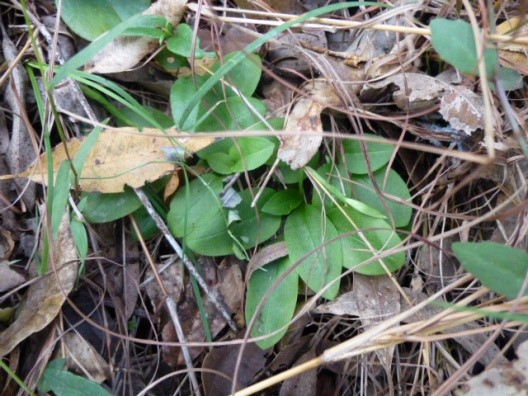
Leaves

Nodding Greenhood Orchid leaves

On the high side of the track of the bush reserve was a cluster of several Nodding Greenhoods, some in flower and some yet to flower.  Had I seen them without the flower, I would never have picked the plant as an orchid.

 The first photo here shows the plant itself without a flower spike.  The leaves grow flat to the ground in a basal rosette and the plant has a small underground tuber.  To my untrained eye, they looked like a lot of the other plants growing on the forest floor.

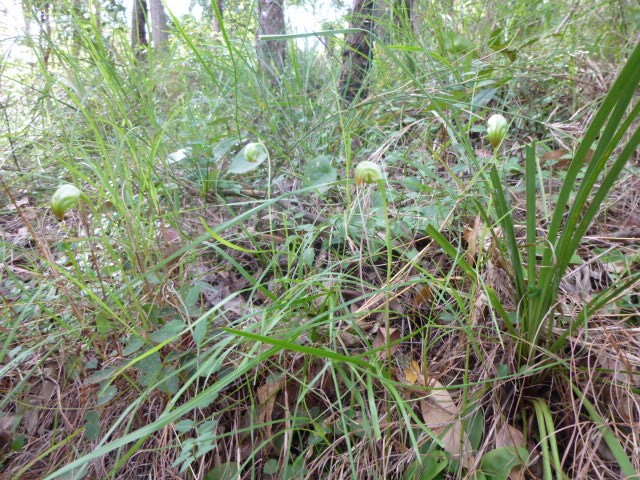
Nodding Orchid

Cluster of orchids in flower

This next photo shows most of the cluster of Greenhoods with their long stem and single blossom.  As you can see, they don’t actually stand out much, blending quite well into the background.

Of the 78 or so named species found in Australia, New Zealand, New Caledonia and Papua, the Nodding Greenhood is probably the most common, occurring in all states, except maybe, Western Australia.

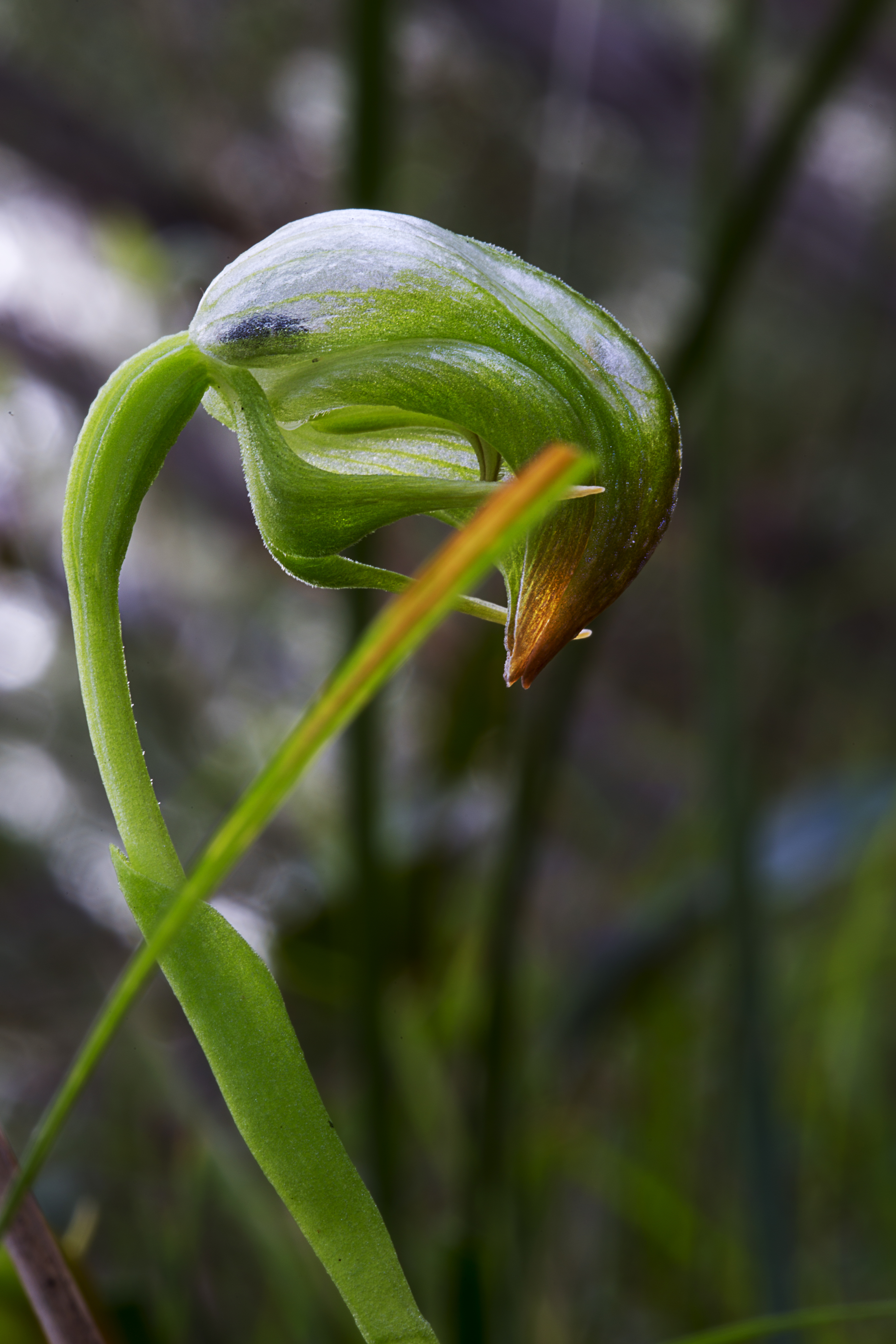
130502_0016_02

Nodding Greenhood flower with insect inside

Greenhoods are generally fertilised by insects who land on the strap like hinge of the labellum.  They are then flung into the hood with their only escape being the up the tube formed by the closed labellum and the column wings.  At the outlet, the insect has to press past the pollinia where their sticky viscid disc adheres to its back.  As it repeats this process with other greenhoods, the sticky disc on its back is pressed against the stigma beneath the column wings of the next plant and more pollinia is attached as it proceeds out of the flower.

The hood is a soft semi-transparent apple green colour, and insects inside it can easily be seen.

Photos by Sharyn Kann and Alan Moore, with information taken from Australian Native Orchids in Colour by Leo Cady & E R /Rotherham.

Brisbane Orchid Society meet regularly at the refurbished Progress Hall, Upper Mt Gravatt – 4th Monday month at 7:45Pm.

By: Michael Fox


View in Google Maps

The first stage of the Self-guided Walks Project is now complete thanks to Jon and Karla Henry who have made GPS maps of the existing walking tracks.

We are now researching the information about the tracks – trees, birds, geology, local history – European and Indigenous, stories about the mountain.

What would you like to know about the Reserve or what would you like to share to others?

Do you have a story to share about a walk with your children or perhaps a memory of a visit with a grandparent?

Do you have some pictures to share?

Email your ideas, stories and links to pictures to megoutlook@gmail.com

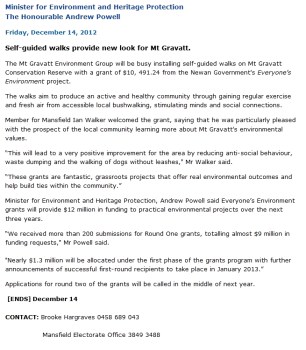
Media Statement - funding approved for self-guided walks in the bush

Media Statement – funding approved for self-guided walks in the bush – Mt Gravatt Conservation Reserve

By: Michael Fox

Support of an Everyone’s Environment Grant will allow us to open Mt Gravatt Conservation Reserve to the community in a completely new way.

As the Minister’s media release says, 2013 will be busy as the concept is to duplicate the popular self-guided Summit Track walk for the whole walking track network in the Reserve.

A partnership with Brisbane City Council will see the installation of station markers at points

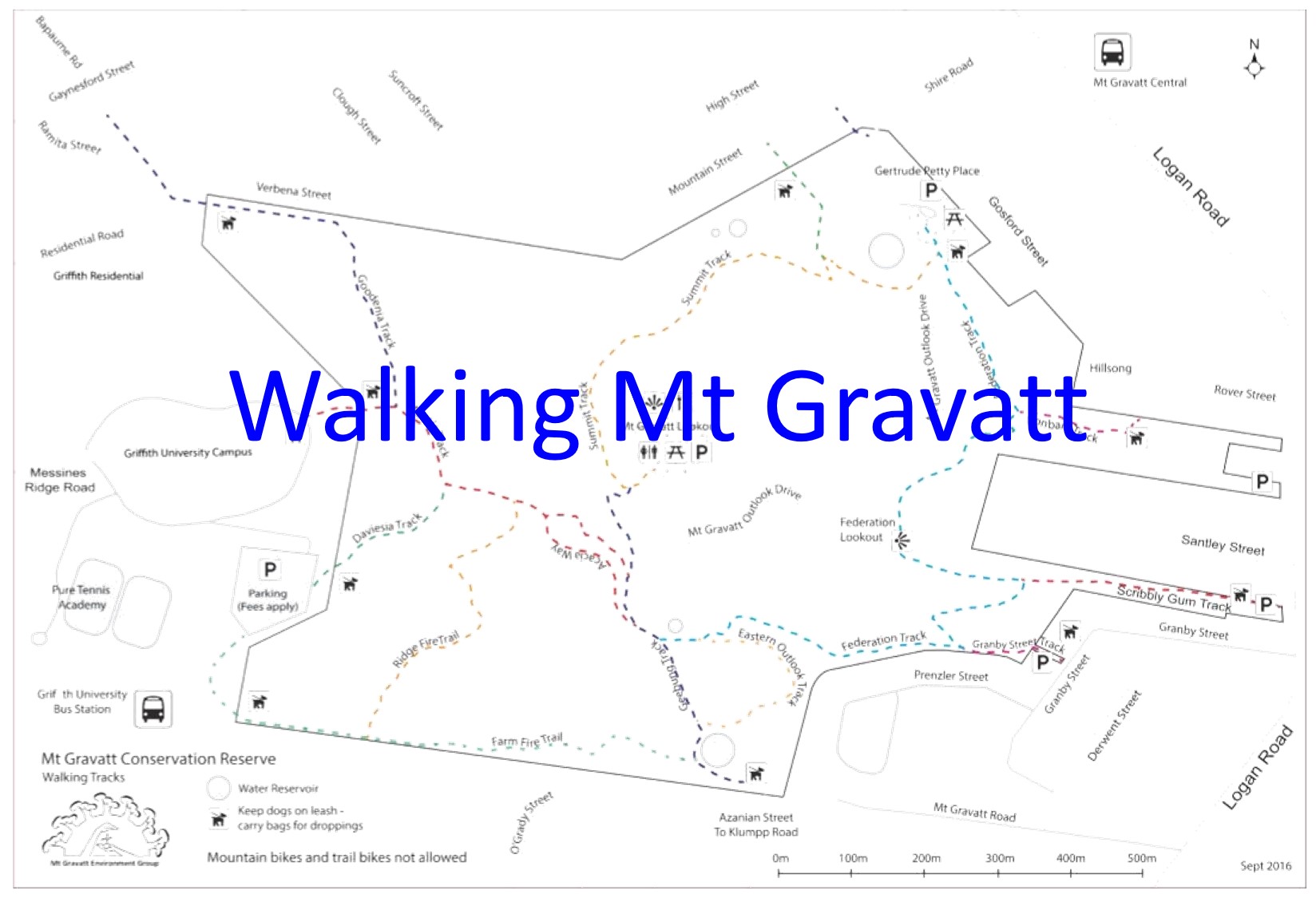
Mt Gravatt Conservation Reserve walking tracks

Mt Gravatt Conservation Reserve walking tracks

of interest. Mt Gravatt Environment Group will research the flora, fauna and geology while drawing on the knowledge of groups such as Mt Gravatt Historical Society to present the human story of the mountain.

The first stage of research has already been completed as Jon and Karla Henry have used GPS technology to map the walking tracks including some of the relatively unknown tracks like the link from the Scout Hall on Logan Road.

I acknowledge the strong support of Ian Walker, Member for Mansfield, who has worked with us at Bushcare sites, joined our planning meetings and talked about our work with colleagues and in parliament:

“The degree to which community involvement at a voluntary level enhances the life of the residents of Mansfield is immense. In addition to the P&Cs, Meals on Wheels, Neighbourhood Watch and sporting groups—go the Vultures—are groups like the Mount Gravatt Environment Group, which does a magnificent job looking after Mount Gravatt and its environs …” Ian Walker MP, Maiden Speech to Queensland Parliament

I also acknowledge the valuable advice and support provided by, the often forgotten, department members in both, the state Department of Environment and Heritage Protection, and BCC Local Asset Services.

« Previous PageNext Page »