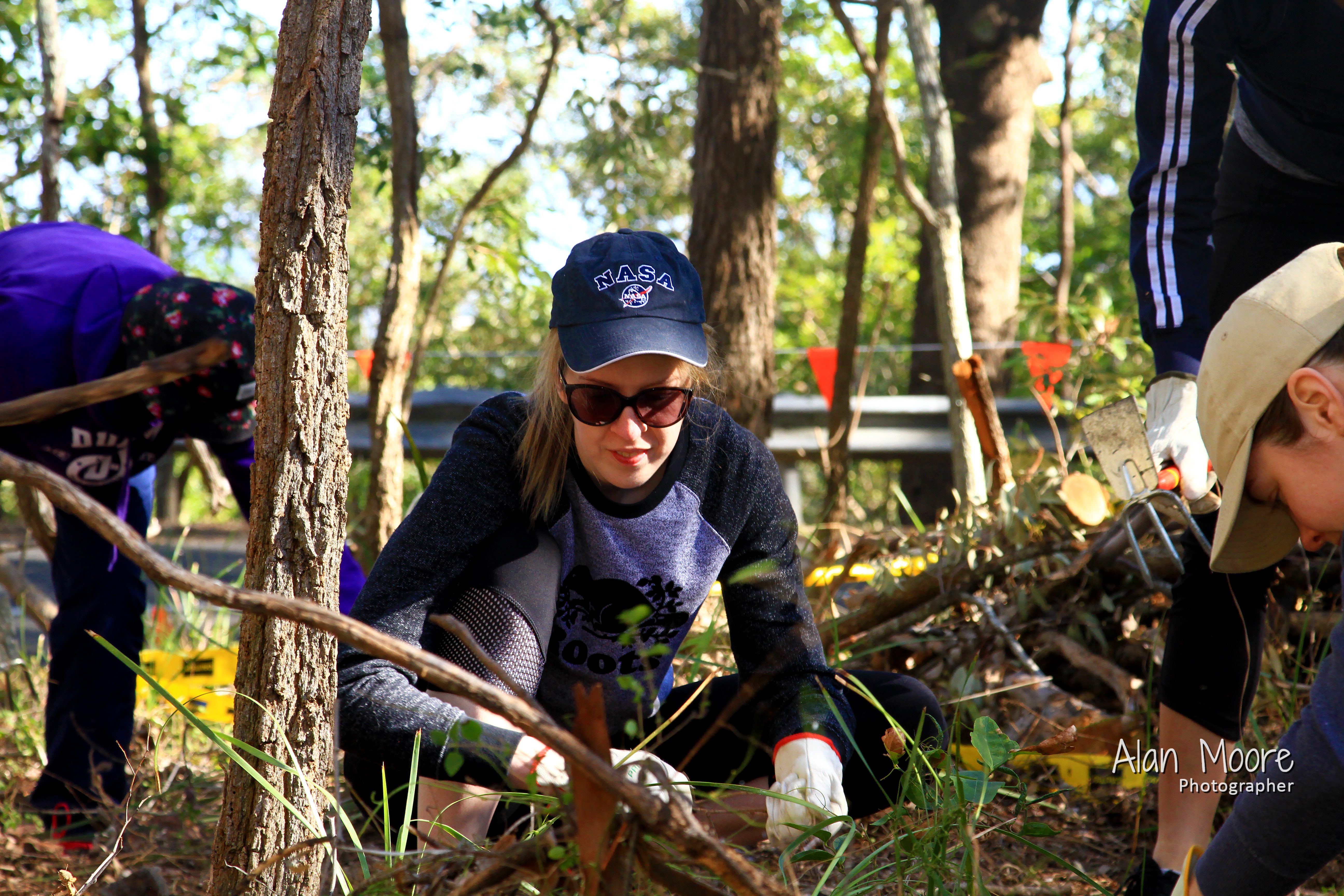
Tuesday Bushcare focused on maintenance and clearing weeds at the 2017 National Tree Day planting site.
Two garbage bags of Mother-of-Millions Bryophyllum tubiflorumremoved will not eradicate this garden escapee. Complete eradication will take years however systematic control will reduce the spread while the area is cleared of other weeds.
Resurrection Plant growing from a leaf.
Dumping garden waste like Mother-of-Millions is a real problem for our bushland, parks and creeks. Being a succulent it survives even in harsh conditions. Like Resurrection Plant Bryophyllum pinnatum, another invader from Madagascar, Mother-of-Millions regrows from as little as a single leaf. Garden waste like lawn clippings, prunings from shrubs and old pot plants are rubbish not compost adding value to bushland.
Dump garden rubbish in rubbish bin not in bushland.
I was also able to show Jake and Carl some of our interesting flora.
Like the curious Bird’s Nest Fungi Cyathus novaezelandiae which propagates by the action of rain drops knock the egg-like peridioles out of the cup shaped fruit body.
Rasp Fern Doodia media (australis) with an, as yet, unidentified insect. You realise how well named Rasp fern is when you run your fingers over the leaves: they feel just like the rough sharp surface of a wood rasp.
We also found what are probably nest holes for the small Pardalotes: small birds that dig nest holes in earth banks but spend most of their time high in the trees where you can hear their distinctive “chip chip chip” call. Watch video of Striated Pardalote.
Tuesday Bushcare today was weeding the 2015/16 National Tree Day planting and preparing for this year’s planting site.
The planting was planned to create habitat for small forest birds. A combination of Habitat Tripods to create the scrubby tangled space that is safe for birds like Fairy Wrens to nest and attracting insects as food for Fairy Wrens. #WaterFoodShelter
Finding all these species in the small bird habitat is evidence of success and an excellent example of how Pollinator Link Plant Local to Feed Locals can bring Birds, Butterflies and Bees to your garden. #WaterFoodShelter
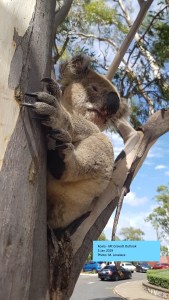
Walking the Mountain this morning we saw a pair of Sulphur-crested Cockatoos Cacatua galerita high in the trees getting very upset about something. Initially we thought they were getting upset with a murder of Crows in the trees.
Stingless Native Bee
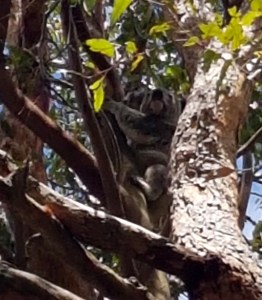
Then Jude spotted a Koala hanging on for dear life as the Cockatoos and Crows all harried it.
In the same area I found tiny Stingless Native Bees Tetragonula sp. collecting nectar and pollen on Bottle Brush Grass Tree Xanthorrhoea macronema flowers.
Look for the pollen on legs.
Ringtail Possum nesting in dead tree
Our last find was a Ringtail Possum Pseudocheirus peregrinus asleep in its nest in a dead tree.
Dead trees (called stags) are an important part of our bushland habitat providing homes for insects, lizards, birds and even Possums.
It was a pleasure to welcome the Sherwood Scouts to Fox Gully Bushcare on Saturday.
Scout Leader Kate had a range of activities prepared to build skills in reading contour maps and using a compass.
.
Ringtail family
.
.
.
First stop was the Federation Track to see a family of Ringtail Possums Pseudocheirus peregrinus. High in a tree with strong backlighting the two adults and a joey were hard to photograph.
Checking Glider box with GoPro camera
Scout Ed tried his hand using the GoPro camera on a pole to check one of the new Squirrel Glider Petaurus norfolcensis nest boxes.
Nest box installation is an important part of habitat restoration as till July 1893 the mountain and surrounds were designated as a railway timber reserve. My intial survey of the 2ha of Fox Gully Bushcare reflects this history with only thirty six trees older than 100 years and only five old enough to have a 50% chance of having nest hollows. Many bird species and arboreal marsupials like Giders depend on tree hollows for breeding. Nest boxes provide a interim solution for these species as the forest recovers and natural tree hollows develop.
So it was particularly special to find our find a Squirrel Glider in one of the new boxes. Squirrel Glider are listed as threatened by Brisbane City Council and families typically use up to five nest hollows.
Mother Brushtail at home
With installation of nest boxes the initial one family of Squirrel Gliders has been breeding and there are now two families living in the Bushcare site. Evidence that the Gliders have now started using the new nest boxes is a sign that the population of these special creatures may expand further.
Continuing on down the Geebung Track we checked on mother Brushtail Possum Trichosurus vulpecula in the Kookaburra nest box. Mother Brushtail moved in shortly after the initial installation and has since raised at least two joeys in her home.
Returning via the Eastern Outlook Track we examined the seam of quartz rock that runs through the mountain, the natural regeneration in the area where Creeping Lantana Lantana montevidenses has been cleared and the Stingless Beehive Tetragonula sp. in a fallen tree.
Two hundred and seventy eight native species in our 66 hectare Reserve is equal to 20% of all native plant species in Great Britain which has 22.6 million hectares. The extra ordinary species diversity in the Reserve is something worth protecting and valuing.
.
.
Koala Mum & Joey
.
.
As well as plant diversity the Reserve has a healthy population of breeding Koalas.
Andrew Wallace our BCC Habitat Brisbane Officer spotted this mother and joey (baby Koala) at Gertrude Petty Place a couple of weeks ago. This is one of at least two joeys born in the Reserve during 2016. There have been twenty-three Koala sightings reported in 2016
Please keep reporting the sightings: photo (phone camera photos are fine), approximate location, date time. Your reports are important evidence that helps us get ongoing funding and support for our restoration work.
I led the team on an off track adventure to reach the nest boxes. While Carl operated the GoPro camera on the extendable pole the ground crew monitored on iPads using WiFi connection.
Carl became a real professional keeping the tall wobbly pole under control while he lifted the lid on each box and inserted the camera.
Lantana Busters at work
Not surprisingly none of the boxes had been occupied in the short time since installation. However, it is valuable to get a information on how long it takes before boxes are adopted.
.
.
.
Then is was back through the bush to the Lantana Busting site.
Scolopendrid centipede – tail to left
1,600 square metres of Creeping Lantana Lantana montevidensis were cleared and raked into swales on National Tree Day. Now we are doing the detail work of clearing the remaining roots to eradicate this invasive garden escapee.
There is an amazing about of wildlife among the leaf litter as well as in the trees. We disturbed a Scolopendrid centipede which I think Baoyi wanted to keep as a pet. Be careful handling centipedes as they may bite if disturbed or handled. The bite may cause severe pain and associated swelling.
Home made cakes a reward for hard work. (l-r) Sophie, Jocelyn, Harry, Baoyi, Carl, Amanda and Dana in front
Centipedes are predatory and will kill and consume a variety of other invertebrates such as spiders, molluscs, many insects, slaters and other centipedes. Prey is usually immobilised by venom injected through the fangs and then torn into pieces by the mandibles and the soft parts are eaten.
All that hard work deserves a reward. Thanks to Mt Gravatt Environment Group member Dana for the home made cakes.
At our 2016 Photography Workshop Alan Moore introduced us to a new way of seeing the bush around us … contre jour: French for “against daylight”, a technique in which the view is directly toward a source of light. A form of photography artistry Alan related to French impressionists like Claude Monet.
Alan challenged participants to experiment with their camera’s manual settings like aperture and exposure before sending them out on assignment to see nature in a new light.
See ferns in a new light:
Fiona
Katrina
Playing with camera flair:
Kate
Dana
Lyn
Jude
Gregg
Greg
Margaret
Nat
Marie
Misting spider webs to catch the light:
Tricia
Fiona
X-ray view of leaves:
Tony
Maree
Forget contra jour and just meet the locals:
Toni
The 2017 Photography Calendar will be available in November ready for posting to family or friends overseas.
Also called Lamb’s Tail Wattle, it is a key food supply for caterpillars of Imperial Hairstreak butterflies –Jalmenus evagoras. Look for the caterpillars around February-March.
Learn to identify Early Black Wattle with the winter flowers so you can find the trees in summer. The red colour and triangular shape of the stems are key identifiers.
As the name suggests Blackthorn, with its spiky habit, is useful for Security Planting keeping people out of bushland areas and protecting small forest birds from larger more aggressive birds.
Black She-oak Allocasuarina littoralis is one of the most interesting trees flowering at the moment. In March the male Black She-oaks started producing their flowers showing up as the russet brown tips with the trees glowing in direct winter sunlight. Female Black She-oaks only started to produce their distinctive red flowers in June.
…………. Black She-oak Allocasuarina littoralis – (left) male (right) female
At 100mm wingspan it is quite a large moth for south east Queensland.
Soft hairlike scales around the head
.
.
.
The eye spots on this moth are spectacular and it seems to have a layered wing creating an interested 3D effect.
.
.
.
.
.
Red Narrow-necked Leaf Beetle Lilioceris bakewelli
.
.
Caterpillars of this moth feed on Barbedwire Vine Smilax australis. The only other species I have found that feeds on this tough vine is the Red Narrow-necked Leaf Beetle Lilioceris bakewelli.
















 Mount Gravatt Environment Group