Wildlife of Mt Gravatt Reserve


2:30am Still can’t go back to sleep because our visitor is exploring the deck trying to find a tree to climb down. Read about 11:40am visit.
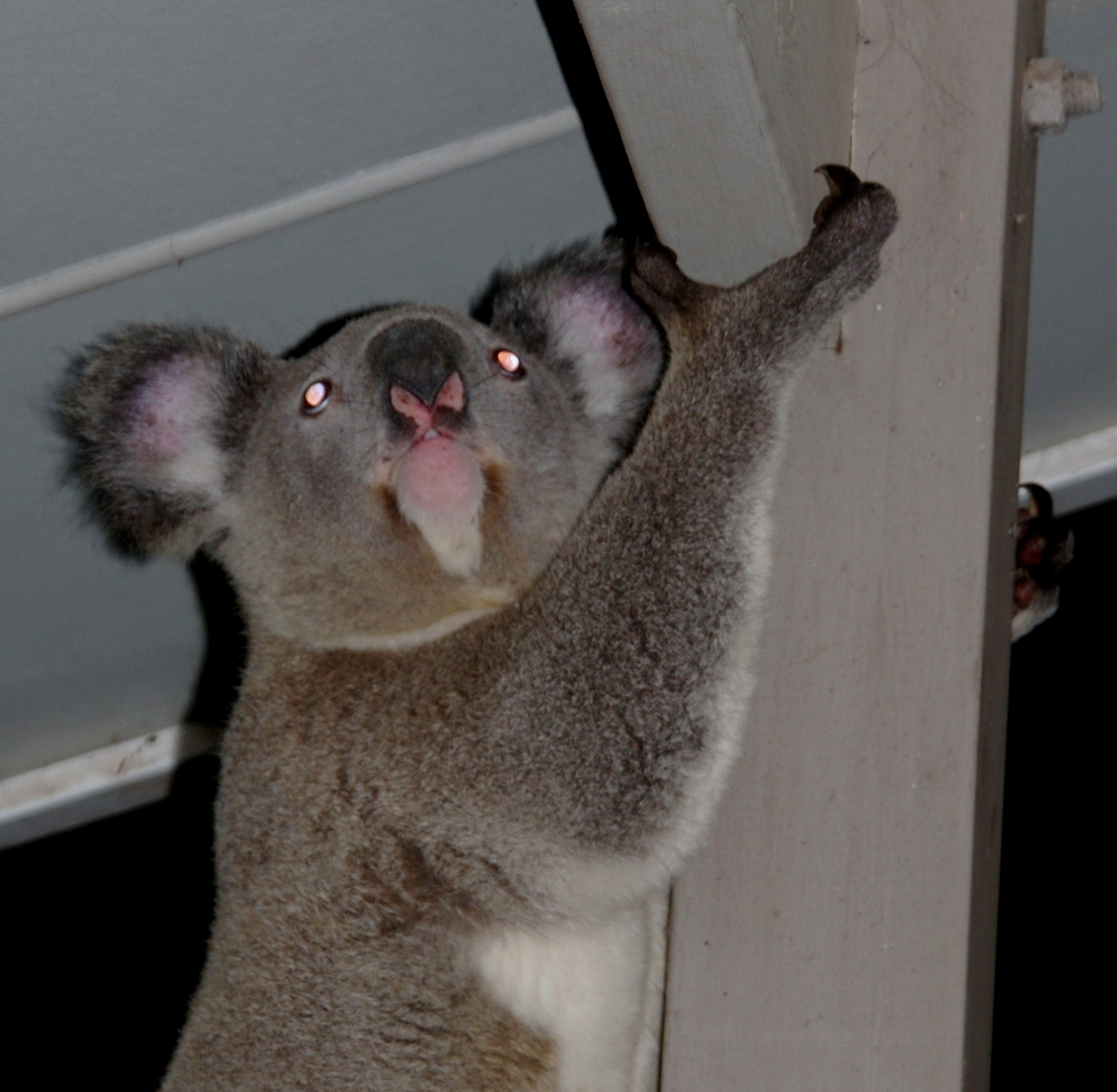
We thought he was ok when he started to climb down on the corner post but he could not figure out how to get his butt over the projecting deck planks. Then it was exploring along the 50mm edge outside the wire … no good … mmmm …. let’s slide backwards through the wire back onto the deck. Now we can sit back and think …. perhaps the other corner post.

At this point we decided he was just going to hurt himself and we needed to move him on. So thick jumper and heavy coat to protect my arms, did I mention the claws, and thick leather bushcare gloves to protect my hands. Koalas look cute and cuddly but they must be 80% muscle, 18% teeth and claws, and 2% everything else. I had to remove Koalas from our property on two occasions when we lived at Victoria Point in Redlands City, so I knew from experience that it would be like wrestling a tiger with the bite of a crocodile.
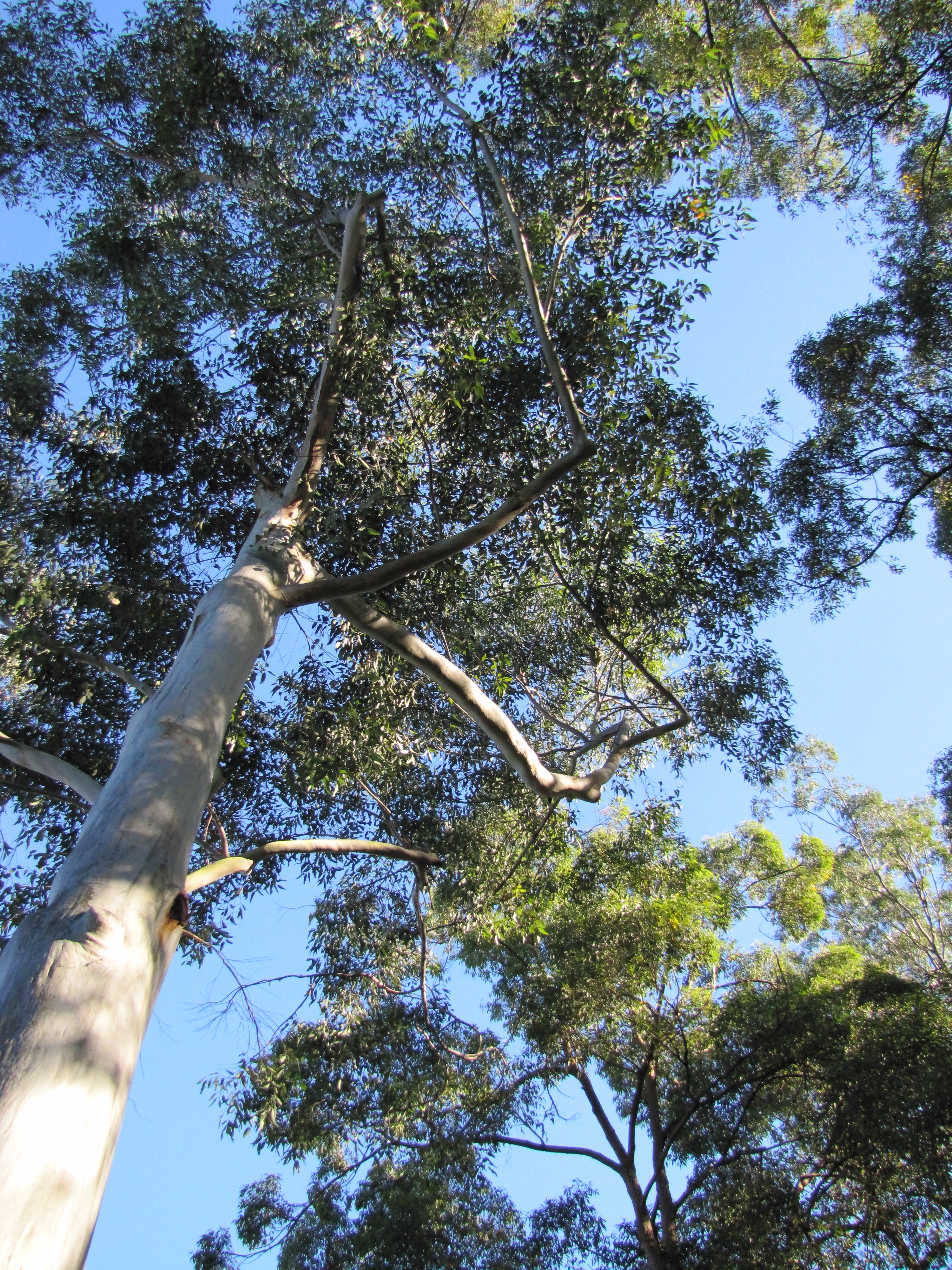
So much growling, biting and scratching as I scooped him up, carried him through the house, downstairs and out to the backyard. Out through the fence, straight up the Eucalyptus grandis and we were able to get back to sleep.

When I checked this morning, our midnight visitor was asleep in the highest possible branch in the Grandis. He woke up for a few minutes when some of the neighbourhood kids came see then tucked his head back down and back to sleep.
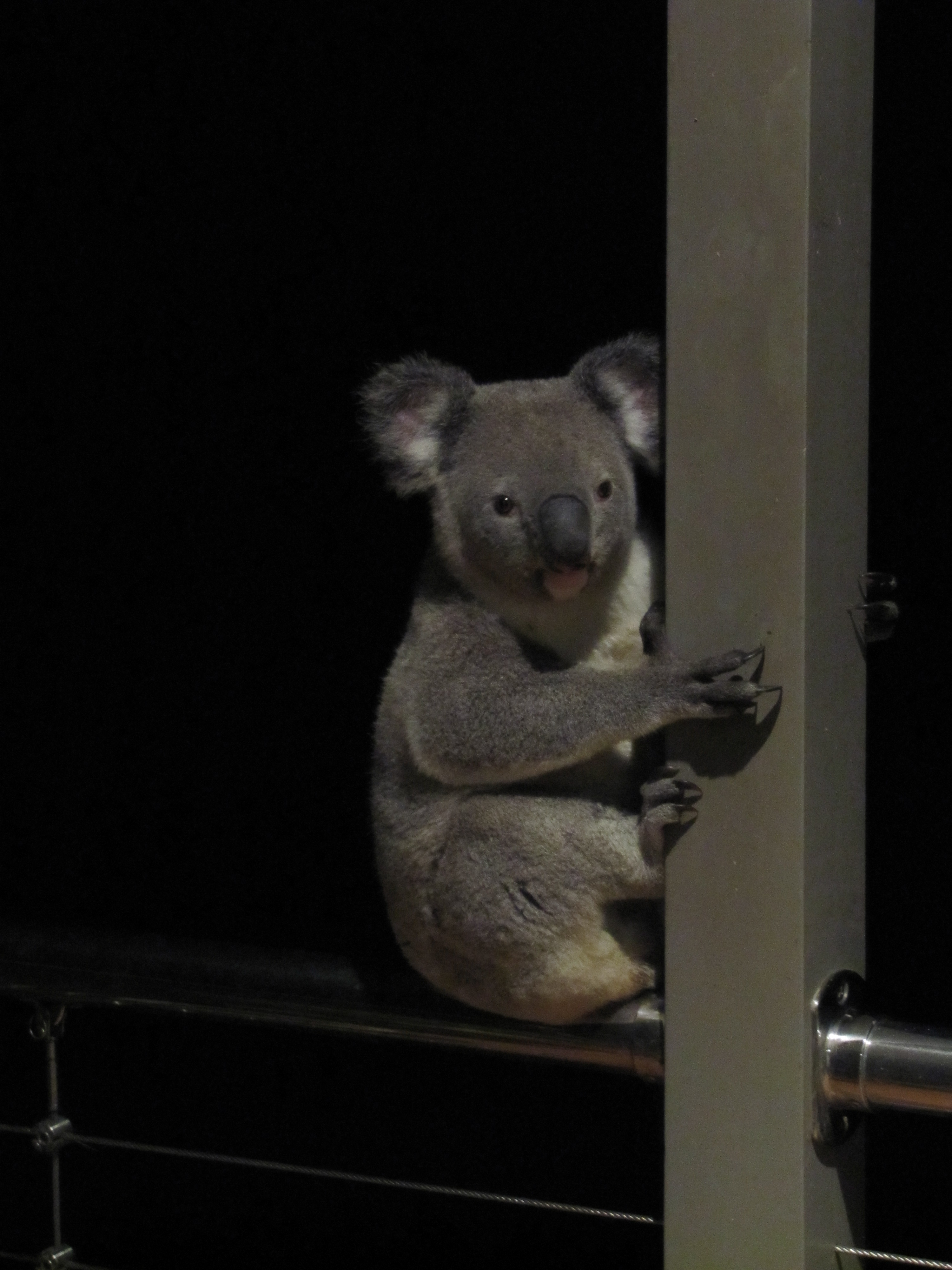
11.40 p.m…What is that scratching sound outside on the deck? A Possum?

Certainly the scratching of claws on the metal railing sounded possum-like. Imagine our surprise when, on turning on the deck lights, we saw this young male koala. He had clambered up the timber post, nearly coming to grief on the stainless steel wires, coming to rest with his butt on the metal rail.

From there, he allowed a couple of photos until we tried to get Jian into the picture too…that was enough and he  continued up the post, finding at ceiling height, that he had reached his limit.

We tried unsuccessfully a few times to help him down, but as cuddly as he looked, those claws are ferocious and he warned us off any further attempts with ‘stay clear’ growls and grunts.  Not wanting to stress him, that is where he is staying for now…..hopefully he can find his own way down by morning…or we’ll have to build a tree for him to climb down.

Read Koala update: the morning after.

Shanghai student Jian meets a local

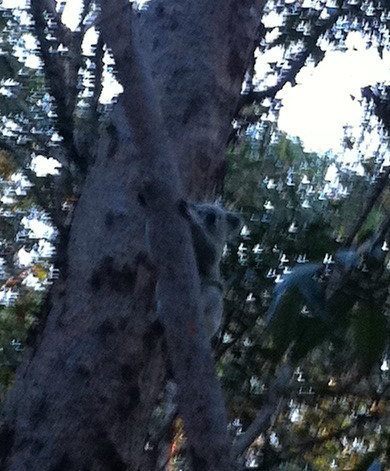
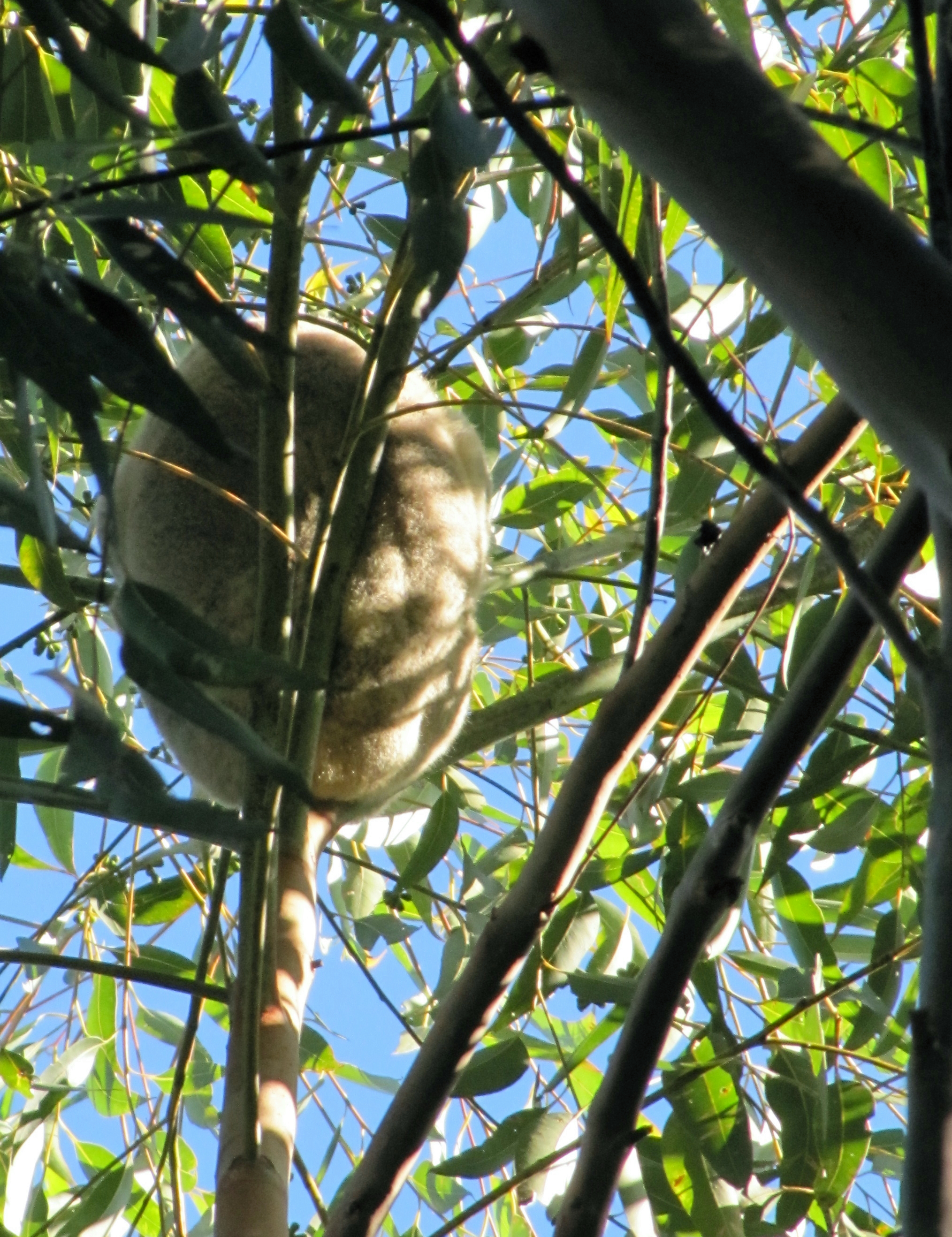
Thanks to park visitor Barry we have another confirmed Koala sighting near Gertrude Petty Place.

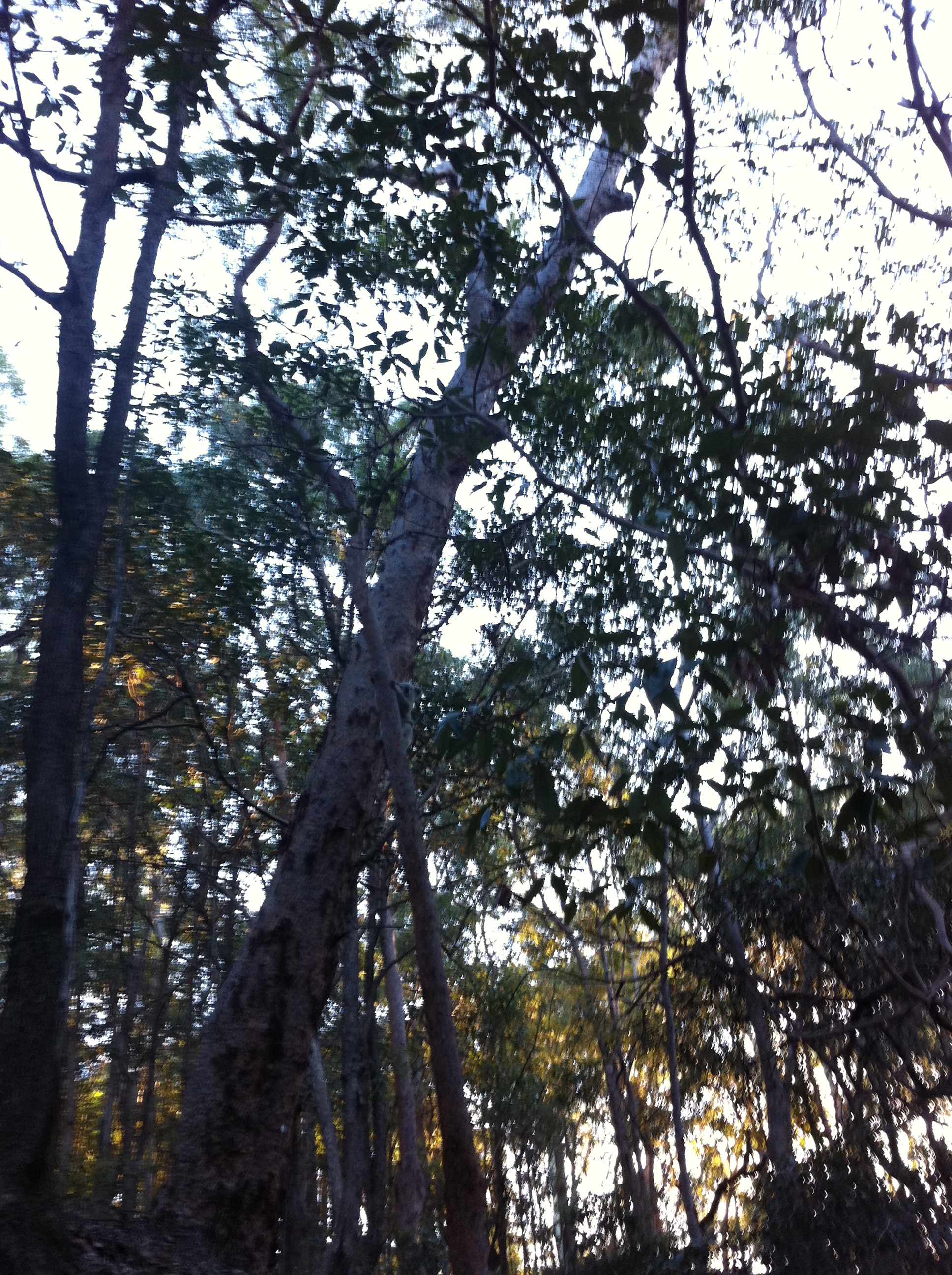
Can you spot the Koala? Scroll down.

Barry was a little embarrassed about the quality of his photo, however, given the height of our furry friend, I think this is a fantastic photo for someone using a mobile phone!

Well done Barry and thank you for passing this photo on with the location details. We are starting to build a wildlife sighting database for our Reserve, so we really appreciate information about sightings with location information and ideally digital photos which automatically give us date/time of sightings.

I was particularly pleased to receive this photo today and then find that today’s ABC Bush Telegraph program, was also about Koalas.

Given our efforts to protect and restore this unique bush habitat in middle of suburbia the segment on The history of Europeans and the koala was particularly interesting. The interview with Ann Moyal, author of new CSIRO science history book The Koala, had particular impact. Photos are an important part of our community education, so to visit the Bush Telegraph web page and see a photo of 3,600 Koala pelts loaded on a truck in Clermont district Queensland: in 1927!

Our Mt Gravatt Reserve was conservation protected in July 1893 and now, almost 120 years on, the forest is still recovering from logging.

Hon. Kate Jones, Minister for Environment and Resource Management joined us today at the Summit of Mt Gravatt to share our vision for restoration of this special part of our community.

L-R Hon. Kate Jones, Helen Schwencke, Michael Fox, Hon. Phil Reeves

Phil Reeves, local member and Minister for Child Safety and Minister for Sport joined myself and butterfly expert Helen Schwencke of Earthling Enterprises, hosted our Environment Minister.

Like most visitors Minister Jones was blown away by the beauty of the mountain which recalled her days of walking the eastern slopes of Mt Cootha as a child.

Our discussion covered everything from public toilets at the Summit, to habitat consolidation and wildlife corridors linking the Reserve with Mimosa Creek Precinct and Roly Chapman Reserve. The Minister asked about Koala sightings: Fox Gully and Rover Street Bushcare sites, also behind houses in Mountain Street. Also discussed were the species diversity with Echidnas and two hundred and fifty-four native plant species, as well as, the need for nest boxes to support Squirrel & Sugar Gliders in a forest with only a small proportion trees over one hundred years old.

The reality of flood recovery priorities means that government funds, for bushland restoration in the Reserve, will be limited in the short-term. However, Mt Gravatt Environment Group is currently revising our five-year Strategic Plan, so it was encouraging and valuable to be able to brief the Minister on our vision and plans for the Mountain habitat. The Minister was particularly impressed with our efforts to build relationships with Griffith University and corporate sponsors like ANZ Bank, which will help with some short-term projects.

Follow Us on Twitter

Another amazing critter in our bushland: Mottled Cup Moth caterpillar Doratifera vulnerans.

I have seen capsules on trees and wondered what they are. They look just like a gum nuts in the wrong place on the tree.

Yesterday I was asked to identify two caterpillars from a local bushcare site. My bushcare colleague had a painful encounter with the stinging spines on these otherwise pretty caterpillars so I put on disposable gloves before I opened the container to photograph these strange creatures.

Butterfly expert Helen Schwenchke put me on the right track when she suggested looking up Cup Moths on the Australian caterpillar identification site. These intriguing pink yellow spiky critters are caterpillars of the Mottled Cup Moth Doratifera vulnerans.

Back to the caterpillars for a real surprise. One had carefully stripped a piece of the eucalypt branch and started spinning silky threads: it was building it chrysalis while I watched!

This process took about 70 minutes with the caterpillar curled tight and completely covered in silk thread.

By  morning the chrysalis had hardened, shrunk to less than half the size and created this capsule that looks just like the gum nuts of the eucalypt trees the caterpillars feed on. See the picture at the top: the chrysalis is the one on the right.

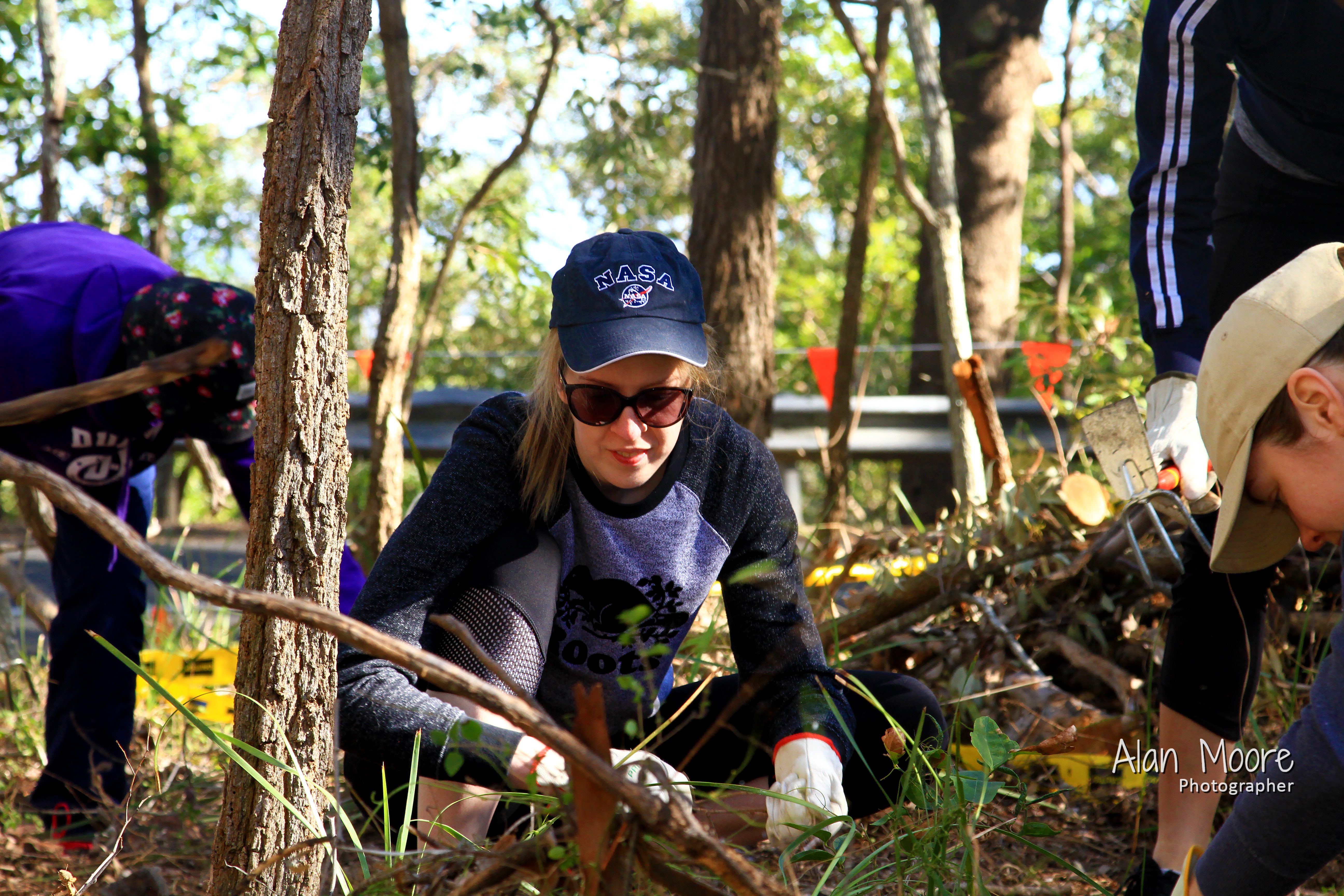
Do you want to help clean up the home of these unique creatures? Register for Summit Cleanup on Sunday 6th March.

Thanks to Bill and Alison Semple we have photographic evidence that echidnas are still active on the Mountain.

Alison photographed this prickly character foraging for food last week. Bill and Alison were walking on the mountain when they were made this special find.

Echidnas Tachyglossus aculeatus is one the few ground dwelling mammals found in the Reserve. Commonly called Spiny Anteater, for obvious reasons, dig into ants nests and termite mounds using their long tongue to search out dinner. Like the platypus these fascinating mammals lay eggs like reptiles then nurture their young in a pouch feeding them on mother’s milk. It never ceases to amaze me that we can find special animals like this only ten minutes from Brisbane CBD.

Keep an eye out for the beautiful Blue Tiger butterflies – Tirumala hamata visiting the mountain at the moment. Note the tiger like spots on the head.

When I could not identify any caterpillar (larval) food plants in the Reserve for these butterflies I contacted Dr Carla Catterall who kindly shared her extensive knowledge. It turns our Tigers are tourists just visiting Brisbane on holidays.

Dr Catterall advises that the Tiger Blue is a migratory species – so to understand why we are seeing them we need to search for info about its migratory habits rather than its food plants.

Because of these large-scale coordinated movements by many individuals at once (which are poorly understood), this species appears and disappears in large numbers from time to time (and apparently there are a lot of them in the Brisbane region at present).  It is also known to migrate over water (for example, I [Carla Catterall] have seen them flying across the ocean between Gladstone and Heron Island).

The larvae would have hatched, fed and pupated somewhere else, probably a long way away from Toohey Forest (tens to hundreds of km).

Thank you Dr Catterall.

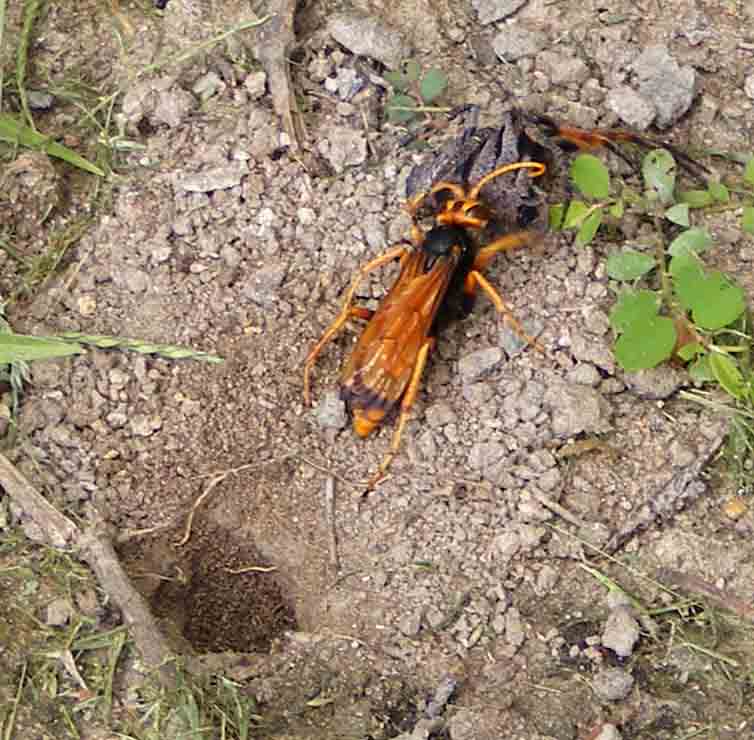
Female Orange Spider Wasp – Priocnemis bicolor, with a Huntsman spider which it has just paralysed.

The male dies shortly after mating and the female prepares a nest in the ground to be stocked with food for the larva when the egg hatch.

The wasp had to drag its prey over one metre to the newly dug nest.  The debris is still beside hole.

The spider is dragged down into the nest.

Finally the dirt is put back into the nest and the tamped down. Note the debris is now cleared from around the hole.

Thanks to Sue Jones for this amazing sequence of photos.

Click on photo to see larger image.

Who or what is digging in your backyard?

It may suprise you.

Mike

Geutrude Petty Place Buscare site is alive with butterflies at the moment.  The work Sue and the team have done removing weeds and planting native grasses and shrubs is really paying off with the rain we have been getting this summer. With the weeds removed natural regeneration means a large number of different native grasses and sedges have returned a critical success factor for bringing back the butterflies.

I photographed two new butterflies this morning which have not previously been recorded on Mt Gravatt.

A Spotted Sedge-skipper – Hesperilla ornata posed on some native Barbed Wire grass. Saw Sedge which is indigenous to the Reserve, is the laval food plant for the Spotted Sedge-skipper. With natural regeneration bringing back the native sedges we can expect to see more of these beautiful butterflies on Mt Gravatt in the future. This is particularly important because these butterflies are classed as “uncommon” in Braby’s Butterflies of Australia.

I also found this male White-banded Plane – Phaedyma shepherdi.

At 55mm these are quite a large butterfly for Brisbane. The patterns on the wings identify this specimen as a male.

I also found Splendid Ochre – Trapezites symmomus and Small Dusky-blue – Candalides erinus butterflies.

Mike

« Previous Page