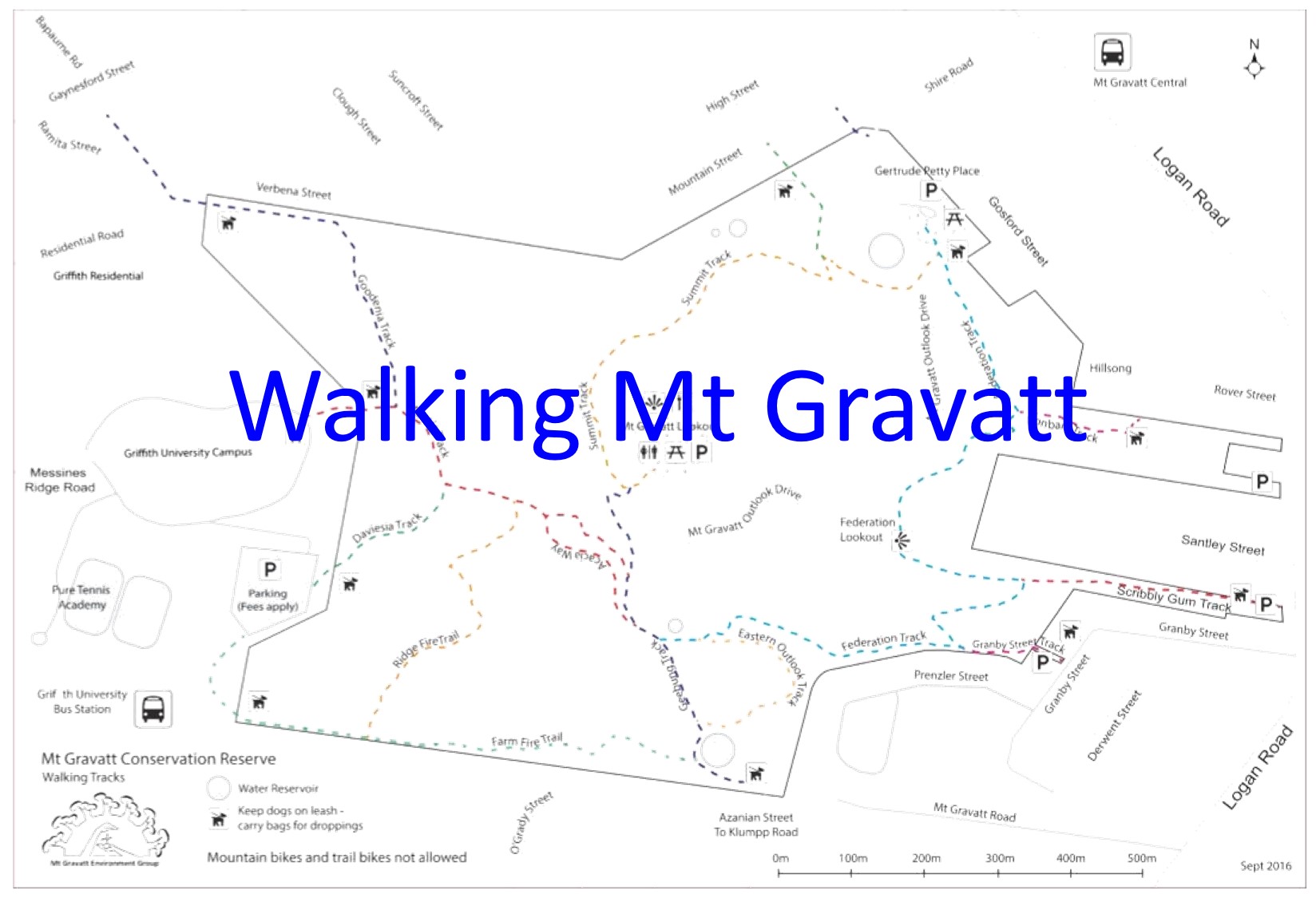
Mt Gravatt Conservation Reserve


IMG_9378

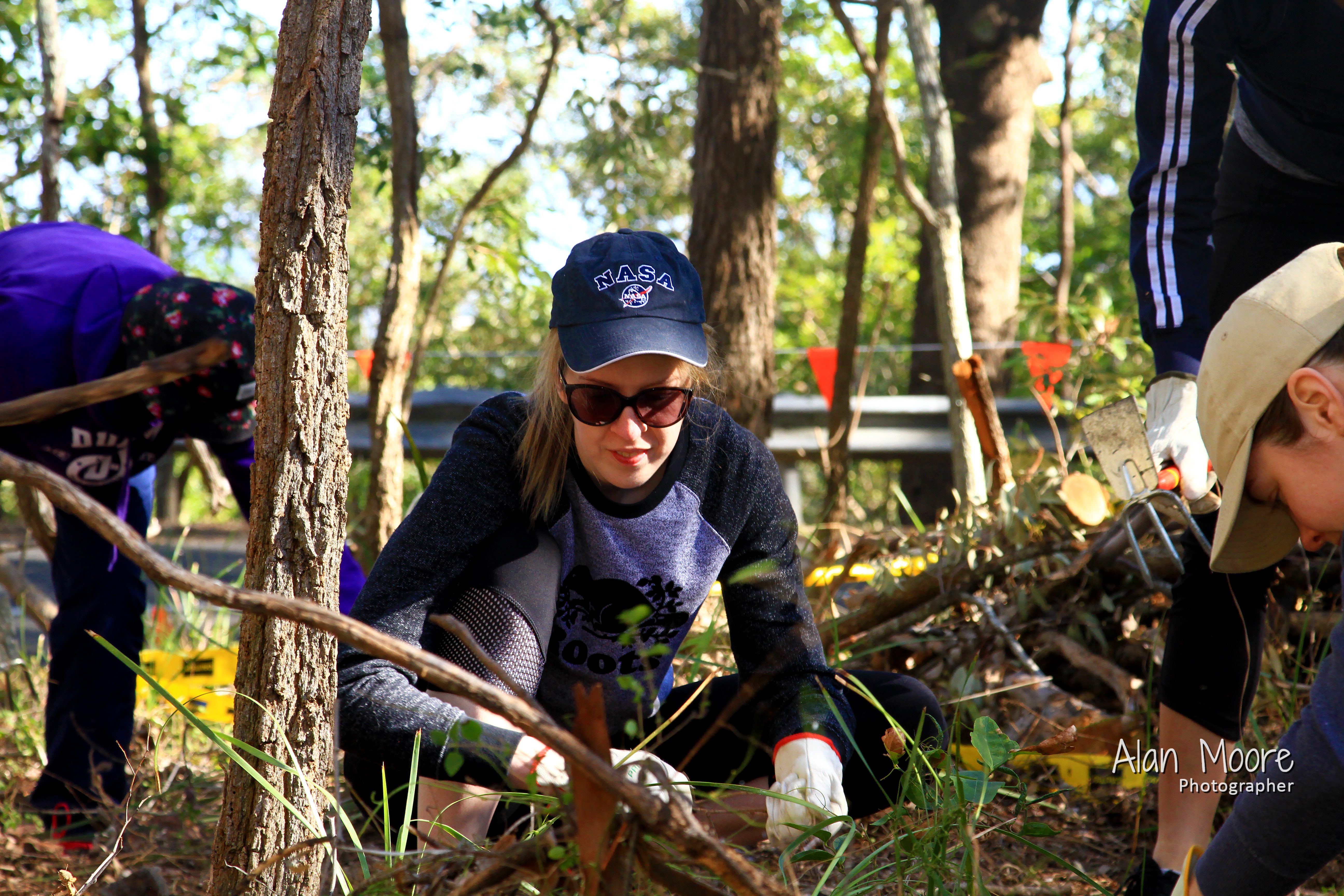
Griffith Mates (l-r) Laura, Lothar, Vikram, Sienna and Herman

By: Michael Fox

The Griffith Mates team helped us reach an important milestone last week. The final stage of a five year project was reached as the last patch of Fishbone Fern Nephrolepis cordifolia has been cleared at our Fox Gully Bushcare site Zone 13.

.

.

Fishbone jungle - 11 May 2013

Lost in Fishbone jungle

A team from FWR Group started the daunting task of clearing the Fishbone jungle from the gully.

In its natural environment, Fishbone Fern is usually found growing in rocky areas, on rainforest margins, or as an epiphyte on palm trees in the wetter parts of tropical and sub-tropical Australia. (Weeds of Australia)

CVA team Fox Gully - 22 May 2013 2

Conservation Volunteers (CVA) team

In urban areas where Fishbone Fern has been cultivated as a garden plant it has escaped into remaining patches of bushland crowding out indigenous species. Six species of native fern are indigenous to the Fox Gully habitat. Removal of the weed is allowing natural regeneration of indigenous grasses, ferns and vines.

.

.

.

Removing Fishbone Fern is a time consuming job so the support of a team from Conservation Volunteers Australia (CVA) was a major boost for the project.

.

.

White-banded Plane -25 Apr 2015

Common or Varied Eggfly Hypolimnas bolina

.

.

It is a particular pleasure to welcome Griffith Mates back as they always have a great interest in our local wildlife. They even insisted on walking through the forest from Mt Gravatt Campus.

So it was good to be able to show this perfect specimen of Common Aeroplane Phaedyma shepherdi butterfly posing on a Spotted Gum Corymbia citriodora.

.

Squirrel Glider - 25 Apr 2015

Squirrel Glider Petaurus norfolcensis

.

We finished the morning by checking the nest-boxes introducing our visitors to some of our cutest wildlife.

.

.

.

Magnified Native Cherry

“That is a tiny flower.” Photo: Herman Kai

.

.

.

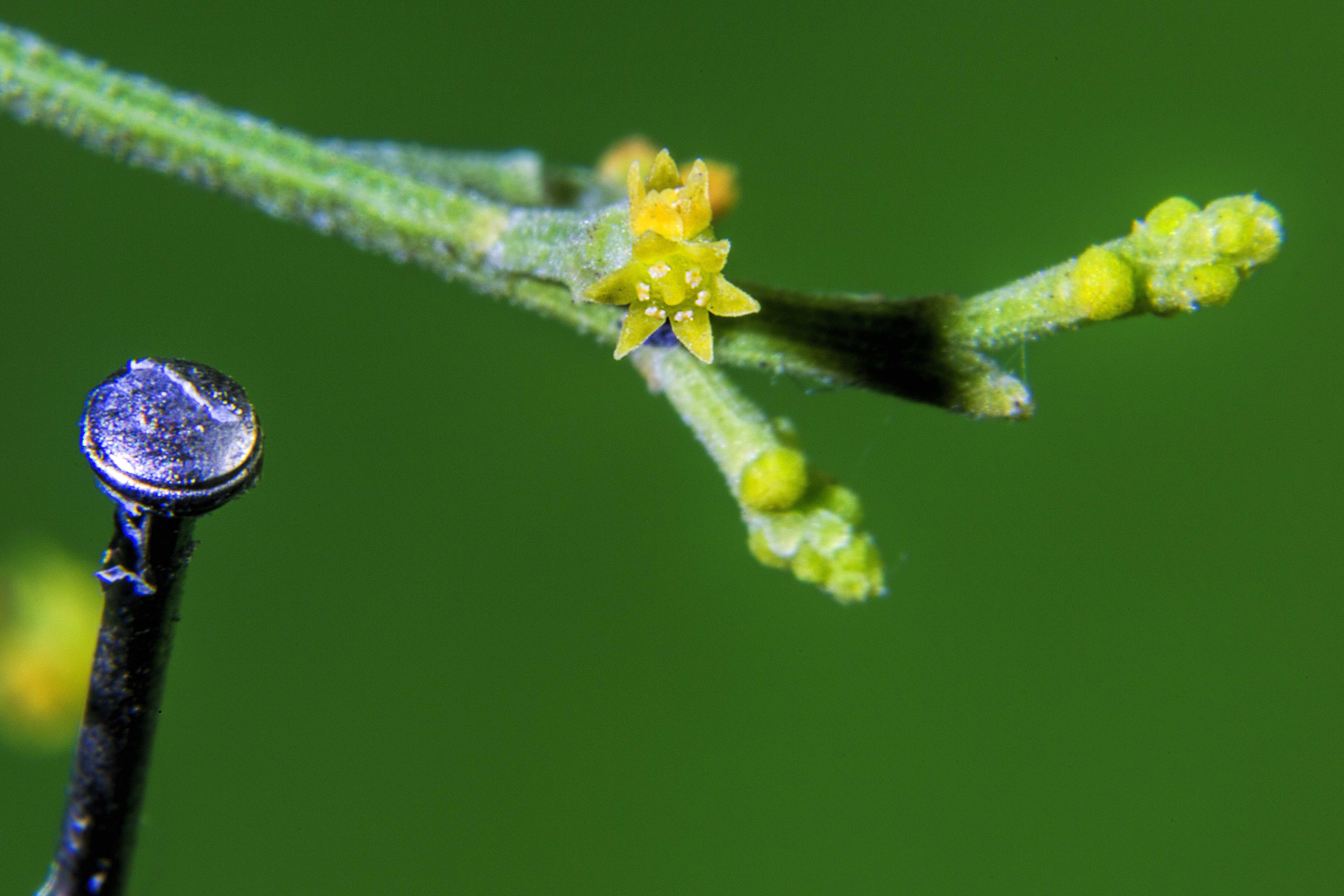
And Australia’s smallest flower on Native Cherry Exocarpos cupressiformis. Looking for flowering bushfood trees is difficult when you need to carry a magnifying glass.
Exocarpos cupressiformis - flower - 28 April 2015 - Alan Moore - low res

Native Cherry Exocarpos cupressiformis beside pin head

By: Michael Fox

Want to know about macro-photography learn from Alan Moore at our 2015 Photography Workshop.

Exocarpos cupressiformis - fruit - 25 April 2015 - Alan Moore - low res

Native Cherry fruit

Alan helps with our research of local flora and fauna, however, I think this has been the most challenging assignment yet.

Just finding suitable flowers to photograph on the Native Cherry Exocarpos cupressiformis required the use of a magnifying glass.

Smaller than a pin head this surely has to be Australia’s smallest flower. Now the challenge is the find how these tiny flowers are pollinated so they create tasty bushfood  fruit.

Exocarpos cupressiformis - close - 22 Nov 2014

Bushfood – Native Cherry Exocarpos cupressiformis

By: Michael Fox

Australia is famous for its loud brightly coloured parrots … read Tim Low’s “Where song began” or visit any park when the eucalyptus are flowering.

Our flowers however, with some notable exceptions, have a reputation for being understated or inconspicuous.

Native Cherry Exocarpos cupressiformis is an excellent example of inconspicuous. The orange or red fruit are quite noticeable but the flowers are the tiny buds smaller than the stems they grow on.

Native Cherry - flower - 13 Apr 2015

Tiny flower of Native Cherry

.

The flowers are so tiny I had to use an olloclip macro attachment on my iPhone 6 to get close.


Griffith Mates team - Fox Gully - 21 Mar 2015

Hard workers (l-r) Sienna, Lara, Indya, Dan, Alex, Shiori, Abraham

By: Michael Fox

The Griffith Mates team joined Fox Gully Bushcare again in March. It is always fascinating to have team around. I listened to two students, one from Norway and one from China, who have never met before, having an in-depth discussion of the Chinese economy while pulling weeds in the Australian bush.

Scorpion-tailed Spider - 21 Mar 2015

Scorpion-tailed Spiders Arachnura higginsi

The students are always interested in the wildlife as well. It can be checking Squirrel Gliders in the nest boxes or like this time finding an interesting spider or beetle.

Snail-eating Carabid - 21 Mar 2015

Snail-eating Carabid Pamborus alternans

Scorpion-tailed Spiders Arachnura higginsi are a curious Orbweaver spider. Female Scorpion-tailed spiders develop a long tail that can be arched over the head must like a scorpion’s attack position. This female Scorpion-tailed Spider is the first I have found in the Mt Gravatt Conservation Reserve and a new addition to our Flora & Fauna list.

The team also discovered a Snail-eating Carabid Pamborus alternans which has not been recorded before in the reserve. These beetles live under logs and feed on snails and earthworms.

A great team effort … two new species found and fourteen bags of Fishbone Fern Nephrolepis cordifolia roots removed from site. We concentrate on removing the roots because the leaves have very few fertile leaves to spread spores.This invasive environmental weed is typically spread by dumping of garden waste in bushland. The industry website Grow Me Instead lists alternative garden plants all of which are indigenous to Fox Gully  – Gristle Fern Blechnum cartilagineum, Rasp Fern Doodia aspera and Rough Maidenhair Fern Adiantum hispidulum.

See nature close-up

2015 Photography Workshop
Mt Gravatt Environment Group
Sunday 24 May

Register here

log

Shape, texture and colour in bushland – Photo: Alan Moore


Erebus Moth - 15 Mar 2015

Erebus Moth Erebus terminitincta

By: Michael Fox

I identified another moth species yesterday in Mt Gravatt Conservation Reserve – Erebus Moth Erebus terminitincta. (Identified using Brisbane Insects website)

At 100mm wingspan it is quite a large moth for south east Queensland.

Erebus Moth - close - 15 Mar 2015

Soft hairlike scales around the head

.

.

.

The eye spots on this moth are spectacular and it seems to have a layered wing creating an interested 3D effect.

.

.

.

.

.

Lilioceris bakewelli - Feb09

Red Narrow-necked Leaf Beetle Lilioceris bakewelli

.

.

Caterpillars of this moth feed on Barbedwire Vine Smilax australis. The only other species I have found that feeds on this tough vine is the Red Narrow-necked Leaf Beetle Lilioceris bakewelli.

Koala mapping - Mar 2015

First Koala sightings 2015

By: Michael Fox

2015 is off to a good start with six sightings of Koalas reported already, and, importantly, the sightings have been right around the Reserve.

Koala - Mt Gravatt Campus - 23 Feb 2015 - Michael McGeever

          Koala – Griffith Uni Mt Gravatt Campus                          Photo: Michael McGeever

The latest sighting was on Sunday while we were doing a guided walk for our Griffith Mates visitors. Pieter Demmers spotted the Koala high in a tree beside Acacia Way. Seeing this Koala in the bush was particularly special for our visitors from Germany, France and China.

Michael McGeever spotted another Koala, probably a male,  just at the entry to the Mt Gravatt Campus

.

.

.

.

Koala - Fox Gully - 27 Feb 2015

Young Koala Fox Gully

.

Then we were woken about 4am last week. A young Koala seemed to be calling its mother with the short squeal – almost a ‘yip’, they use to communicate. I was able to get a photo when is climbed an Acacia near the house.

In 2014 at least two Joeys (baby Koalas) were born in Mt Gravatt Conservation Reserve. In 2015 we want to do more tracking of Koalas with the aim of identifying and tracking individuals to help us understand their movement patterns and how to reduce the number killed on the South-east Freeway.

So if you see a Koala, please take a photo – phone camera is ok, note the location and any comments eg. mother with joey or walking along the road.

Sightings can be reported to Koala Tracker and/or emailed to megoutlook@gmail.com.

.

Blue Tiger - 5 Jan 2014

Blue Tiger feeding on Blackthorn nectar

By: Michael Fox

Blue Tiger butterflies Tirumala hamata are one of the most beautiful found in Mt Gravatt Conservation Reserve and this has been amazing season for all butterflies as reported by ABC News – Butterflies booming in south-east Queensland

Blue Tiger butterfly caterpillars feed on only three plant species, none of which are found in the Reserve. Reference: Butterfly host plants of south-east Queensland and northern New South Wales (2013) – Moss, J. T.

Fortunately the adult Blue Tigers are less choosy, visiting the Reserve to feed on nectar of the Blackthorn Bursaria spinosa.

Imperial Hairstreak - pupation - 2 Feb 2015

Imperial Hairstreak caterpillar forming pupa

Watch carefully to see the butterfly’s proboscis flicking in and out the reach the nectar deep in the flower.

Imperial Hairstreak - roosting - 4 Feb 2015

Imperial Hairstreak roosting at night

Imperial Hairstreak Jalmenus evagoras butterflies are breeding in the Reserve with caterpillars feeding on Early Black Wattle Acacia leiocalyx. Imperial Hairstreak caterpillar and chrysalis also depend on attendant “Kropotkin” ants – Small Meat Ant Ants Iridomyrmex sp. which provide protection in return for sugary fluids secreted by caterpillar. Click on photo to enlarge.

Last night I learned something new about Imperial Hairstreak butterflies, they roost at night on their caterpillar food trees. At great time to get a close up photo as they slow moving in the cool night air. I was helping Helen Schwencke – Earthling Enterprises, as she collected Acacia leaves for the Hairstreak butterflies she is raising for her life-cycle research. We were both surprised to find the adult butterflies roosting on the same trees.

Yellow Albatross - close - 20 Jan 2015

Yellow Albatross Appias paulina

By: Michael Fox

Finding a new butterfly species in Mt Gravatt Conservation Reserve is special, a small surprise adding colour to your walk in the bush. The Yellow Albatross Appias paulina brings the number of butterfly species found in the Reserve to forty-eight.

Caterpillar food plant for the Yellow Albatross is the attractive Native Holly Alchornea ilicifolia.

Glasswing - 26 Apr 12

Glasswing Acraea andromacha

Glasswing - caterpillar - crop - 5 Jan 2015

Glasswing caterpillar on Spade Flower


Our butterfly species information has also been updated with a photo of a Glasswing caterpillar on a Spade Flower Hybanthus stellarioides.

Visit the Flora & Fauna pages to explore the amazing species diversity in the Reserve.

Xanthorrhoea macronema - 22 Nov 2014

Bottle Brush Grass Tree

By: Michael Fox

After the long dry period it is a pleasure to see the bush come back to life. Walking the Eastern Outlook Track this morning we found a number of the uncommon Bottle Brush Grass Trees Xanthorrhoea macronema in flower or getting ready to flower.

Xanthorrhoea macronema - 9 Oct 2014 - Alan Moore low res

New flower ready to burst into life

The Bottle Brush Grass Tree is very different to the better known Grass Tree Xanthorrhoea johnsonii. The johnsonii has tall flower spike (scape) reaching up to 1.9 metres with flowers covering most of its length and over time the tree develops the characteristic fire blackened trunk. The Bottle Brush Grass Tree on the other hand has a scape reaching only 1.6 metres with a striking cream-white bottle brush shaped flower that is only about 13cm at the top of the scape and it remains just a crown of leaves at ground level never developing the characteristic fire blackened trunk of other species.

The furry bottle brush flowers are very popular with native bees both the small black Stingless Native Bees Trigona carbonaria and the solitary Blue Banded Bees Amegilla cingulata.

.

If you are walking keep an eye out for the new flower spikes … they will be ready in a couple of days.

.

.

.

Drynaria rigidula - 22 Nov 2014

New life in Basket Fern

.

.

.

The Basket Ferns Drynaria rigidula are all sending forth new leaves after dying off in the long dry.

.

.

.

.

.

.

.

Coracina novaehollandiae - 22 Nov 2014

Black-faced Cuckoo-shrike

.

.

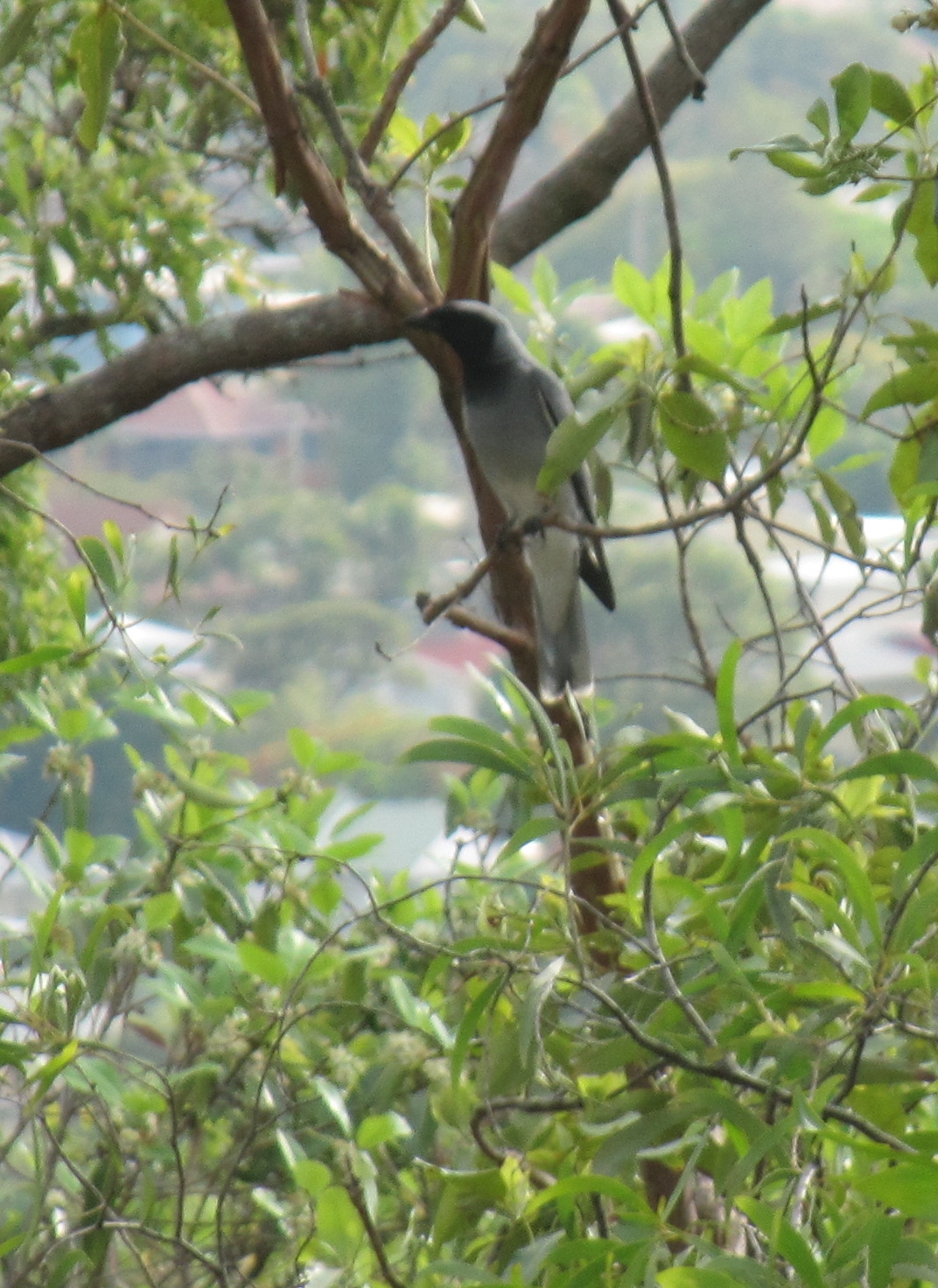
A little further along the track you may be lucky to see or hear the Black-faced Cuckoo-shrike Coracina novaehollandiae we met on our walk. Listen to the call on Birds in Backyards site.

.

.

.

.

.

.

.

Todiramphus sanctus - 19 Nov 2014

Forest Kingfisher

.

Or you might see the handsome Forest Kingfisher Todiramphus sanctus.

Please let us know if you have any sightings and photos to share – megoutlook@gmail.com


« Previous PageNext Page »