8:30am Briefing the team and taking their minds off the cold (Photo: Alan Moore)

By: Michael Fox

7:45am The first participants have arrived even before I have finished setting up … and it’s cold!

8:30am The team is assembled, time for briefing: we have over 200 plants ready. Plants selected included vines like beautiful butterfly plant Sarsparilla Vine Hardenbergia violacea, trees like Coast Banksia Banksia integrifolia
– food plant for Sugar Gliders, and trees like the Blueberry Ash Elaeocarpus reticulatus with its fascinating pretty pink downward facing flowers. Downward hanging flowers are a valuable food source in rainy periods when nectar is washed out of Banksia and Grevillea flowers.

9am Ross & Barry planting large Hickory Wattle (Photo: Alan Moore)

d

d

d

d

9am Planting is well underway with people scattered all over the slope. Ross Vasta MP Federal Member for Bonner and gully neighbour Barry work together planting a large Hickory Wattle Acacia disparrima.

9:50am Miranda and Scott

d

d

d

d

d

9:50am Must be time for morning-tea.

Looking around it is a real pleasure to see our neighbours engaged in a cooperative effort to restore this corridor for our wildlife.
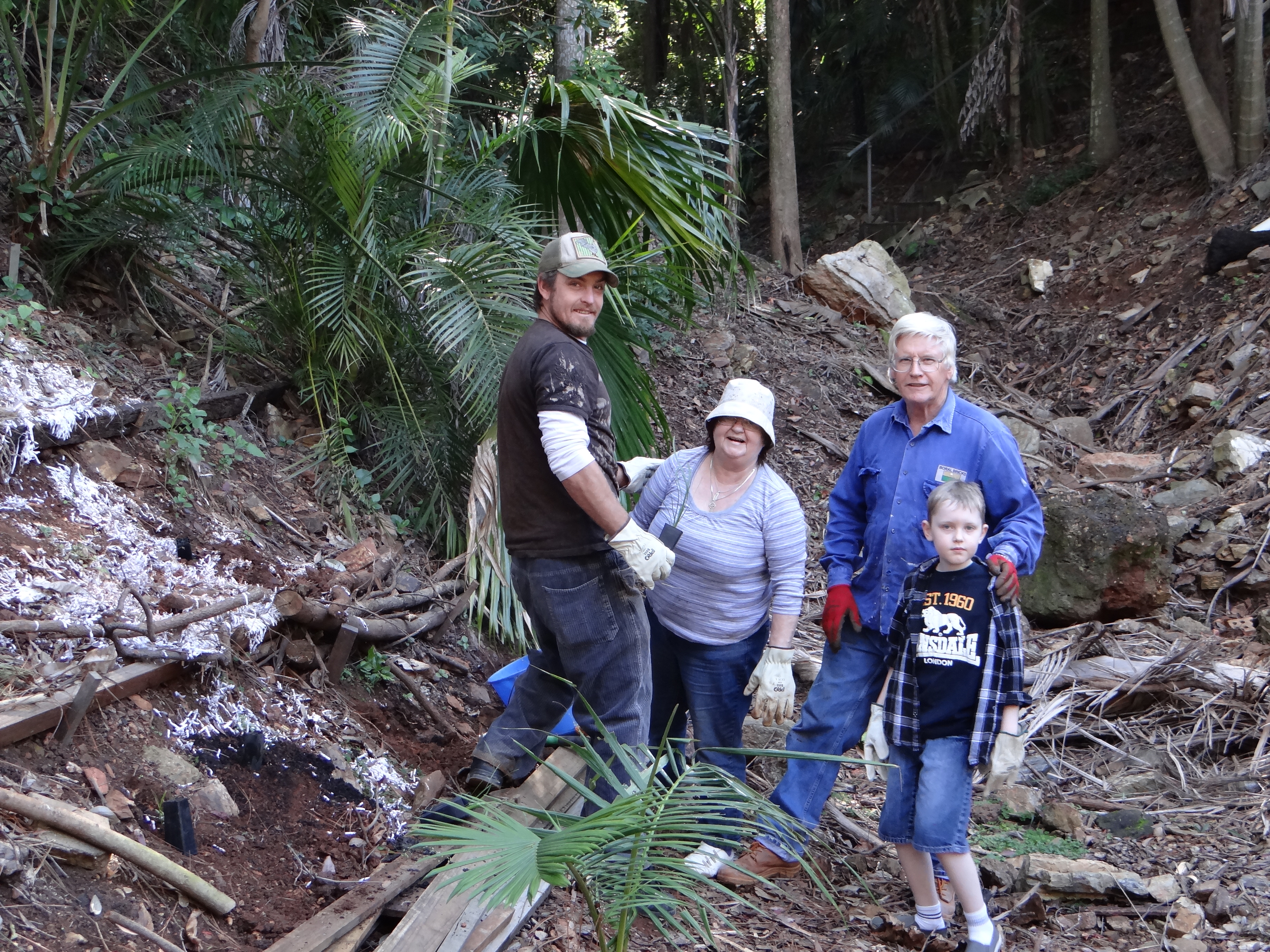
9:50am (l-r) Alistair, Lyn, Ray & Trey

d

d

d

d

Three generations of the Fulton family have been strong supporters of our restoration work with members involved in every planting day since 2008 when they planted two trees in memory of Lyn’s mother. Ray has also propagated Lomandras and potted Acacias that are now thriving in bushcare site.

10:45am Community at work

f

f

d

10:45am Planting is almost complete so the team starts moving up the gully clearing Madeira Vine anredera cordifolia and Devil’s Ivy Epipremnum aureum.

Madeira Vine is a major problem in the gully, smothering trees and spreading aggressively with hundreds of potato like tubers which can each shoot into two or three new vines.

Devil’s Ivy or Pothos
is another invasive weed in the gully, climbing and dragging down trees. Devil’s Ivy, a common house plant, is also toxic to dogs and cats.

10:50am Ann Moran – Field Botanist

d
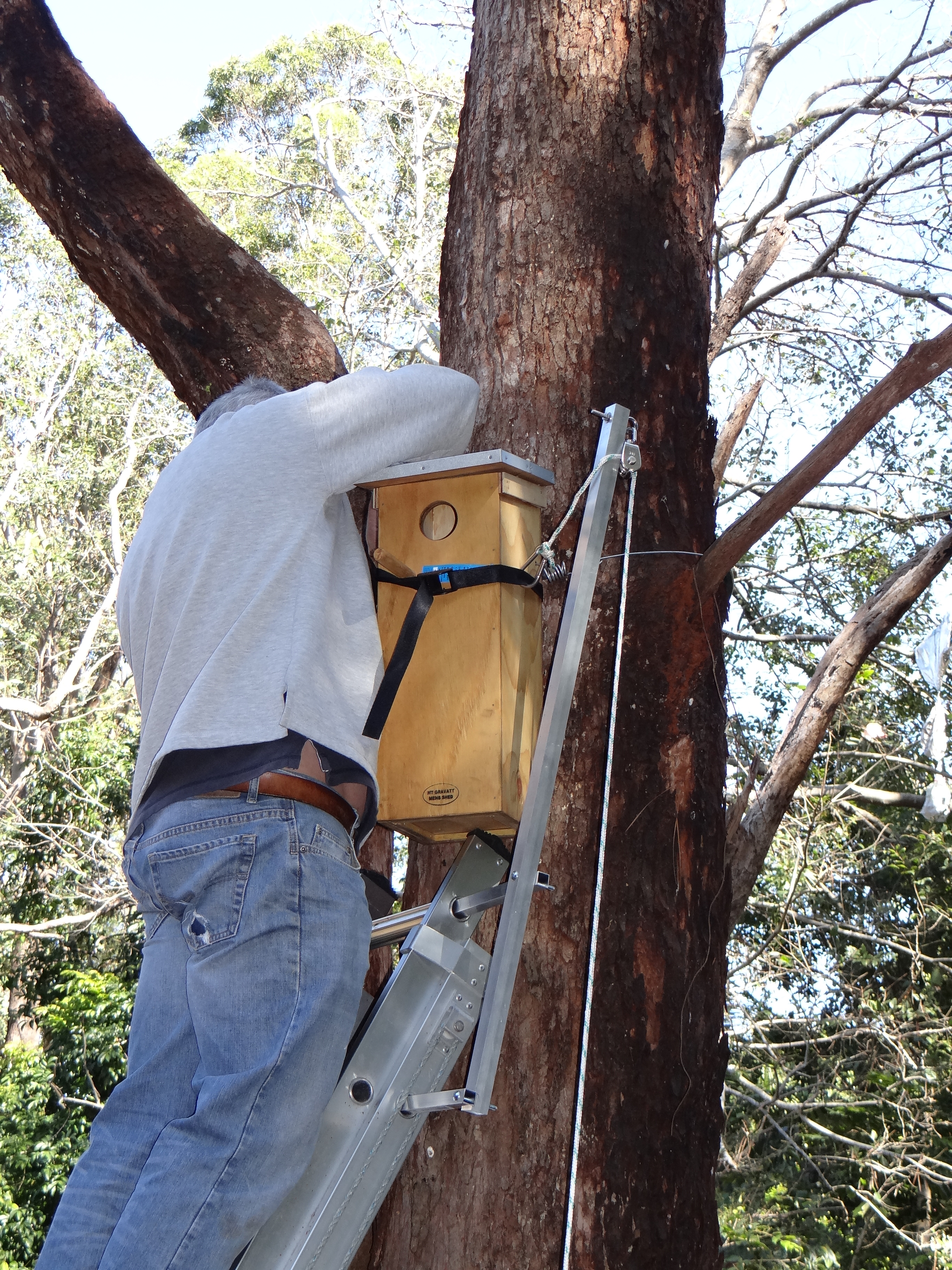
11am Installing Men’s Shed nest box – a new home for Scaly-breasted Lorikeets

d

d

10:50am Further down the gully Ann Moran a Field Botanist with decades of experience, generously shared her amazing knowledge of our native plants. I didn’t realise what looks like multiple leaves on the Black Bean Castanospermum australe are actually one leaf and if you sniff the end of the stem it smells of cucumber.

d

d

d

d

d

dd

d

11am Installing our first nest box. Logging and farming of the mountain habitat means that the forest is less than one hundred years old. Nest hollows typically start to form once trees are over one years old and then can take another fifty years to create. Therefore there is a shortage of nest hollows available for birds and gliders. Mt Gravatt Men’s Shed have now partnered with Mt Gravatt Environment Group to produce high quality nest boxes designed to the needs of local species. Scaly-breasted Lorikeets – all green with flecks (scales) of yellow on the chest, are smaller than Rainbow Lorikeets and have lost out in the fight for available tree hollows. This box with its smaller entry hole which excludes the larger birds will remain available for our Scalies.

Mt Gravatt Environment Group sell Men’s Shed nest boxes for $50. Boxes are available for a number of bird and glider species. For details email: megoutlook@gmail.com
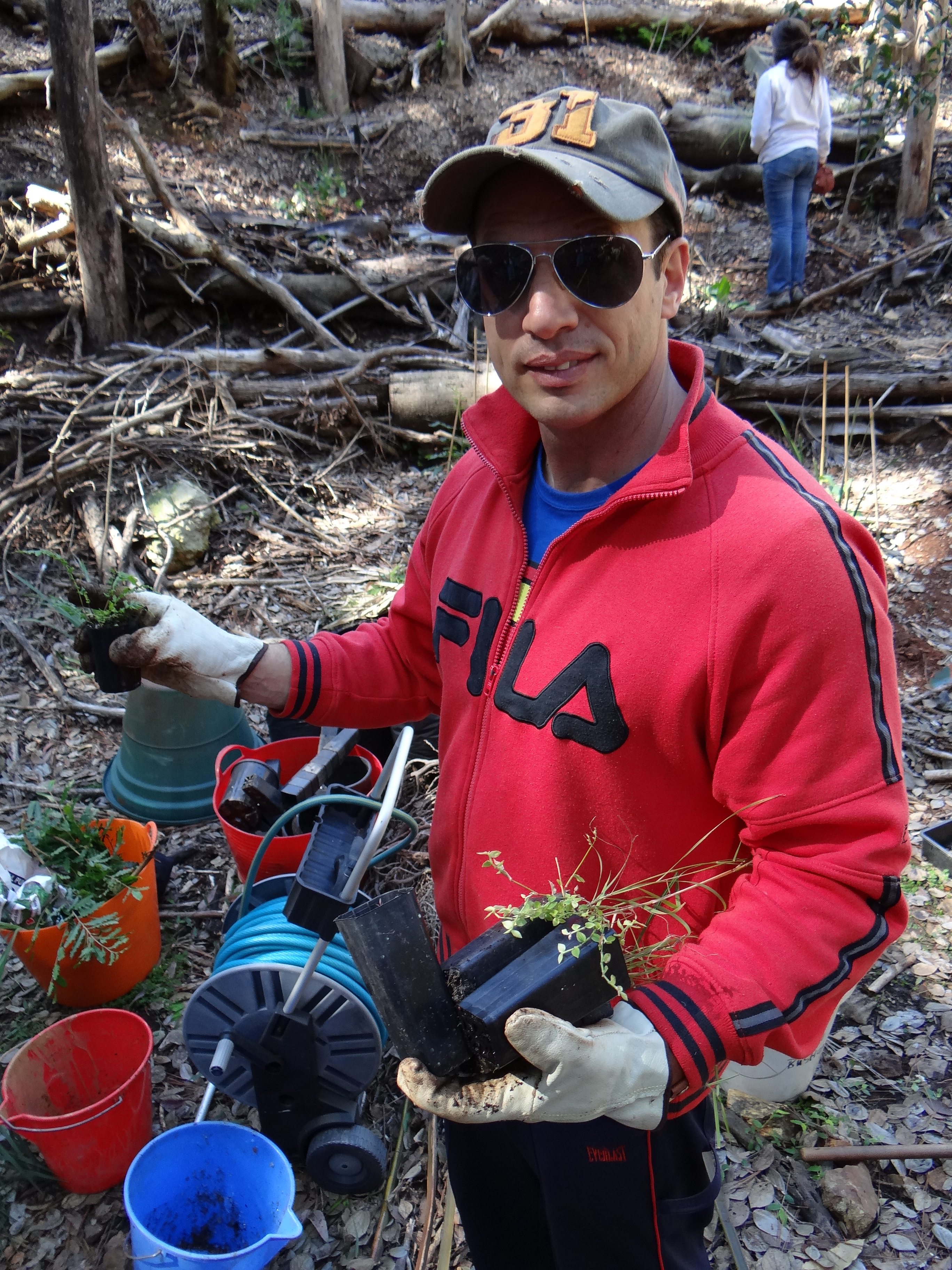
11:20am Andrew with native grasses

11:20am Native grasses like Rainforest Grass Oplismenus aemulus, Graceful Grass Ottochloa gracillima and Scented Top Grass Capillipedium spicigerum  operate as Green Mulch suppressing weeds, retaining moisture and reducing erosion. These grasses are also caterpillar food for butterflies like the Orange-streaked Ringlet.

Andrew get special attention from the photographer: his wife Kerry. A participant in our 2011 Photography Workshop has developed a real skill in capturing the moment and the wildlife.
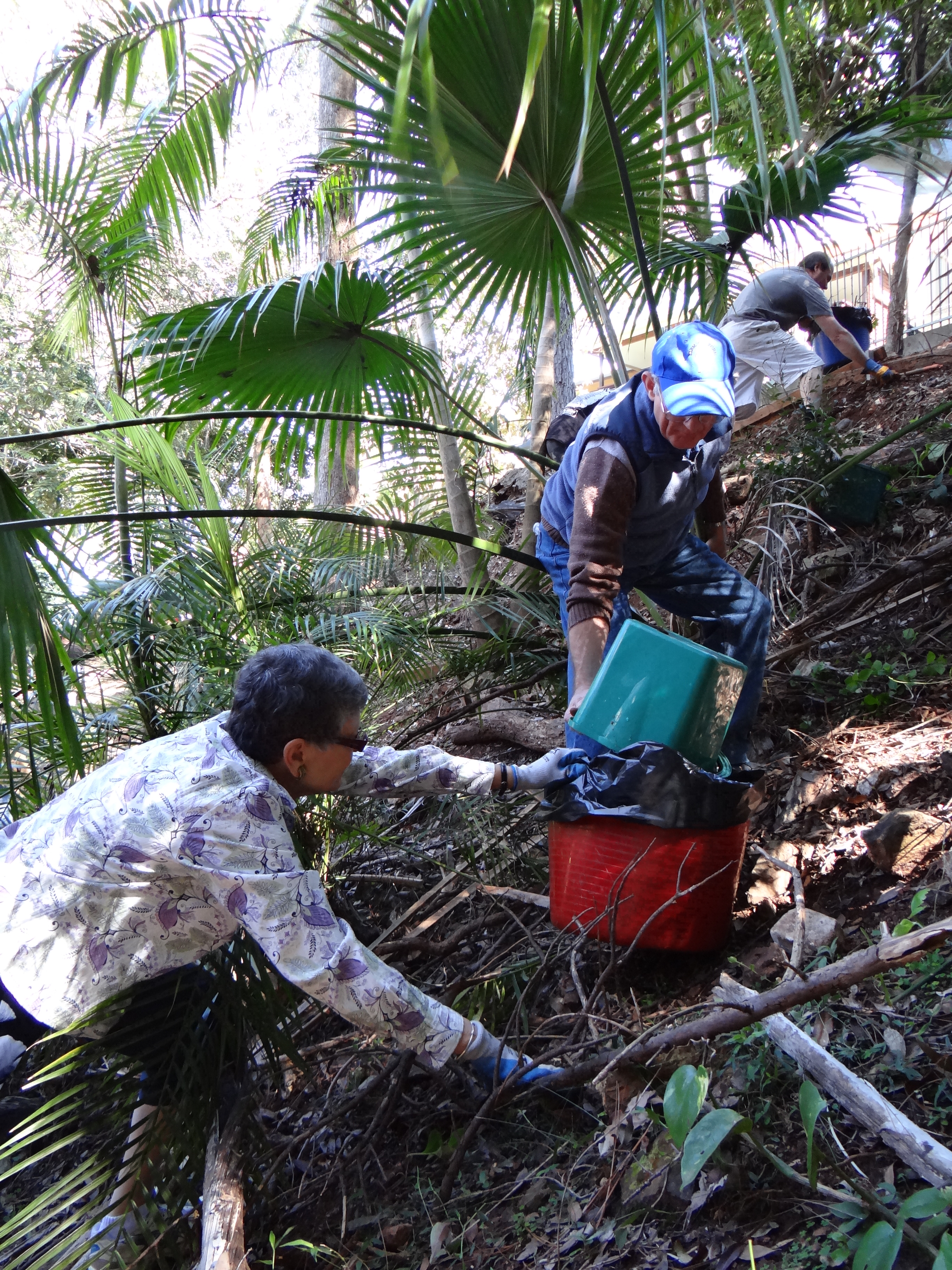
11:30am Susan (left) and Don clearing weeds

d

d

d

d

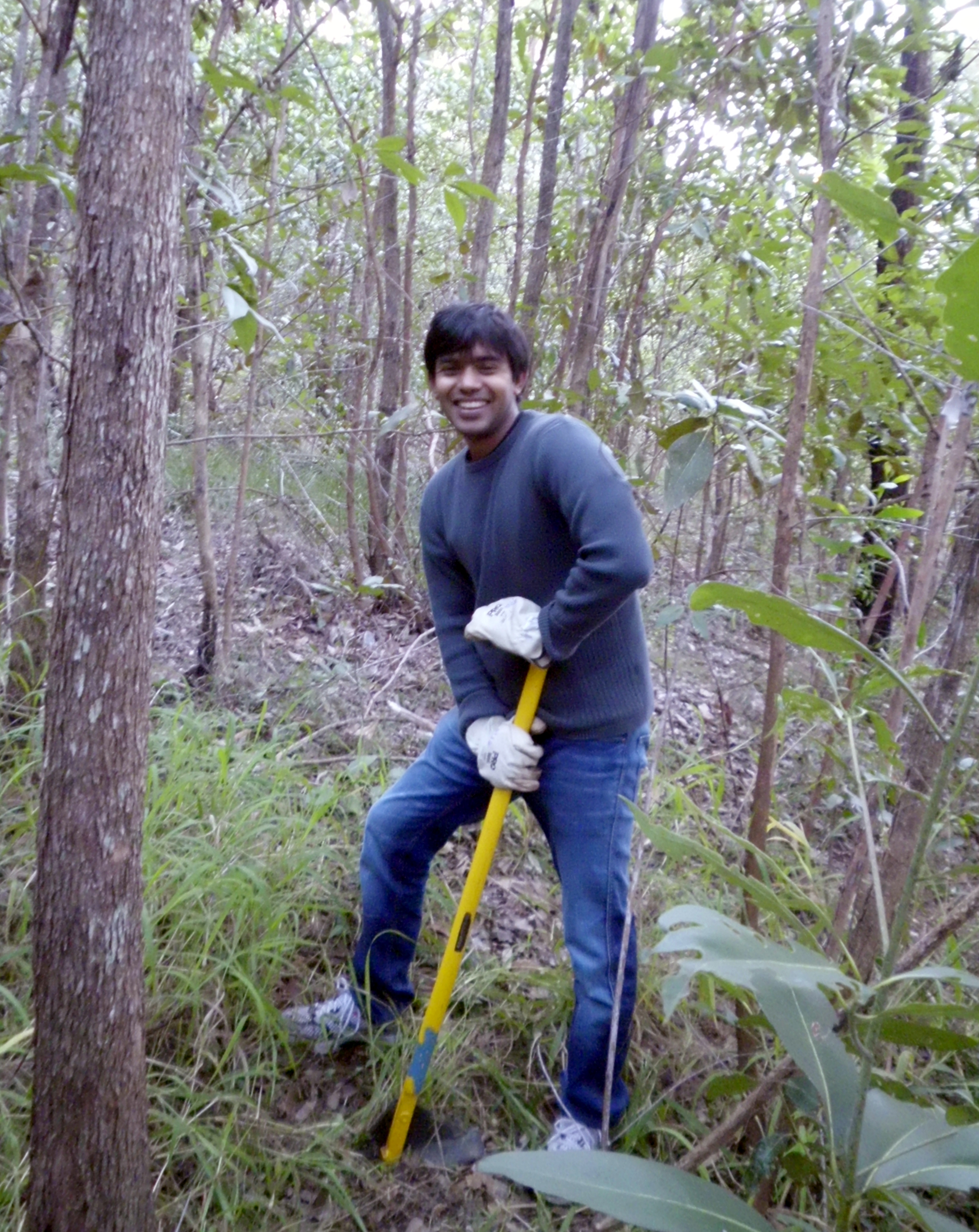
11:30am Susan Jones, Mt Gravatt Environment Group Secretary, pitches in with gully neighbour Don to remove Madeira Vine.

12noon Planting done. Now nature takes over to complete the job

d

d

d

d

d

d

d

d

d

12noon Over 200 plants in place. Now we hand over the nature to complete the job. Come back for the 2013 Community Gully Day to see the results of our partnership with nature.

Thank you to all participants. It is inspiring to be part of such an amazing community event. Also thank you to Annette & Genevieve who hosted the event, Don & Clair, Ray & Lyn and SOWN who donated plants and Jason & Tash who donated timber for the slope.

Some neighbours who were unable to participate on the day made tax-deductible donations that paid for the tube stock.
By: Michael Fox

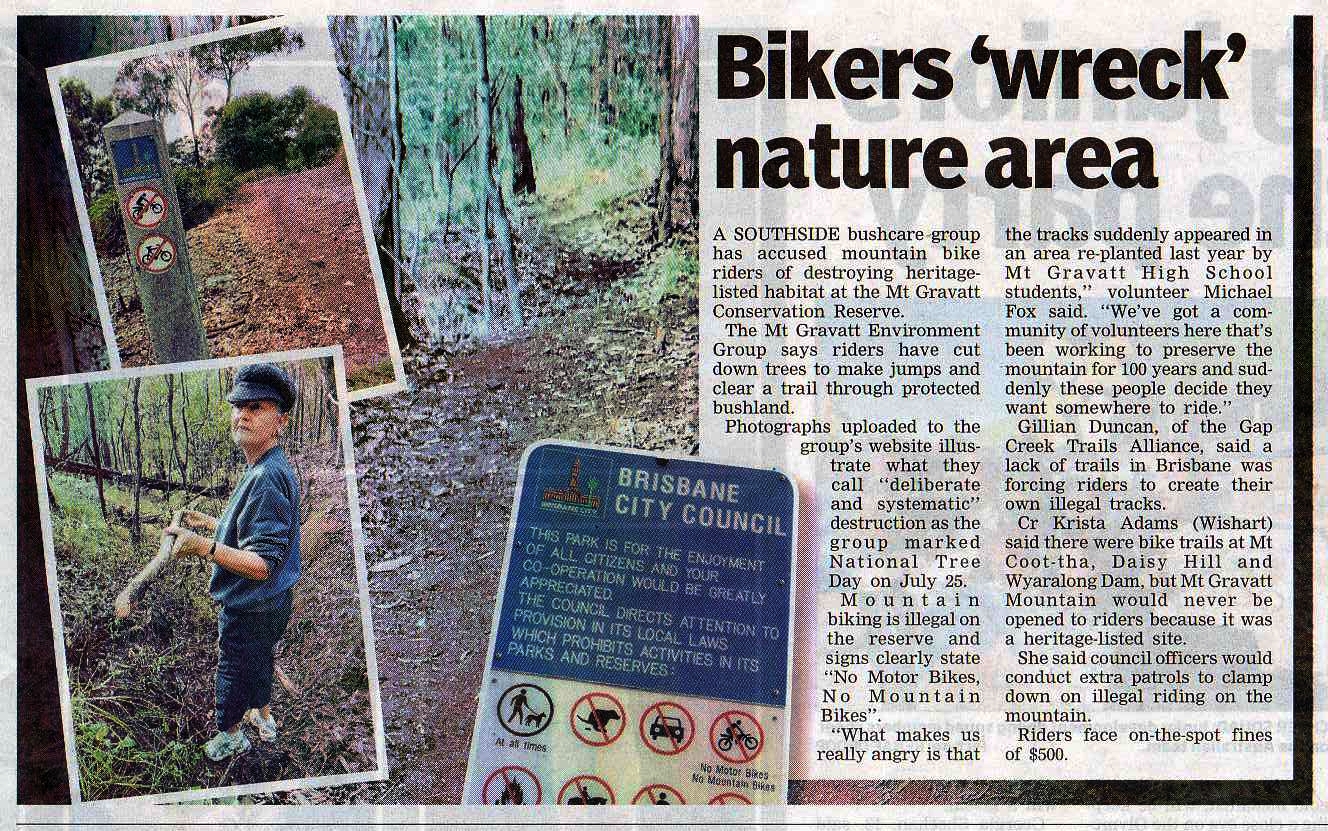
Our community speaks out against destructive mountain biking on Mt Gravatt:

Southern Star – 1 August 2012

Local Councilor Krista Adams has reconfirmed the Council’s long standing commitment to keeping Mt Gravatt Conservation Reserve free of mountain bike riding.

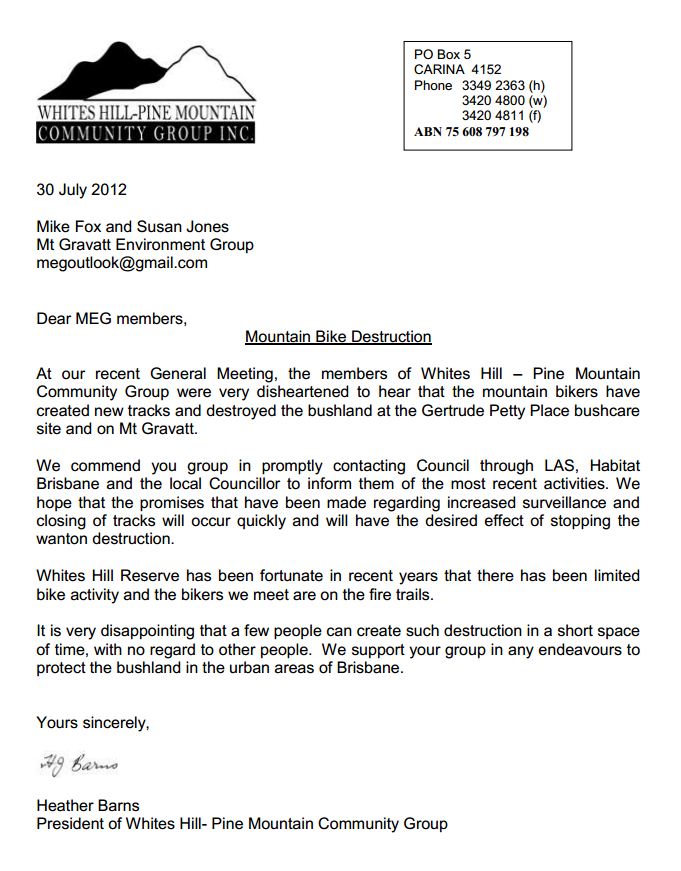
Letter of support – Whites Hill-Pine Mountain Community Group Inc.

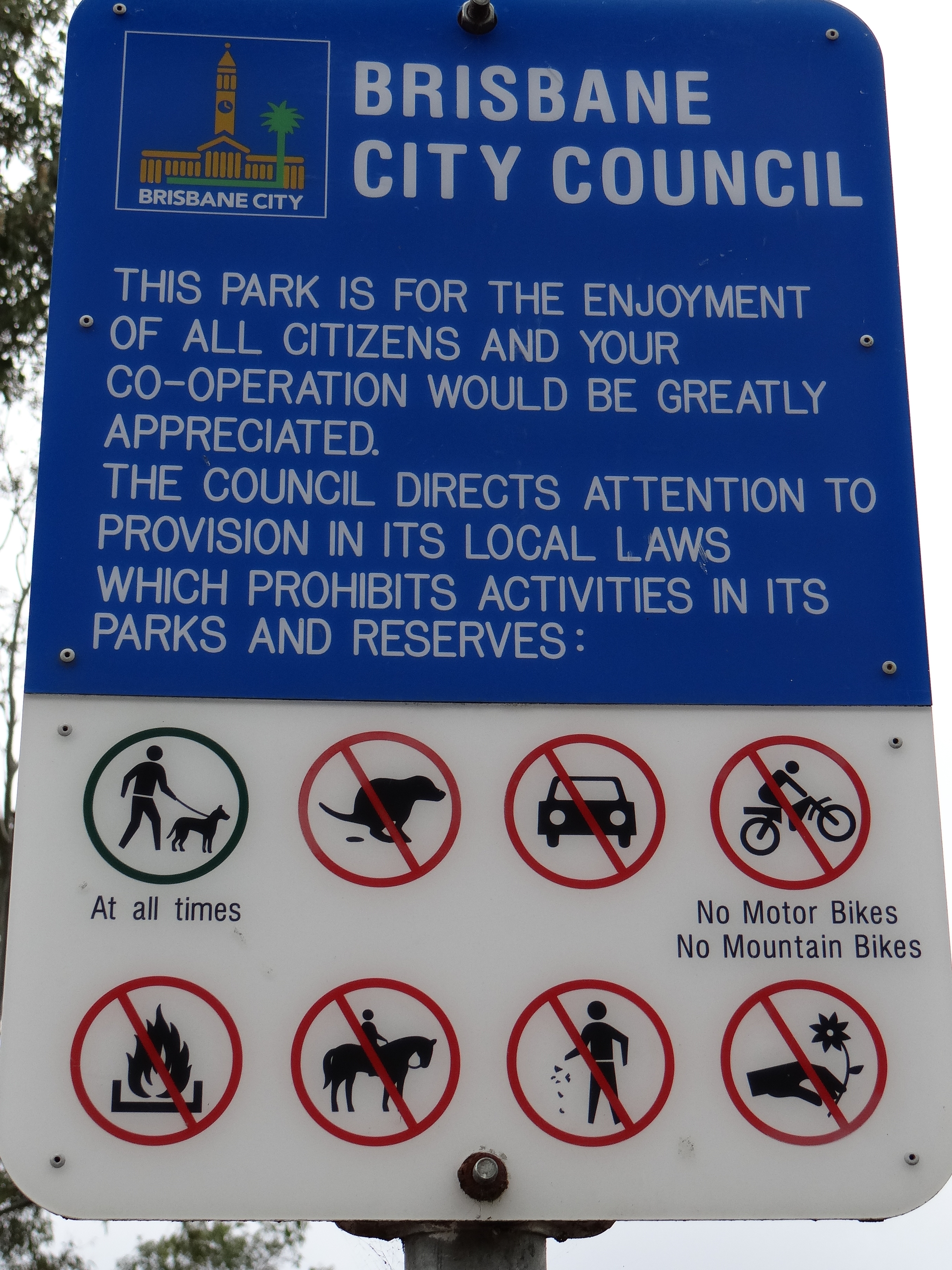
BCC Local Area Services are providing strong on ground action – closing illegal tracks, mulching damaged areas and increasing their presence in the Reserve to catch riders still ignoring our community’s laws. Riders, who apparently could not see multiple signs saying “No Motor Bikes No Mountain Bikes”, have now been told very clearly that off road riding is illegal and subject to $500 fines.

We have also received emails and letters of support by community members and groups heartened by our action and the support we have received from Council.

We are proud of our community

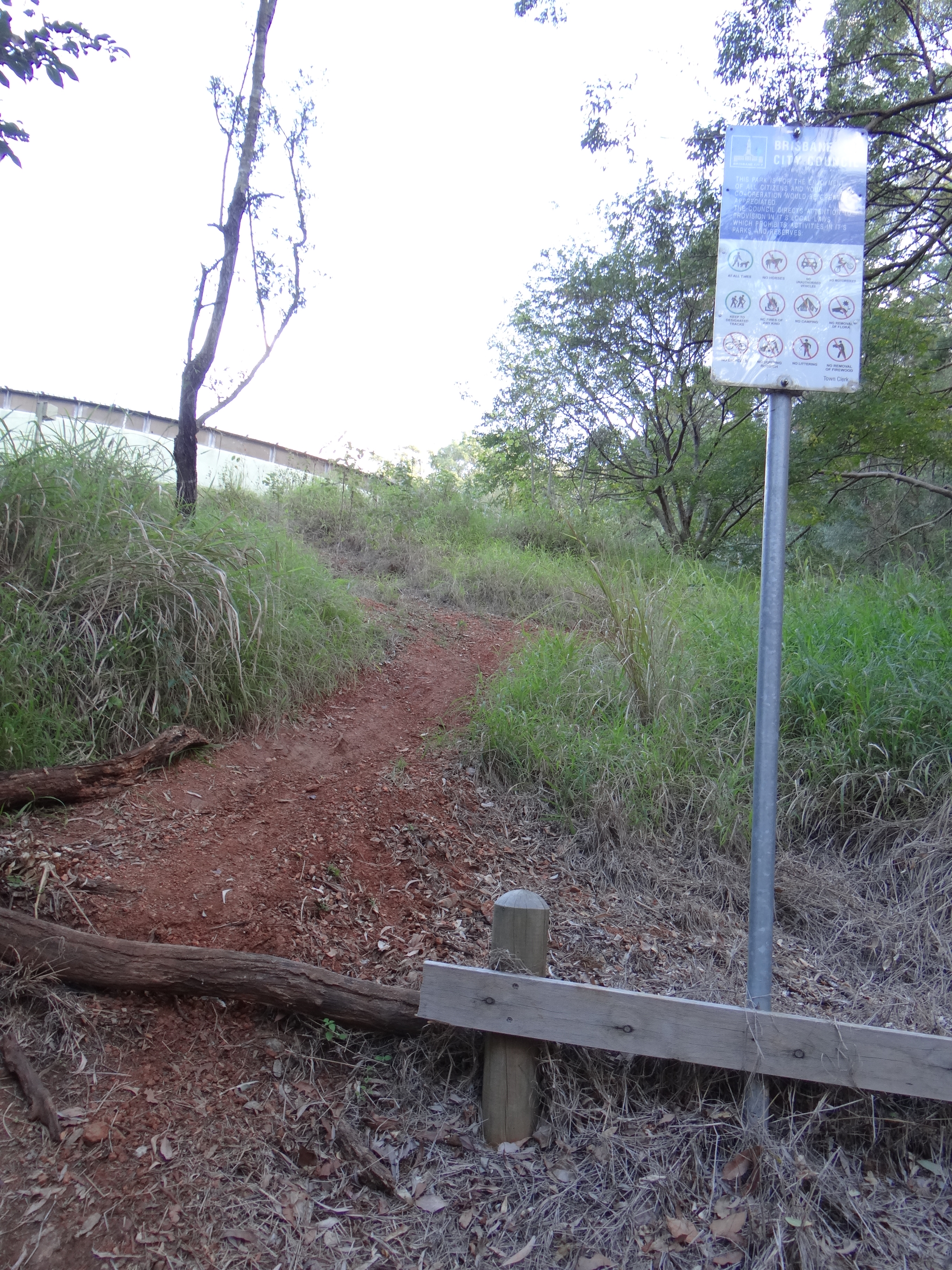
Track exit beside No Mountain Bikes sign

and appreciate the recognition of our work however we know from past experience that illegal mountain bikers will be back fast if we, as a community, don’t stay alert.

As recently as Wednesday last week, National Tree Day, I found fresh bike tracks on in the area just down hill of the water reservoir. I was walking those tracks to document the erosion and tree root damage caused by mountain bikes.

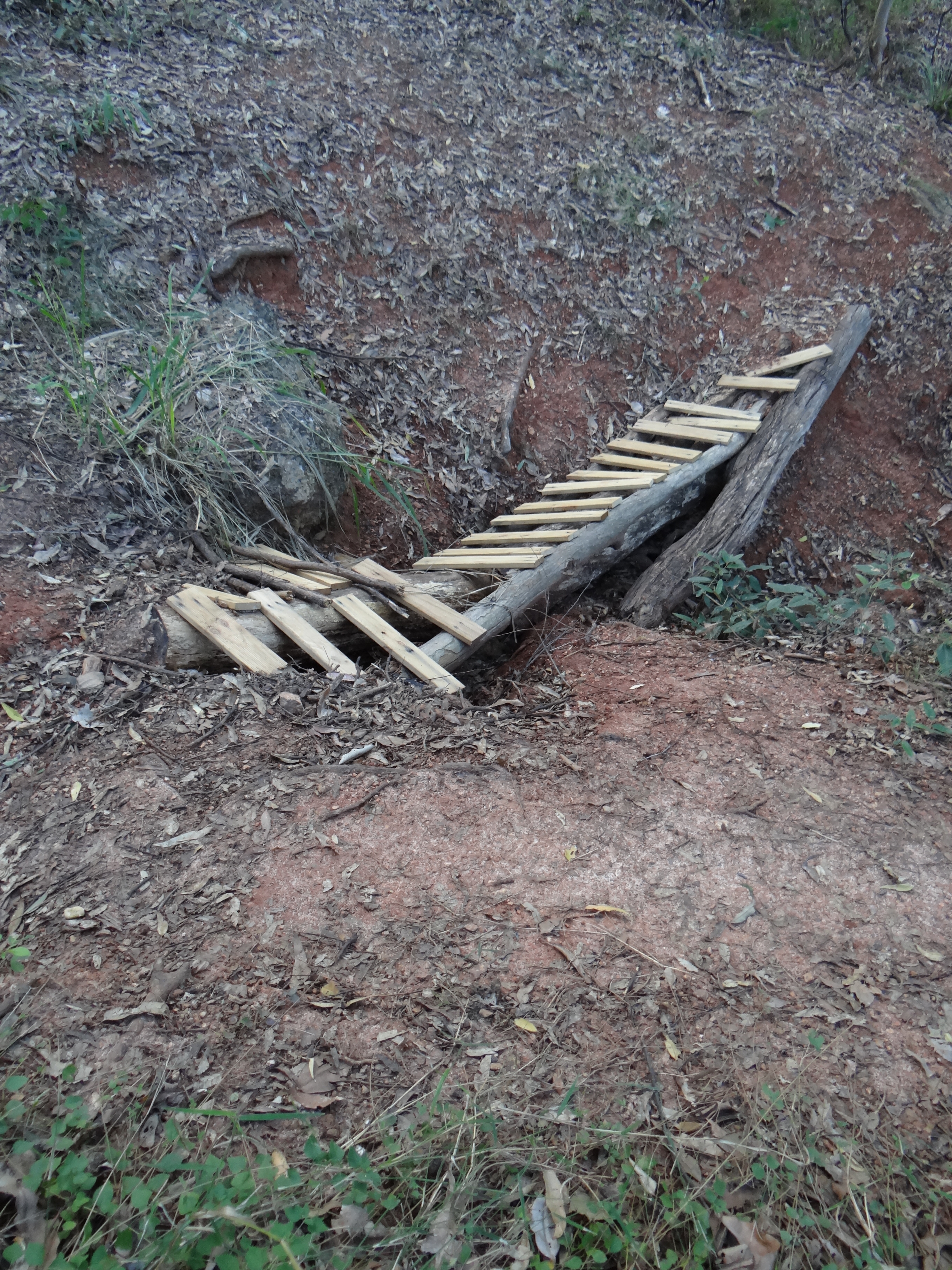
New mountain bike bridge

These were not just tracks cleared through the bush, I even found a what looked like a fairly new timber bridge.

Mountain bike activity in that area has caused erosion up to half a metre deep in places and extensive root damage to mature Koala food trees.

What action can you take?

Illegal mountain biking can be reported to the BCC Call Centre 24/7 on 07 3403 8888

Please be careful about approaching riders by yourself. These riders are already acting illegally and we have had a number of reports recently of community members being subjected to aggressive and violent verbal abuse.

Track erosion

v

g

g

g

g

Roots damaged and under mined by erosion

g

By: Susan Jones

After the fun of last week’s National Tree Day planting of 140 natives to attract birds, bees, butterflies and koalas, it was time to start watering.   Council do not supply water for smaller plantings and we are not permitted to use mains water.   Consequently we have to depend on water from our own garden tanks, which we bottle in recycled 3 litre milk containers and carry to site.  Sheamus shared the load and added a dash of worm juice to his bottles, which will give the plants a good start.  We will continue to water weekly for a month, unless it starts to rain again.

Mirandha and her Griffith Uni volunteer team of Lin, Lyn, Moeko, Thomas and Rashed joined our regular group members and quickly dispersed to water and put mulch around the base of our plantings.   Next, it was back to the tedious task of removing Creeping Lantana Lantana montevidensis and Guinea Grass Megathyrsus maximus.  Rashed tried his hand at using our Tree Popper, a very handy device that grips and easily pulls deep-rooted weeds from the ground. His target was Mickey Mouse Plant Ochna serrulata, an extremely deep rooted weed that is now showing the first signs of flowering.    With the arrival of Spring, the plants will fruit and birds will disperse the seeds all around the mountain and into our gardens.   If we do not get all the plants out before fruiting time, we remove fruiting branches and return later to remove the rest of the plant.

A lot of work was achieved at this regular Wednesday afternoon working bee.   It’s so beautiful in the bush on a sunny winter’s afternoon – why not come out and join us, and meet delightful young people from all around the globe.


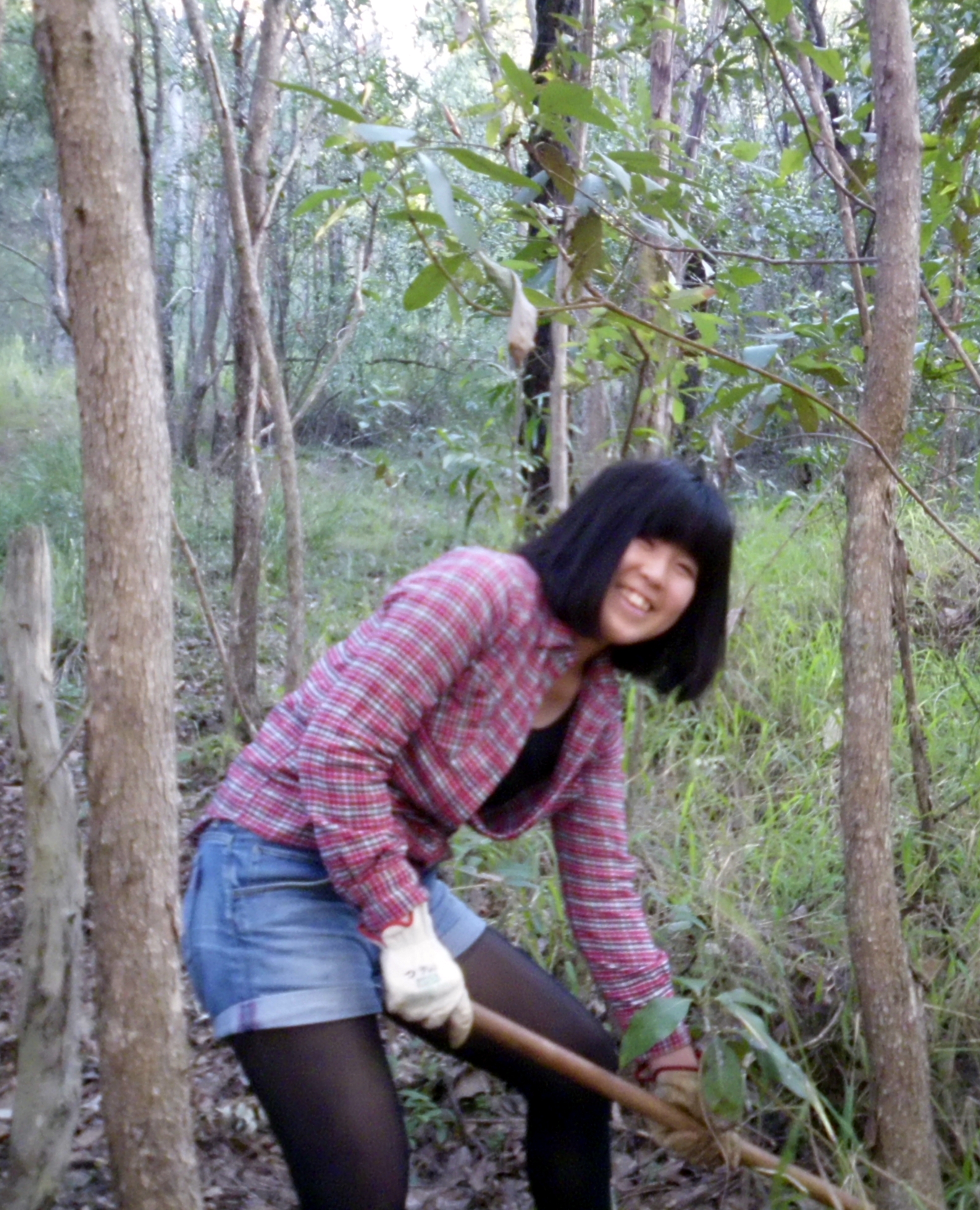
Griffith Uni student volunteer

By: Susan Jones

“Shall we celebrate National Tree Day again this year, Sheamus?” I asked last year’s volunteer coordinator. “Of course!” was the prompt reply.  As it turned out, we celebrated twice!

On Wednesday  25 July, students and a science teacher from Mt Gravatt High School, together with a team of Griffith University students rallied to plant 100 native tubestock, specially chosen to provide food and shelter for birds, butterflies, bees – and of course, our resident koalas!  What a great team!  In just over an hour all the plants were in the ground and it was time to protect them with plastic sleeves, supported by cane stakes.

It was great to welcome Griffith Uni students back to our site for this celebration, as they had spent many hours  tediously clearing the area of Creeping lantana Lantana montevidensis  last university semester.

Mt Gravatt SHS team planting

Brush-turkey looking for lunch

On Saturday 28 July, we had ready another 40 plants to be put in by volunteers who couldn’t join us on Wednesday.   When I arrived on site, I found a female Brush-turkey Alectura lathami checking out all the holes prepared for planting.  Her curiosity and anticipation of a free meal made me laugh.

We had …. volunteers of all ages turn up: a special thanks to the three grandparents who more than pulled their weight.

Our 2012 National Tree Day planting was a great success: “ thank you” to everyone involved.

Your generous contribution will enhance amenity  for community users and provide healthy habitat for wildlife in our 66 ha Mt Gravatt Conservation Reserve.

Granparents restore Conservation Reserve for future generations

Granparents restore Mt Grvatt Conservation Reserve for future generations


Glorious morning to be in the bush


By: Michael Fox

Key threats to Mt Gravatt Conservation Reserve:

  • Weeds/Garden Waste/Dumping
  • Downhill Mountain Biking, Trail Bikes & Unofficial Tracks
  • Feral and Domestic Animals

Mt gravatt run – Uploaded by on 17 Aug 2011

2011 Mt Gravatt SHS – National Tree Day Planting

“We felt gutted seeing the damage they had done.  The irony is, that if we, CVA volunteers and Griffith Uni student volunteers hadn’t cleared out the area, they wouldn’t have been able to get through there!”

Susan Jones was talking about finding that mountain bikers have established a brand new trail right through the middle of the area restored by Mt Gravatt SHS students in 2011

No Motor Bikes No Mountain Bikes

and being prepared for our July 25 National Tree Day planting. The action was quite deliberate and systematic as the sign was thrown away and sapling Brush Box, Soapy Ash and Wattles were sawn off as well as broken down.

x

Mountain

Biking is illegal in Mt Gravatt Conservation Reserve

x

Mountain biking is not allowed in the Reserve. Signs at the Summit and at Gertrude Petty Place clearly state “No Motor Bikes No Mountain Bikes”.

Rider ignores No Bike sign

The bike in the video above actually leaves the road and takes a track straight past a No Bikes sign. Click on photo to enlarge. v

The mountain biking is not only illegal it is also damaging a unique environment that our community has fought to protect for over one hundred years: Mt Gravatt Historical Society, tells us that up till July 1893 the mountain and surrounds were designated as a railway timber reserve. In response to community pressure the Queensland Government of the time protected this special habitat by declaring the Reserve.

Mountain bike riders are actively destroying mountain habitat

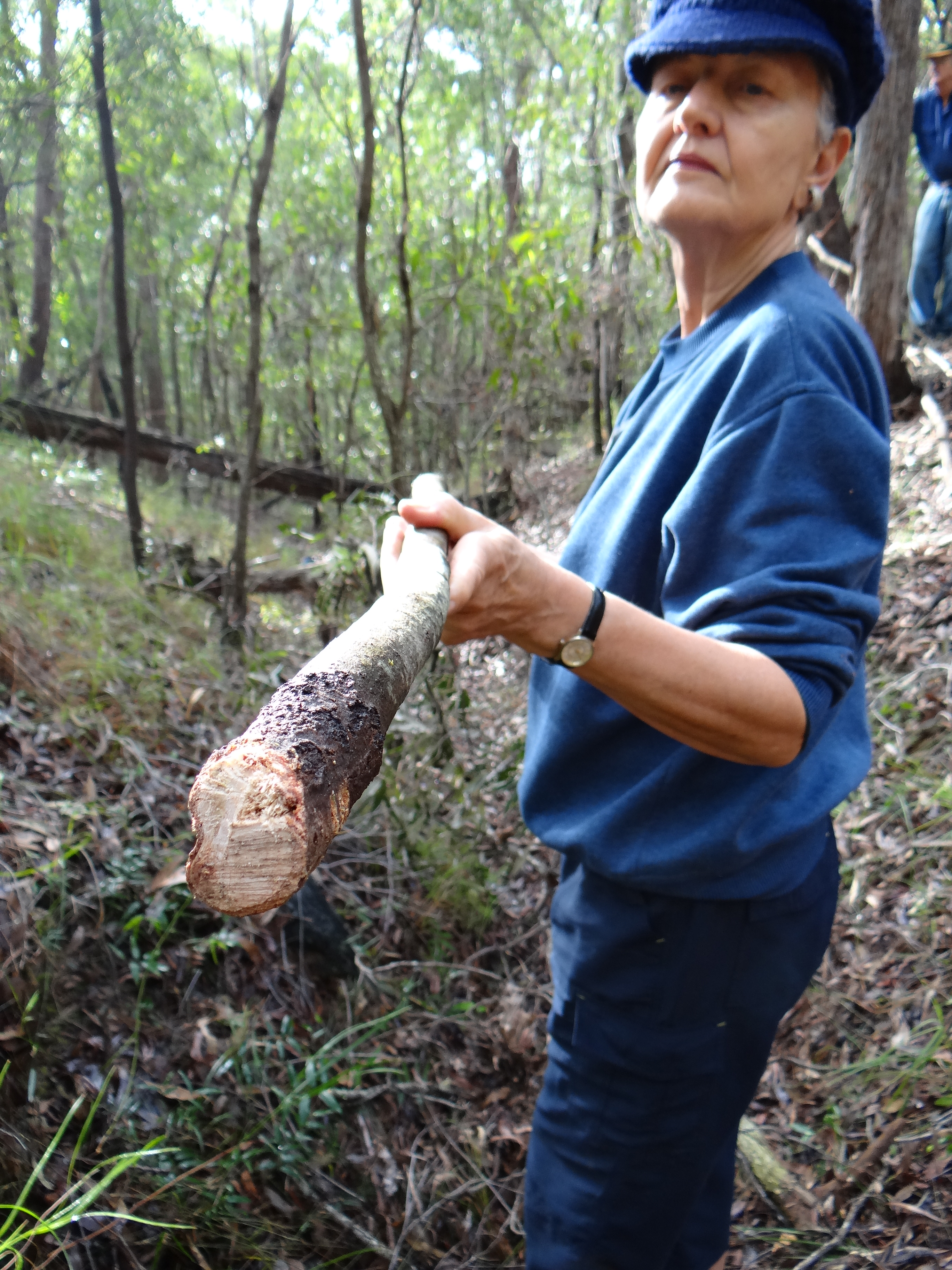
Susan showing cut sapling

a

I inspected the latest damage this week with Susan Jones. What really stunned us was the systematic habitat destruction with saplings sawed or broken off and used to make jumps for riders. Cut and broken trees included a four metre Early Black Wattle Acacia leiocalyx just about to flower. Early Black Wattle is the caterpillar food plant for Imperial Hairstreak Jalmenus evagoras, a beautiful butterfly which is returning to the mountain with the restoration of our bushcare sites. Other trees destroyed included Soapy Ash Alphitonia excelsa, caterpillar food plant for Small Green-banded Blue butterflies Psychonotis caelius, Brush Box Lophostemon confertus, caterpillar food plant for the

Butterfly trees chopped up for bike jump

fascinating Four-Spotted Cup Moth Doratifera quadriguttata.

Many Lomandras have been destroyed by the action of bikes, including a flowering (male) Many Flowered Mat-rush Lomandra multiflora, caterpillar food plant for Brown Ochre Trapezites iacchus and Black-ringed Ochre Trapezites petalia butterflies: two of forty-five butterfly species found in the Reserve.

Young trees destroyed to make a bike track

It is hard to show the enormity of the damage. None of the trees were very large but the collage of cut stumps gives some idea of the number of trees destroyed to create track for entrainment of a small number of people.

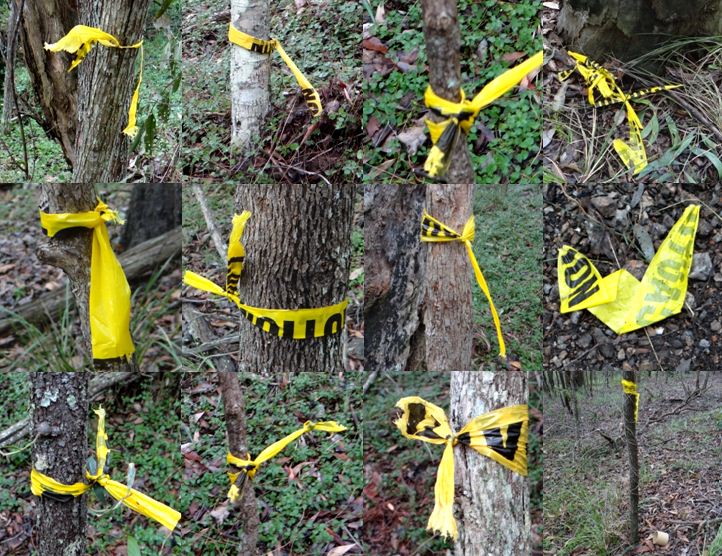
And by the looks of it this is only the start. Following the track down from the Summit we found yellow markers tied to trees, not only along the track but also what appears to be planned as a new track taking off to the south. Trees had been cut or broken and yellow tape tied to others. It seems that this new track planning was only stopped when the tape ran out … evidenced by the empty spool discarded in the bush.

Further evidence of expansion plans is the cache of tools we found locked to a tree just near the path.

Yellow tape marking out track expansion plans

Track clearing tools locked to a tree

Our community investment

c

Seeing the wanton destruction of our special habitat made me very angry, not just because of the personal impact on me, but also because this action ignores the huge ongoing contribution our community is making.

Conservatively calculated, Mt Gravatt Environment Group is responsible for over $30,000 in volunteer contribution during the 2011/12  financial year.

Over the same period our community has invested $19,905 in grants from Queensland Government, Brisbane City Council and Southside Sport & Community Club.

Donations and direct investments by community members exceeded $8,000.

Ongoing support and investment by BCC Habitat Brisbane program: plants for revegetation, equipment, training and public liability insurance.

Community partners include Mt Gravatt Men’s Shed – nest-boxes, MacGregor Lions Club – native garden restoration Roly Chapman Reserve, Mt Gravatt Girl Guides – planting Pollinator Link garden, Griffith University – student volunteer program, QUT and Australian Catholic University student volunteers.

Sheamus – Young Citizan – Jan 12

Community Recognition

z

Our contribution has been acknowledged with a number of community awards.

Sheamus O’Connor

  • Young Citizen of the Year 2012
  • 2012 YoungStar Community winner

Michael Fox

  • 2012 Lord Mayor’s Green Heart Award
  • 2011 B4C Environmentalist of the Year
  • Shortlisted for selection for Pride of Australia 2012 – Environmental Medal

Mt Gravatt Environment Group

  • 2011 Brisbane’s Spotless Suburbs – Environmental Protections Award
  • B4C Bushcare Group of 2011

Fox Gully Bushcare

  • 2011 Brisbane’s Spotless Suburbs – Partnerships Award

How can you help?

v

Please express your concerns to Cr Krista Adams as Brisbane City Council is trustee of Mt Gravatt Conservation Reserve:

Email: wishart.ward@ecn.net.au

Phone BCC Call Centre: 07 3403 8888

By: Susan Jones

Checking out a native bee nest

Today we had the pleasure of welcoming Holland Park Kindergarten families to Gertrude Petty Place for a bush adventure. The children were excited about catching up with their friends after two weeks holiday and were brimming with energy.

We checked out a  termite’s nest in an old ironbark gum where kookaburras nest each year  and then headed off to search for native bee nests (Trigona carbonaria)in a nearby hollow tree trunk.

Bush tucker – food tastes better in the bush

The children have a native bee nest in a box at school, but they were fascinated seeing nests in the wild.

After a walk through the bushcare site everyone was feeling tired and ready to tuck into a picnic morning tea before heading off home.

Our young friends left with some local native ground cover plants that will be planted in the school grounds to attract butterflies, birds, bees and frogs.

Thanks Amanda for organising this outing and we hope to see Holland Park Kindergarten back in the bush soon.

By: Susan Jones

MacGregor Lions Bushcare Team

“Sue! I need you to bring 20 pair of gardening gloves”.  Newly appointed MacGregor Lions Vice President, Shan Ju Lin, had tapped into her many contacts within the Australian/Taiwanese community, organising volunteers from all over Brisbane to assist Lions with their Roly Chapman Reserve Gardens

Another tub of weeds removed

Project July working bee.   Amongst them were young Taiwanese tourists whom we hope will take home happy memories of their Australian bush experience.

Juvenile Grey Butchebird

Garden bed #3 was cleared of many garden escapes and weeds that had been dispersed as seed by birds and animals.  One large pile of mulch was then spread in the bed to improve soil quality and minimise weed regrowth.   A family of Grey Butcherbirds Cracticus torquatus sat close by and swooped each time an insect, spider or frog was uncovered: it was a gourmet smorgasbord that the birds relished!

Garden bed #4 was a tangled

Native trees being released from strangling grip of Devil’s Ivy

undergrowth of Cobblers Pegs Bidens pilosa, Mother-in-law Tongue Sanseveria trifasciata, Mickey Mouse Plant Ochna serrulata, Fishbone Fern Nephrolepis cordifolia, Chinese Elm Celtis sinensis, as well as, Devil’s Ivy Epipremnum aureumthat was slowly smothering native gums.  With so many willing volunteers the garden quickly re-emerged and the weed heap grew to enormous proportions.  A Ringtail Possum Pseudocheirus peregrinus was disturbed from its sleep in a gum above and immediately a family of Noisy Miners Manorina melanophrys circled the unfortunate creature, announcing its presence with their shrill shrieks.

Thank you to our great volunteer team!  We enjoyed your company and appreciated the hard work you put in to move this MacGregor Lions’ project forward.  We would love to see you back next month!

At our next working bee on 4th August we will finish mulching Garden bed # 3, remove the last of the Devil’s Ivy and weed roots in garden bed #4 and then lay down mulch.     These two beds will then be ready for replanting with bird, butterfly and bee-attracting natives!

Join the MacGregor Lions team restoring birds, butterflies, bees and frogs to this special environment:

Next working bee – Saturday 4th August – 8am to 10am

Meet at garden #4 (from Hoad Street end of pathway).

For details email – Macgregor.Lions.Secretary@gmail.com

By: Michael Fox

Kathleen Noonan is a regular visitor to Mt Gravatt Conservation Reserve and has, in the past, written thoughtful words about the Mountain in her Last Word column in the Courier Mail.

Last Saturday’s column really appealed to me. Particularly her description:

“I’ve returned to Mt Gravatt Lookout because it has a decent scrap of bushland around it to walk in. It’s different from running in city streets. Here, the landscape absorbs you. With each footfall, you return the favour.” Kathleen Noonan

Read Kathleen’s column online

By Michael Fox

Our community can be proud of the young people on the front page of the Southern Star this week, and, the article suggests, we can have hope for some amazing futures to be created by them.

Mt Gravatt Environment Group and our sponsor, Bulimba Creek Catchment Coordinating Committee(B4C), are particularly proud of YoungStar Community winner, Sheamus O’Connor.

More than 100 years before Sheamus was born, in July 1893, Queensland Premier Thomas McIlwraith “… in recognition of the resolve of the settlers, divided off 132 acres of the land [timber reserve], including Mt Gravatt Mountain, from the railway timber reserve.” Mt Gravatt Then & Now Mt Gravatt Historical Society.

The vision of community members over 100 years ago means that today our community has Mt Gravatt Conservation Reserve, a unique habitat with Echidnas, Koalas and forty-five butterfly species only ten minutes from the Brisbane CBD.

In another 100 years our Mt Gravatt community will reflect on the vision and commitment of young people like Sheamus who can see the value in being actively involved in restoration and protection of this unique habitat.

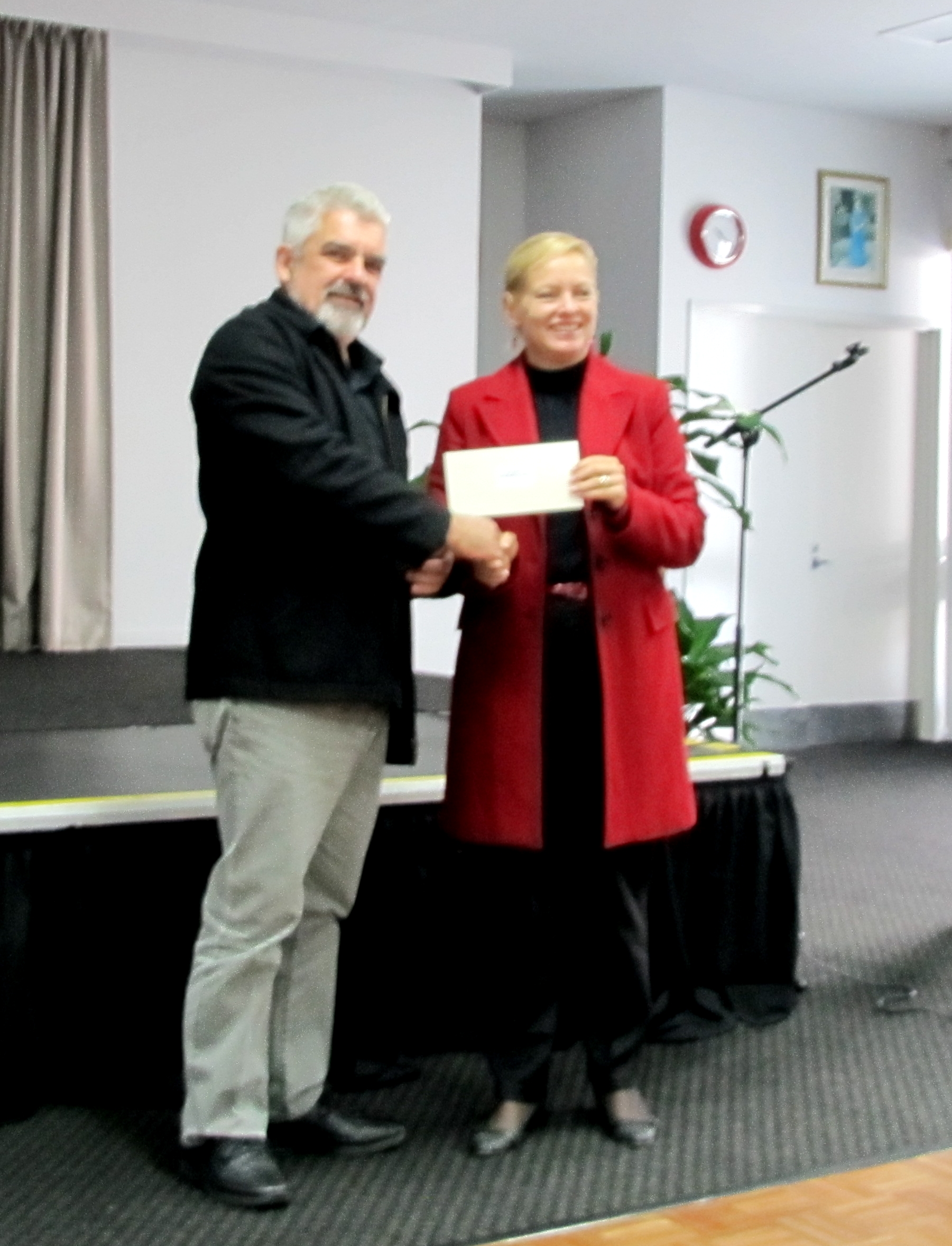
Cr Krista Adams presenting Grant cheque

By: Michael Fox

An outstanding morning tea served in the Carson Room, Mt Gravatt Bowls Club, and politicians handing out grant cheques, no wonder everyone had a smile on their face. I can definitely recommend the morning tea if you are looking for a venue.

As part of their community focus Southside Sport & Community Club gives about $500,000 in grants each year. On behalf of Mt Gravatt Environment Group I received a grant cheque from Cr Krista Adams. The grant will be used to purchase specialised digital camera, iPad and nine metre aluminum pole to allow us to monitor nest boxes installed in wildlife corridors.

Pale-headed Rosella inspecting new Men’s Shed nest box

The nest boxes are made to our specifications by Mt Gravatt Men’s Shed and installed 6 to 8 metres in trees so checking to see who is occupying a box is a challenge. Monitoring is important to ensure they have not been occupied by feral species such as Indian Myna Acridotheres tristis and also provide research data on species restoration and movement through wildlife corridors.

Sharing our table were other grant recipients Wayne & Jennifer on behalf of Bulimba Creek Catchment Coordinating Committee (B4C), Maree – Xavier Children’s Support Network and Hanna – Mt Gravatt West C&K Childcare Centre.