Mt Gravatt Environment Group has joined Fox Gully Bushcare as a finalist in the 2011 Keep Australia BeautifulSpotless Suburbs Award.

Mt Gravatt Environment Group coordinates four Bushcare groups:

  • Gertrude Petty Place Bushcare – Sue Jones
  • Rover Street Bushcare – Brett Dugdale
  • Fox Gully Bushcare – Michael Fox
  • Roly Chapman Reserve Bushcare – currently no team leader

We appreciate Cr Adams’ support in nomination of of Mt Gravatt Environment Group and we are proud to represent our community by reaching the finals of the Brisbane’s Spotless Suburbs competition.

Fox Gully Bushcare is a finalist in the 2011 Keep Australia BeautifulSpotless Suburbs Award.

Fox Gully Bushcare, located on the southern face of Mt Gravatt, is one of four communtiy bushcare groups working with Mt Gravat Environment Group on restoration of this unique pieces of Australian bushland.

Reaching the finals of the Brisbane’s Spotless Suburbs competition is recognition of the strength of our local community, the important role of sponsoring organisations and the quality of the BCC Habitat Brisbane program.

Please join us at the Fox Gully Bushcare site for our first Environmental & Photography Workshops.

Experienced Field Botanist and local photographer Alan Moore will combine to deliver an amazing bushland experience in on the Mountain.

Book early because early booking mean there are only six places left for the Photography Workshop.

This event is sponsored by Brisbane City Council Environmental Grant scheme.

Workshop flyer – 2011 Environmental & Photographic Workshops

Bookings:

Email – megoutlook@gmail.com or

Michael Fox 0408 769 405

Sue Jones and I (Mike Fox) attended the BCC Creek Ranger Forum today at Walkabout Creek Conference Centre. An ideal location for a workshop discussing environmental restoration, with Butcher Birds, Bell Minors (Bellbirds), Kookaburras and Whipbirds providing a background for our presenters.

The presence of Councillor Peter Matic: Chair of the Environment, Parks and Sustainability Committee, was a stong statement about the political commitment to our restoration work. However, for me Peter’s welcome was overshadowed by the welcome to country and amazing didgeridoo playing of a young nephew of Maroochy Barambah: Turrbal Association. My apologies, I did not make a note of his name, so you will have to contact Maroochy if you want to hear a didgeridoo do things I did not know was possible. I have heard about the concept of circular breathing and I have heard didgeridoos being played but not only was there no pause for breath, it sounded like two didgeridoos playing harmony!

The key note speaker was Simon Warner: CEO of SEQ Catchments Ltd, a community not-for-profit with the vision: to deliver a sustainable future for our community. It was heartening to listen to such a business-like pragmatic analysis of the issues of managing south-east Queensland growth, without destroying the very environment that underpins our business economy and the very communities where we live. Simon is very clear-eyed about about the complexity of driving change, acknowledging that the SEQ Natural Resource Management Plan is not perfect just the most comprehensive plan and targets of any region in Australia. Importantly, he recognises that plans converted to legislation are not enough, so implementation and monitoring of the SEQ NRM Plan is driven by the Chief Executive Officer’s Committee for Natural Resource Management in SEQ which reports to the Minister for Infrastructure and Planning.

Maggie Scattini, of private company Brisbane Bushcare gave a very practical presentation based on a decade of contracting in ecosystem restoration. I particularly liked the way Maggie layered up our understanding of the complex relationships starting with soil: my next article for the Southside Community News will have to be about Maggie’s insights on dirt, moving onto the role of  fungi in the forest, then fauna: apparently our glow-in-the-dark mushrooms are actually food for Rainforest Snails. Leave them to the snails, they are poisonous to people. Talking to Maggie and Bill (her husband) we discovered that Brisbane Bushcare was involved in some of the very first bushcare work on the mountain: at what is now the Rover Street Bushcare site.

The final two speakers, Adrian Caneris of Biodiversity Assessment and Management BAAM, and Prof. Carla Catterall of School of Environment, Griffith University, are both strong supporters of Mt Gravatt Environment Group work.

Mike, Sue, Adrian (L-R)

Adrian gave us a guided walk to the shore of Enoggera Reservoir where he helped us see the significant differences in  four habitat types and how that will change what fauna will use each habitat.

Adrian’s presentation then provided a valuable and fascinating insight into the equipment and techniques in researching fauna living in a particular habitat. Everything from pit traps to scats (animal droppings) have a role in identifying fauna.

Carla Catterall passion for her research is imediately apparent when she stands in front of an audience!

Carla’s presentation introduced some challenging ideas derived from research into habitat recovery after cyclone Larry in 2006, also cyclone Yasi and the floods this year. The most surprising for me was the Connell diversity hypothesis which proposes that maximum species diversity depends on some disturbance: fire, flood, cyclone.

This was particularly challenging when reflecting on Maggie’s recommendation to minimise any disturbance of the soil at our bushcare sites and Adrian’s caution to minimise any disturbance of fauna in research activities. The relationships in nature are complex and we need to draw on the expertise of the amazing people. Carla provided a valuable link to research: Griffith Environmental Futures Centre.

I was honoured to present our Mt Gravatt Environment Group vision,  to sixty members of our Mt Gravatt Men’s Shed last Monday.

The Men’s Shed is an interesting collection of retired tradesmen, professionals and farmers who share an interest in practical projects for the community, particularly focused on woodworking, wood-turning, carpentry and welding.

Over a barbecue lunch I talked with a food scientist who still does voluntary work for CSIRO, an accountant/actuary, farmer/landscaper, electrician and engineer. I was also able to demonstrate some of the specialist bushcare tools like the TreePopper.

My Men’s Shed Presentation covered our vision of a Mountain centred community actively engaged in consolidating healthy habitat areas and reducing habitat isolation with wildlife links. I also covered the threats to the Reserve:

  • Garden waste dumping: garden plants become weeds in bushland
  • Downhill mountain biking: erosion, damage to vegetation, danger to walkers
  • Feral/domestic animals: smell of dog waste not picked up keeps Koalas away

And our habitat restoration at four bushcare sites:

  • Gertrude Petty Place – over 2,000 hours volunteer contribution
  • Rover Street – Koalas and Gliders returning to site
  • Roly Chapman Reserve – looking for a new group leader
  • Fox Gully Bushcare – 2,095 native grasses, vines and trees planted

Discussion of how the Men’s Shed could be actively involved covered the potential for nest boxes and, longer term, construction of an environmental/historical display at the Rover Street bushcare site.

Follow Us on Twitter

Our Vision is the first step in revising the Mt Gravatt Environment Group’s Strategic Plan.

Mt Gravatt is the heart of a special community. Indigenous and European histories both have strong links with the mountain.  Although it has been farmed, harvested for timber and increasingly isolated by suburban development over one hundred years, the mountain still supports the most amazing diversity of plant and animal life.  This ecological and cultural landmark exists just ten kilometres from the CBD of the fastest growing city in Australia.

Restoring and strengthening the ecosystems of the mountain and its corridors, will have positive community and environmental outcomes, and is increasingly urgent as the population in the area grows.  Mt Gravatt Environment Group is already working to actively engage the whole community in consolidating healthy habitat areas and reducing habitat isolation with wildlife links.

Why a whole of community focus?

Wildlife does not recognise human created property boundaries or roads. Effective habitat consolidation and linking requires co-operation of a diverse range of property owners – private, corporate, local/state/federal government, community groups, schools and university. Therefore, a key part of our strategy is to identify investments in the environment that also deliver excellent community and business outcomes.

Mt Gravatt Envrionment Group

Please comment. How can we engage the community in this vision?

Follow Us on Twitter

Listen to my interview with Kelly Higgins-Devine: 612ABC Drive.

See our own local Glow-in-the-dark Mushrooms.

Mimosa Creek is beautiful crystal clear stream rising in Toohey Forest before it flows under the Pacific Motorway reappearing beside Klumpp Road, meandering through Roly Chapman Reserve where, if you are quiet, you will often see turtles.

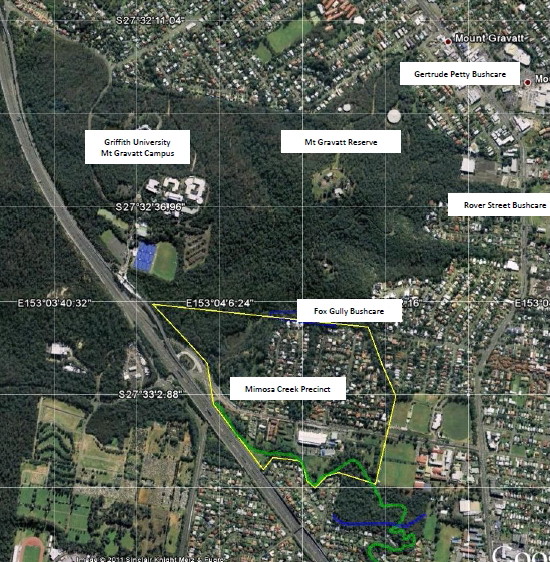
Mimosa Creek Precinct is the reach between the Pacific Motorway and Clairvaux MacKillop College, also including three potential wildlife corridors connecting with Mt Gravatt Reserve.

In developing the Mimosa Creek Precinct Landscape Plan, Mt Gravatt Environment Group aims to provide a community focused approach to environmental restoration of this important habitat with a variety of owners including BCC, Main Roads Dept, Translink, Hibiscus Sport Centre (local & state government), community organisations, schools and private owners. The term Landscape Plan comes from the excellent Birds in Backyards – Best Practice Guidelines, and is used to encompass this complex ownership mix.

Download the plan here: Mimosa Creek Precinct Landscape Plan – ver 1.6 (web) It does not take long to read: it is mostly Google Earth pictures. Appendix PDF files: Roly Chapman Bushcare Plan – ver 1.5 Fox Gully Bushcare Plan 2011 – ver 3.6 Mt Gravatt Strategic Plan – ver1.0

The environment is the key focus of this Plan, however, building and maintaining long-term financial and community commitment requires identification of business opportunities and community benefits derived from habitat restoration.

We have already identified a number of direct community benefits from implementation of the Landscape Plan. Identifying business opportunities that directly contribute to restoration of Mimosa Creek Precinct, is not as obvious. However, to quote Peter Drucker:

“Every single social and global issue of our day is a business opportunity in disguise.”

BizEd july/august 2008

Read the Fox Gully blog post Business Goes Bush in Mt Gravatt.

What community and business opportunities can you identify?

The visit by BOIC (Butterflies & Other Invertebrates Club) reported in our local Southside Community News.

Correction and apology: BOIC President’s name was incorrect. My mistake: I provided the wrong name to the journalist.

Ross Kendall of Butterfly Encounters is currently BOIC President.

Another amazing critter in our bushland: Mottled Cup Moth caterpillar Doratifera vulnerans.

I have seen capsules on trees and wondered what they are. They look just like a gum nuts in the wrong place on the tree.

Yesterday I was asked to identify two caterpillars from a local bushcare site. My bushcare colleague had a painful encounter with the stinging spines on these otherwise pretty caterpillars so I put on disposable gloves before I opened the container to photograph these strange creatures.

Butterfly expert Helen Schwenchke put me on the right track when she suggested looking up Cup Moths on the Australian caterpillar identification site. These intriguing pink yellow spiky critters are caterpillars of the Mottled Cup Moth Doratifera vulnerans.

Back to the caterpillars for a real surprise. One had carefully stripped a piece of the eucalypt branch and started spinning silky threads: it was building it chrysalis while I watched!

This process took about 70 minutes with the caterpillar curled tight and completely covered in silk thread.

By  morning the chrysalis had hardened, shrunk to less than half the size and created this capsule that looks just like the gum nuts of the eucalypt trees the caterpillars feed on. See the picture at the top: the chrysalis is the one on the right.

Do you want to help clean up the home of these unique creatures? Register for Summit Cleanup on Sunday 6th March.