Photography


By: Michael Foximg272

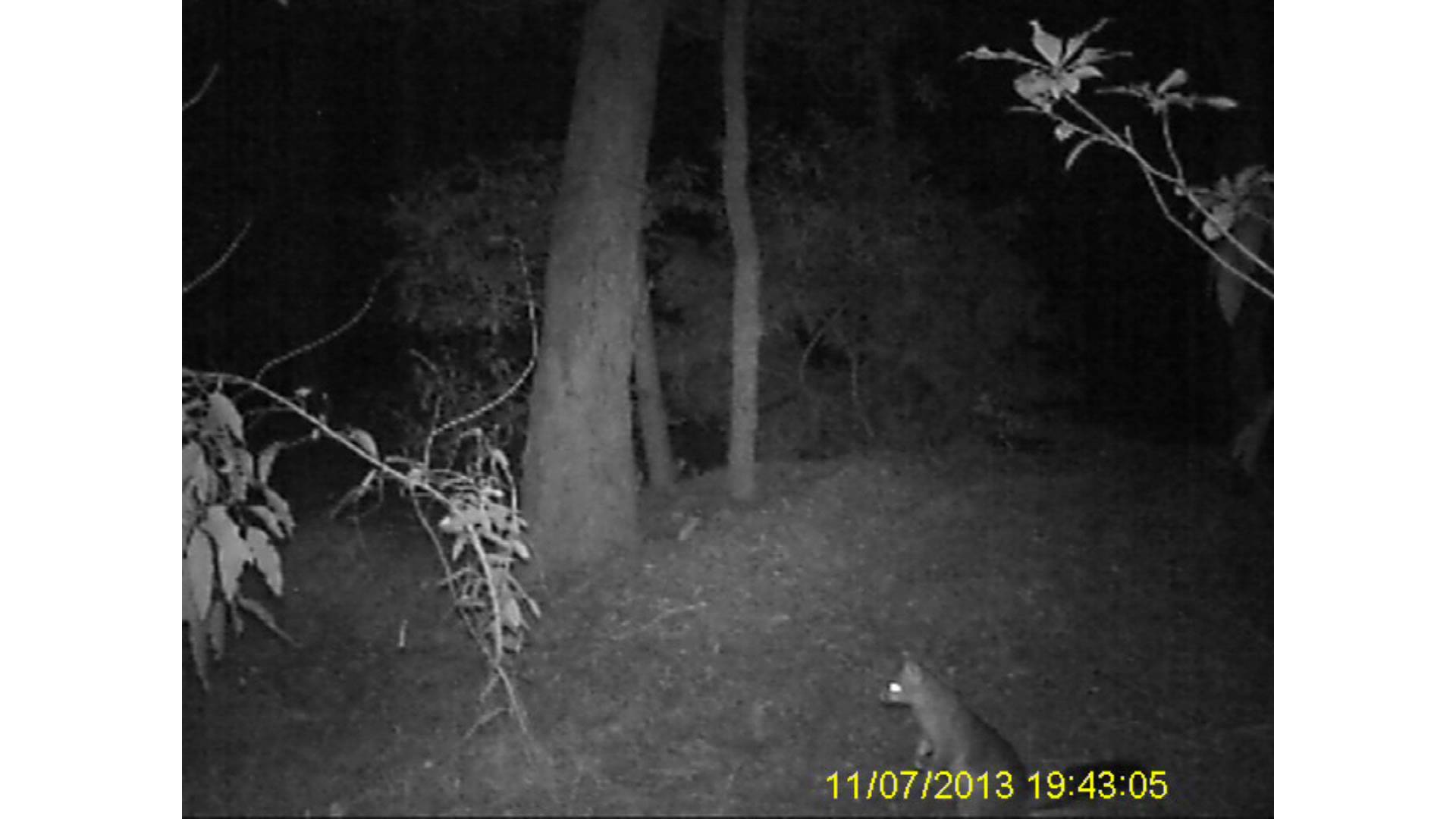
Aldi have bought back their excellent, and at $129 excellent value, Maginon wildlife cameras. If you want one be quick because they will sell out fast.

We have been using two of an older version of these cameras for a couple of years now with excellent results. This new one is of course better with higher resolution video and sound recording. Sound recording would be great at the moment when we are capturing video of the very shy Noisy Pitta living in Firefly Gully. Marshal can hear its call but our camera does not handle sound.

The only issue we have found with these cameras is the intensity of the infrared leds used for video. I have fixed this with masking tape covering two thirds of the leds to reduce the intensity and make the camera less noticeable to our Squirrel Gliders.

See some samples:

Noisy Pitta – day time in colour

Koala at night

Squirrel Gliders at night

Oxalis chnoodes 4 - 3 July 2014 - Alan Moore

Hairy Oxalis Oxalis chnoodes – photo: Alan Moore

By: Michael Fox

I am currently checking and uploading our research Flora & Fauna of Mt Gravatt Conservation Reserve. Keep checking for updates.

Botanist, Ann Moran, has generously checked our first couple of files and we gained another native species bringing our count to 270 native plant species in the Reserve.

Oxalis chnoodes 1 - 3 July 2014 - Alan Moore

Hairy Oxalis Oxalis chnoodes – photo: Alan Moore

I had photographed and identified what I thought was Creeping Oxalis Oxalis corniculata, a weed. Ann took one look at my photos and said that is the native herb, Hairy Oxalis Oxalis chnoodes.

Hairy Oxalis? When I had a close look I found the leaves of our local plant are very hairy. To be able to show this curious plant to community members we needed some real close-up pics … time to call in Alan Moore our local photography guru.


Orchard Swallowtail - Male - Apr10

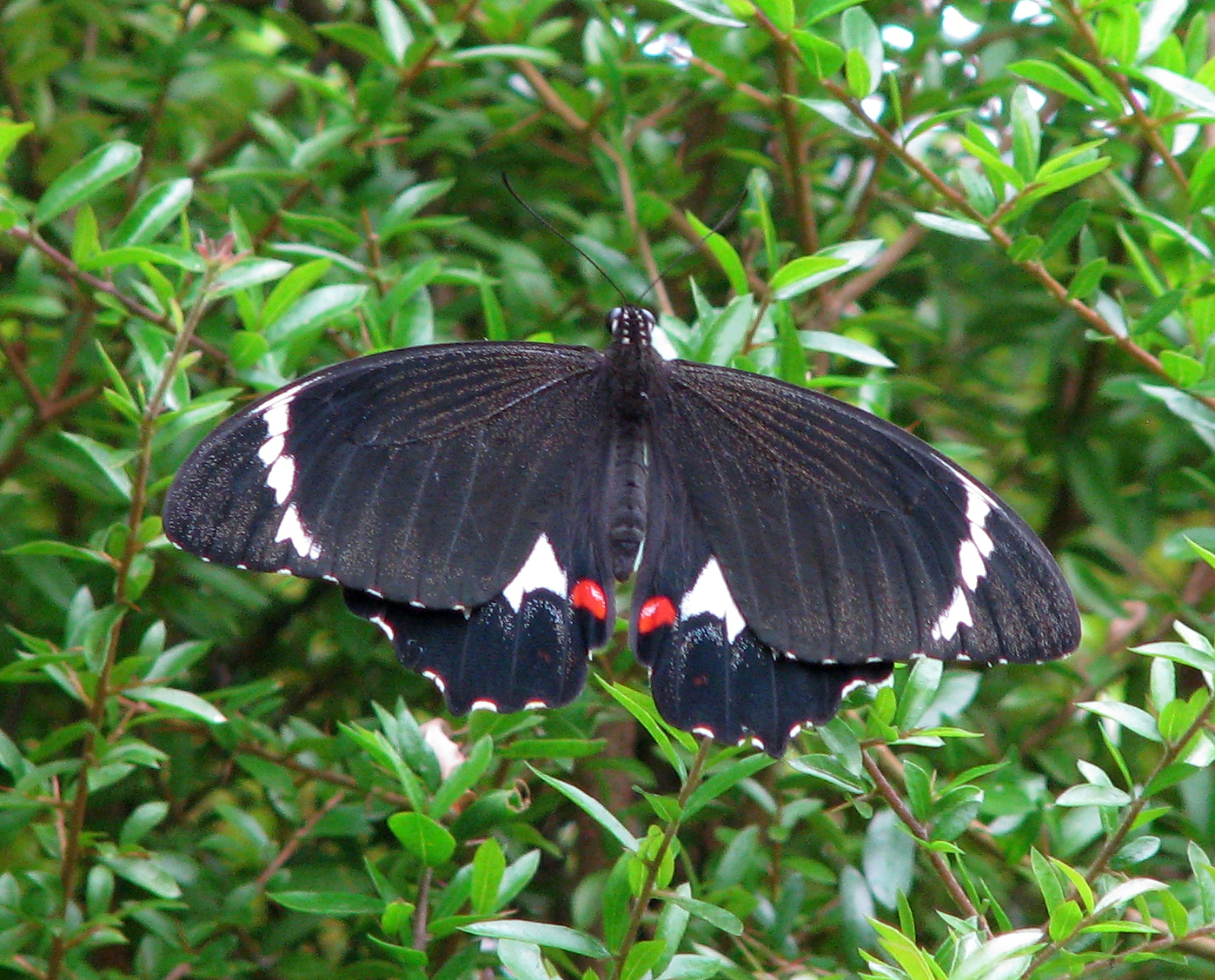
Orchard Swallowtail – Male

By: Michael Fox

Forty-six butterfly species are found in Mt Gravatt Conservation Reserve with a wide range of colours, sizes and behaviour.

I have been aware, for some time, of the different colours of the male and female Orchard Swallowtail Papilio aegeus.

Orchard Swallowtail - Nov 08

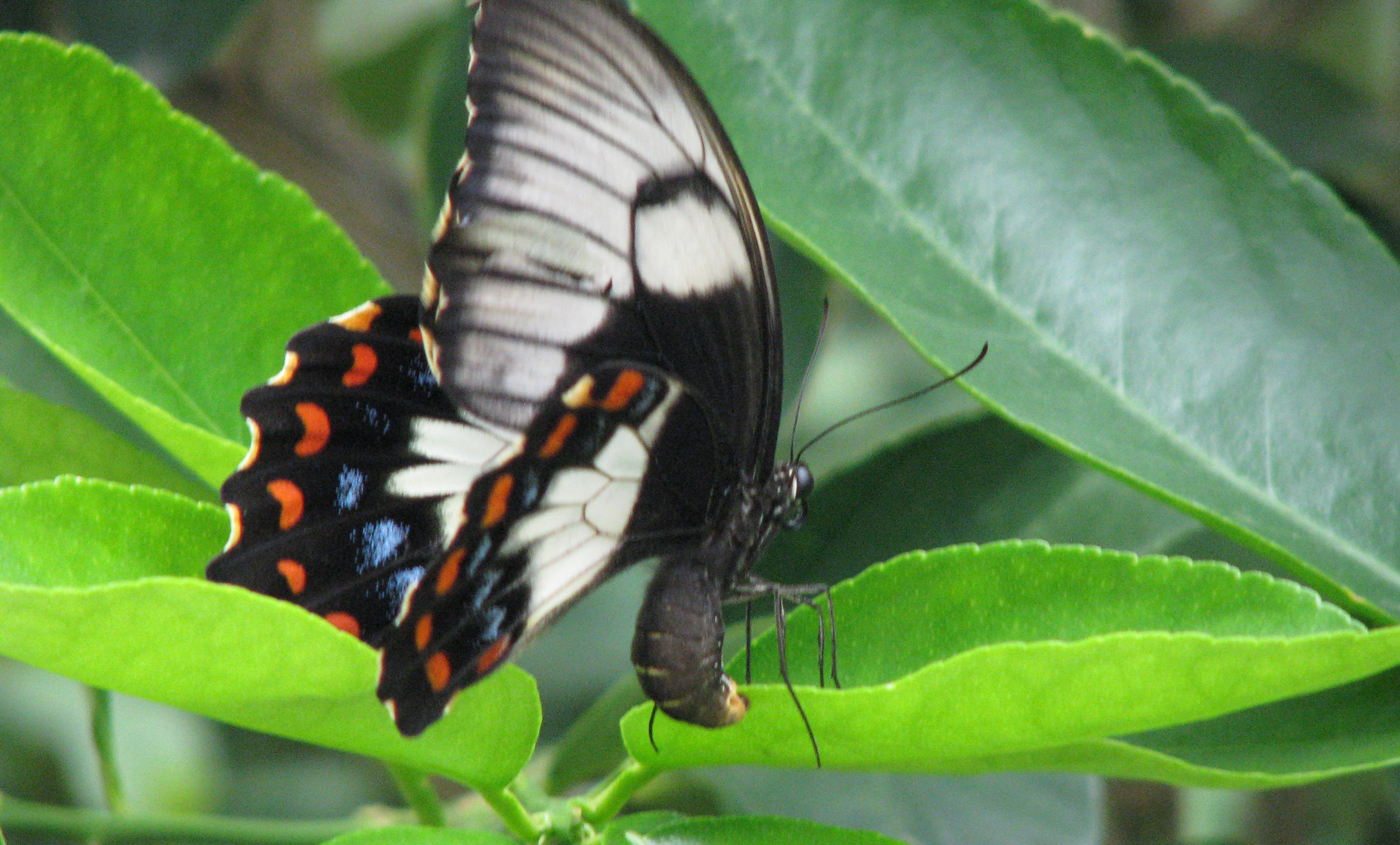
Orchard Swallowtail – Female – laying eggs on lemon tree

Orchard Swallowtail butterflies are large  (male 102mm/female 108mm). However, the females are definitely the most attractive to see flitting around your citrus trees.

These beautiful butterflies are a wonderful addition to any backyard, so if you see some strange caterpillars on your citrus trees please check before you pull out the pest spray. The Orchard caterpillars will do very little damage to your trees before they metamorphosise into beautiful colourful butterflies.

Blue Tiger - male - 17 Oct 10

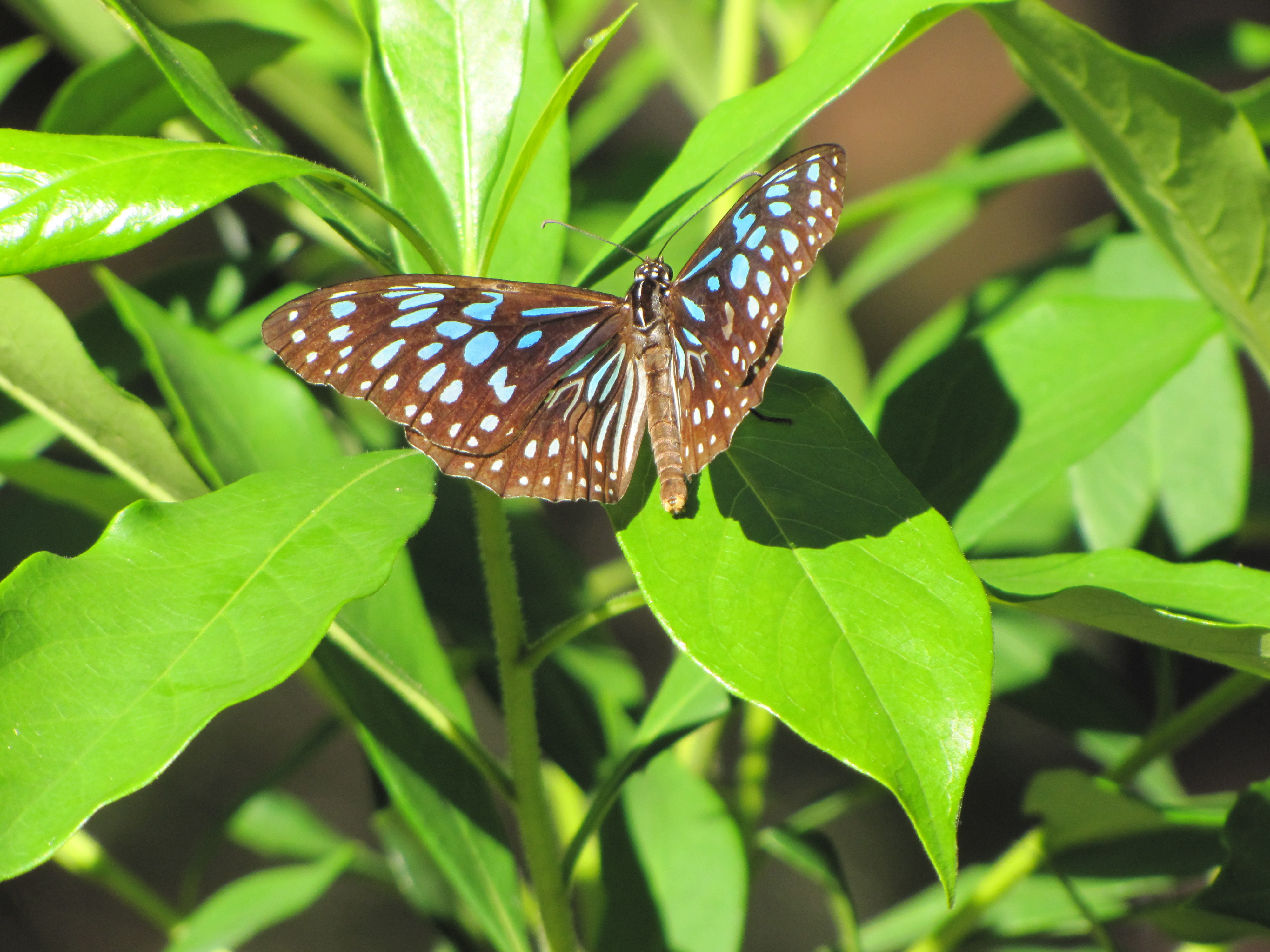
Blue Tiger – male – on Parsonsia leaf

.

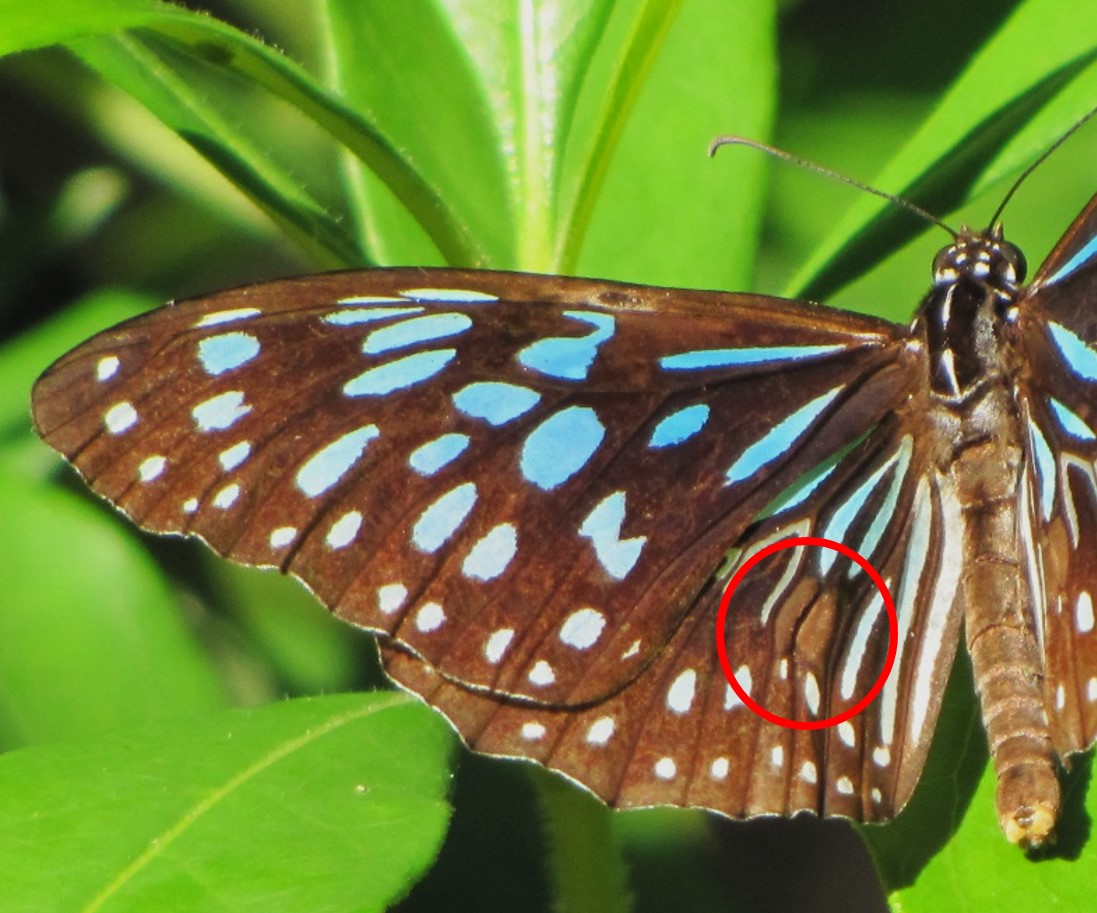
Identifying the sex of Blue Tiger Tirumala hamata butterflies is more difficult. It took a chance comment from Helen Schwencke, Earthling Enterprises, to make me even think to look for a way to identify males vs females. I had sent Helen a picture of a Blue Tiger in the winter sunlight. Helen emailed back commenting that the “male” butterfly would be collecting alkaloids from the Parsonsia leaf to make him more attractive to females.

Blue Tiger - female - 24 Aug 2013

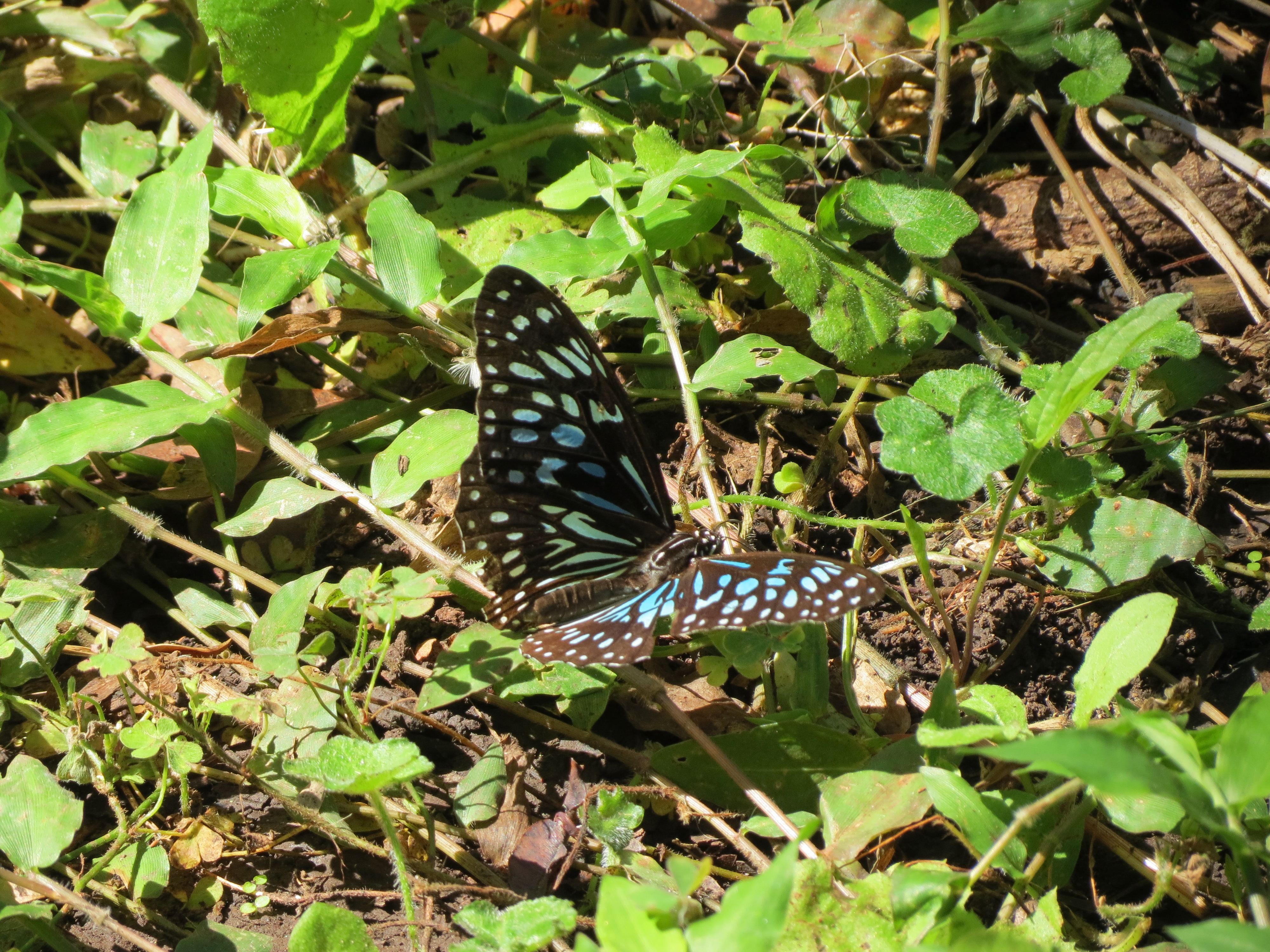
Blue Tiger – female

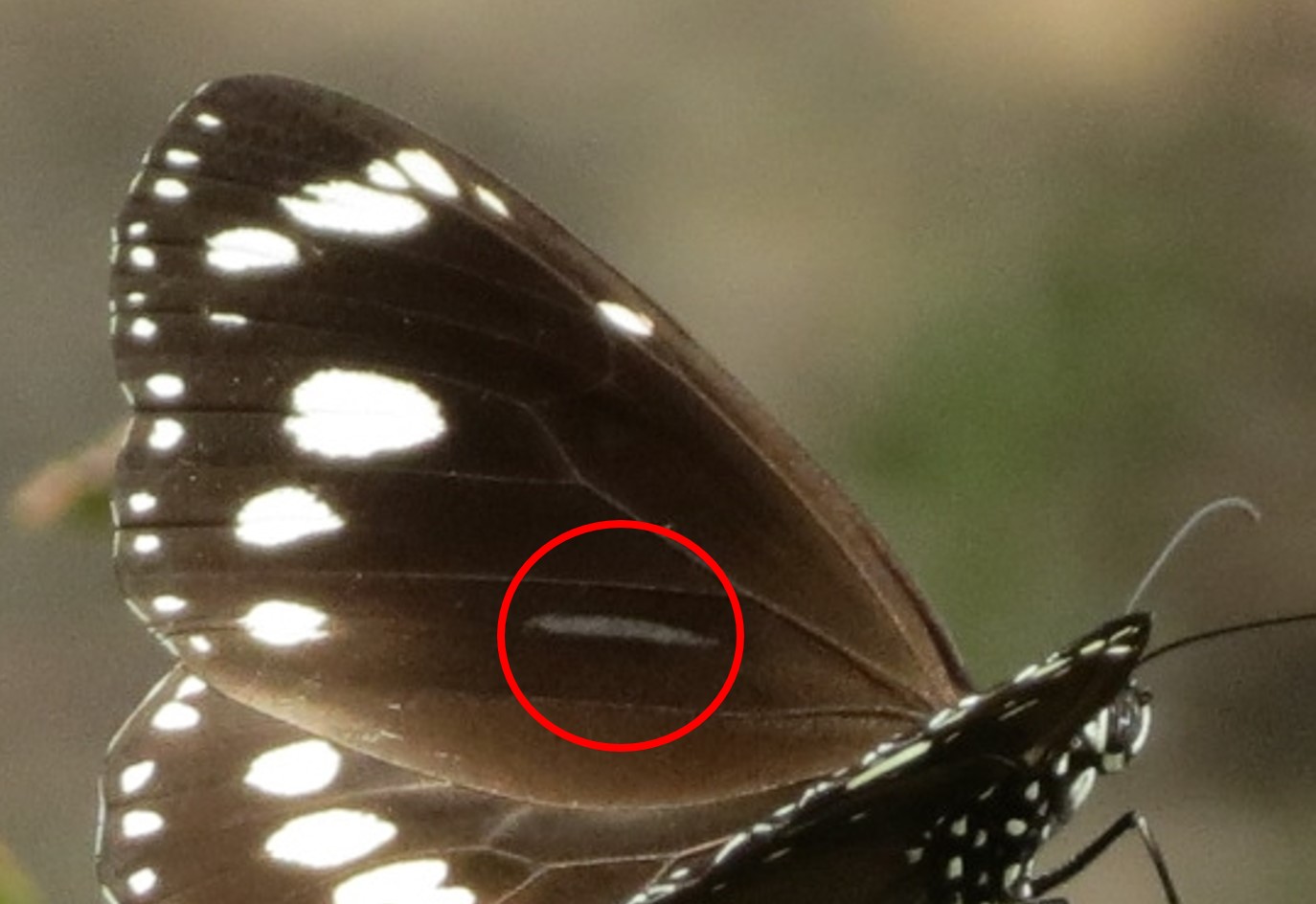
Female Blue Tigers have a very similar patten of colours on their wings. When I asked how Helen identified a male butterfly just from a photo, she introduced me to butterfly “sex brands” which can be found on a number of butterfly species including Blue Tigers and Common Crows.

.

.

Blue Tiger sex brand

Blue Tiger male sex brands circled

.

.

The Blue Tiger males have distinctive sex brands on the hind wing.

.

.

.

.

.

.

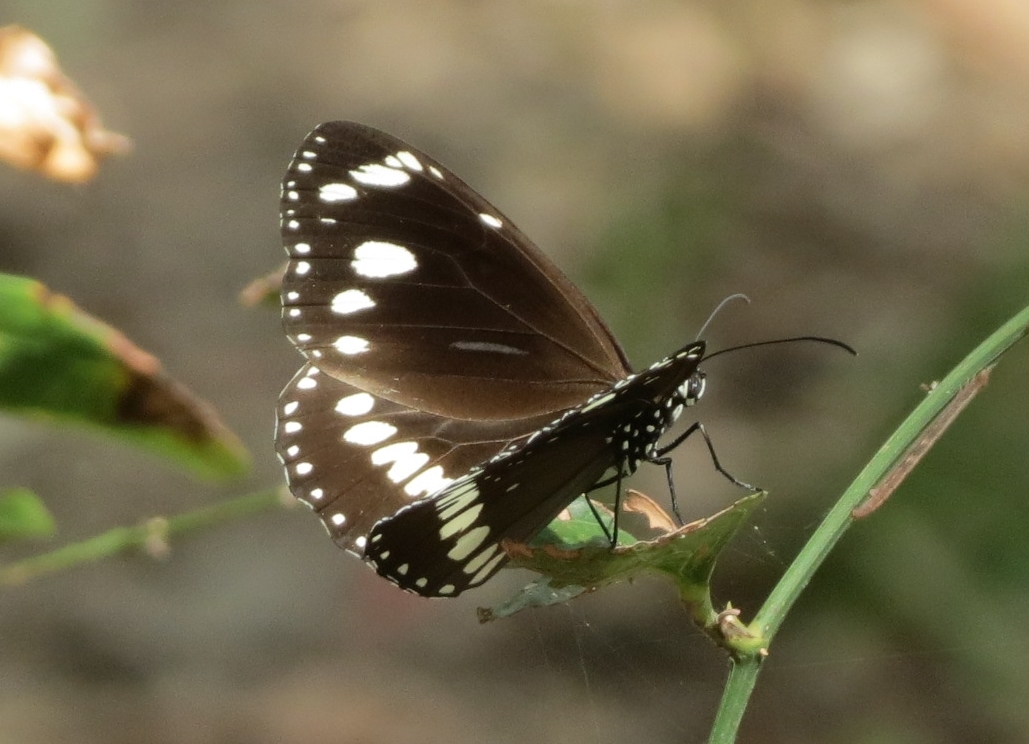
Common Crow - male - 10 Feb 2014 - on barbed wire vine

Common Crow – male.

.

Common Crow - male - sex brand

Common Crow – male – sex brand

The Common Crow Euploea core male has a sex brand on the fore wing.

Now that I am aware of sex brands I will have to ensure all my photographs of mountain butterflies include this information.


.


IMG_6834

Mother of Ducks Lagoon

By: Michael Fox

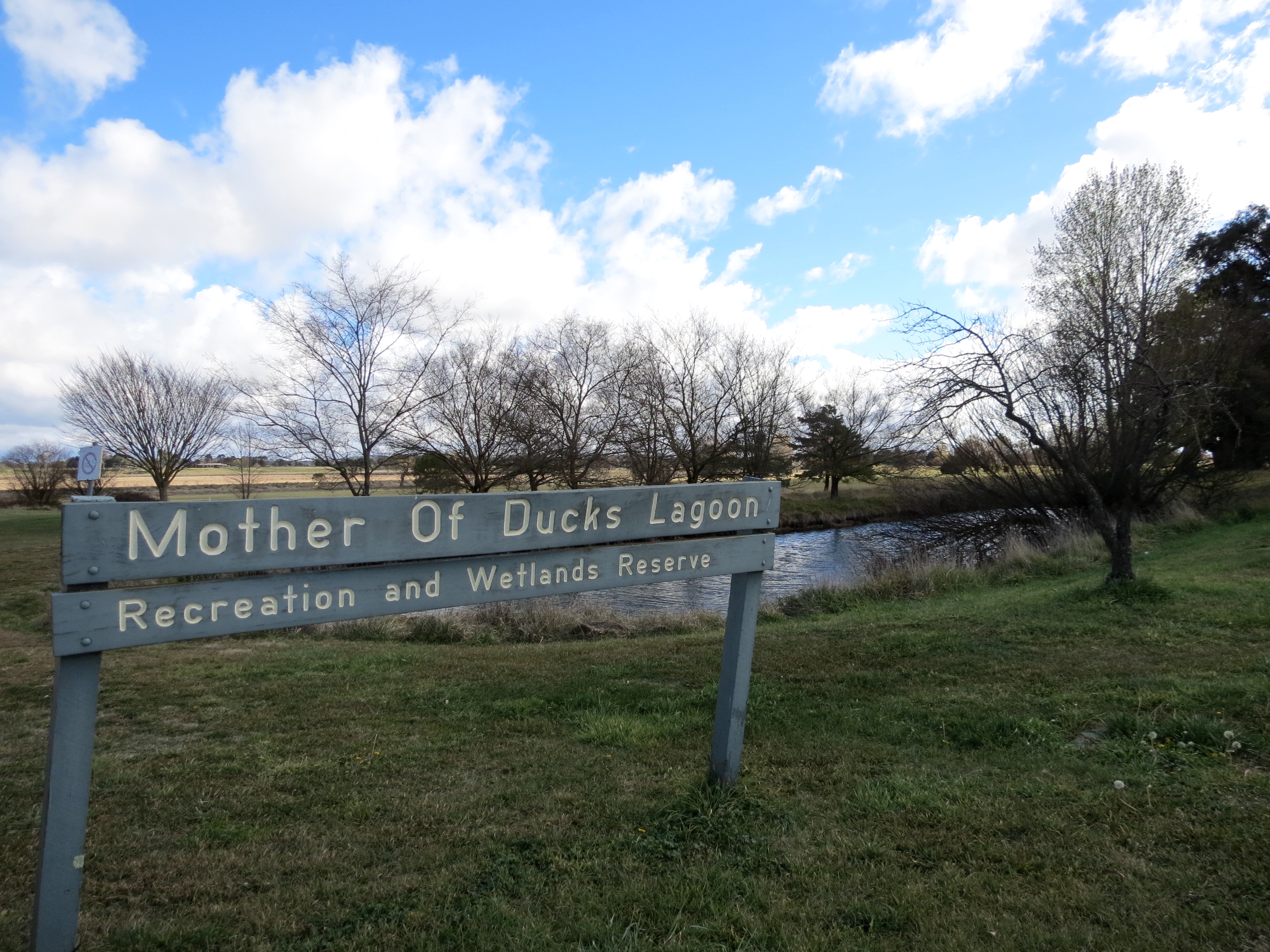
Traveling  back from Armidale, NSW last week we stopped at the Mother of Ducks Lagoon in Guyra.

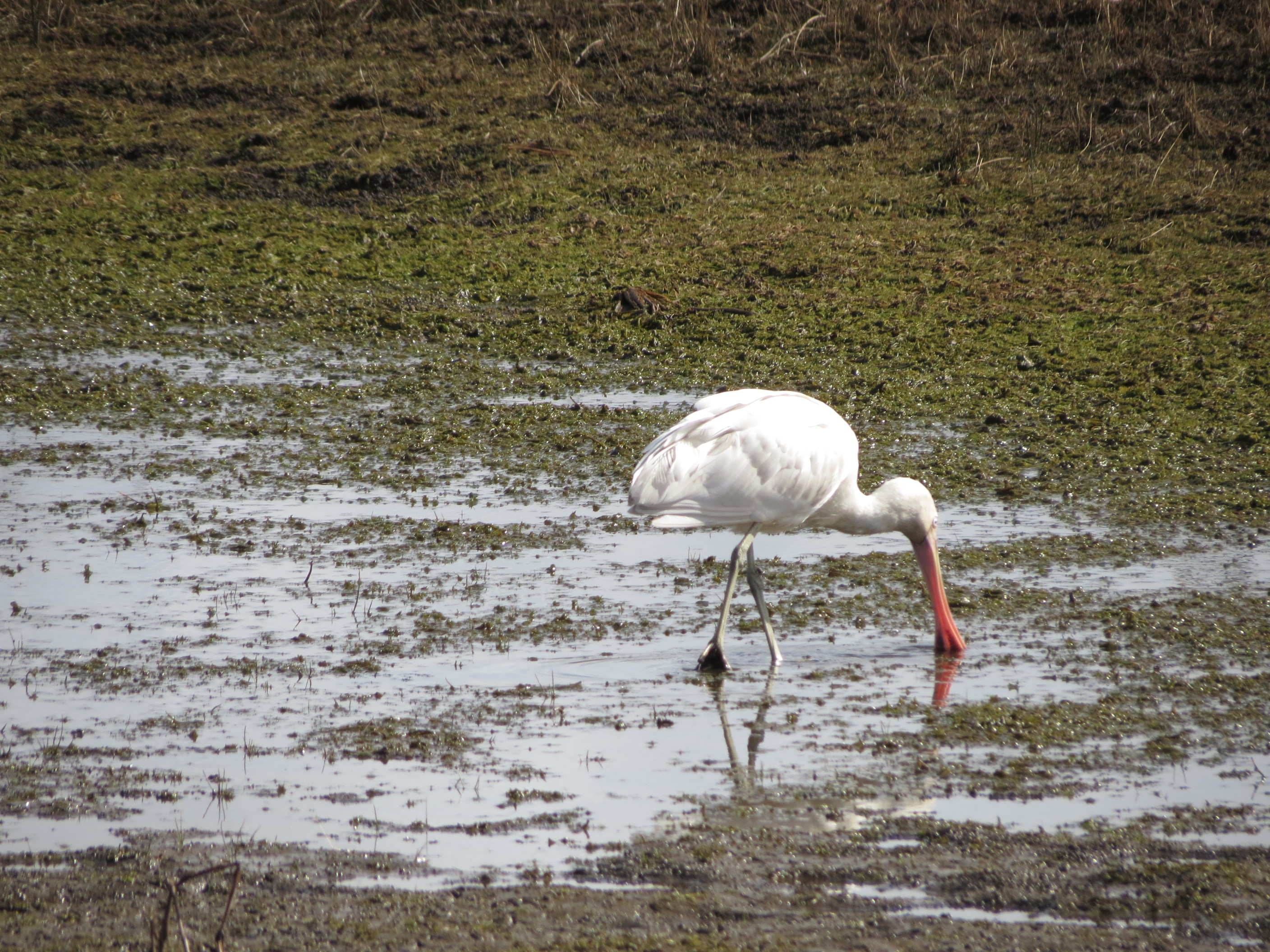
Yellow-billed Spoonbill - Gurya - 20 June 2014

Yellow-billed Spoonbill Platalea flavipes

White-winged Choughs Corcorax melanorhamphos

Mother of Ducks Lagoon (McKie Drive)
One of Guyra’s most important landmarks in Guyra is the Mother of Ducks Lagoon which is a large stretch of water 14kms in circumference, held in a silted volcanic crater.

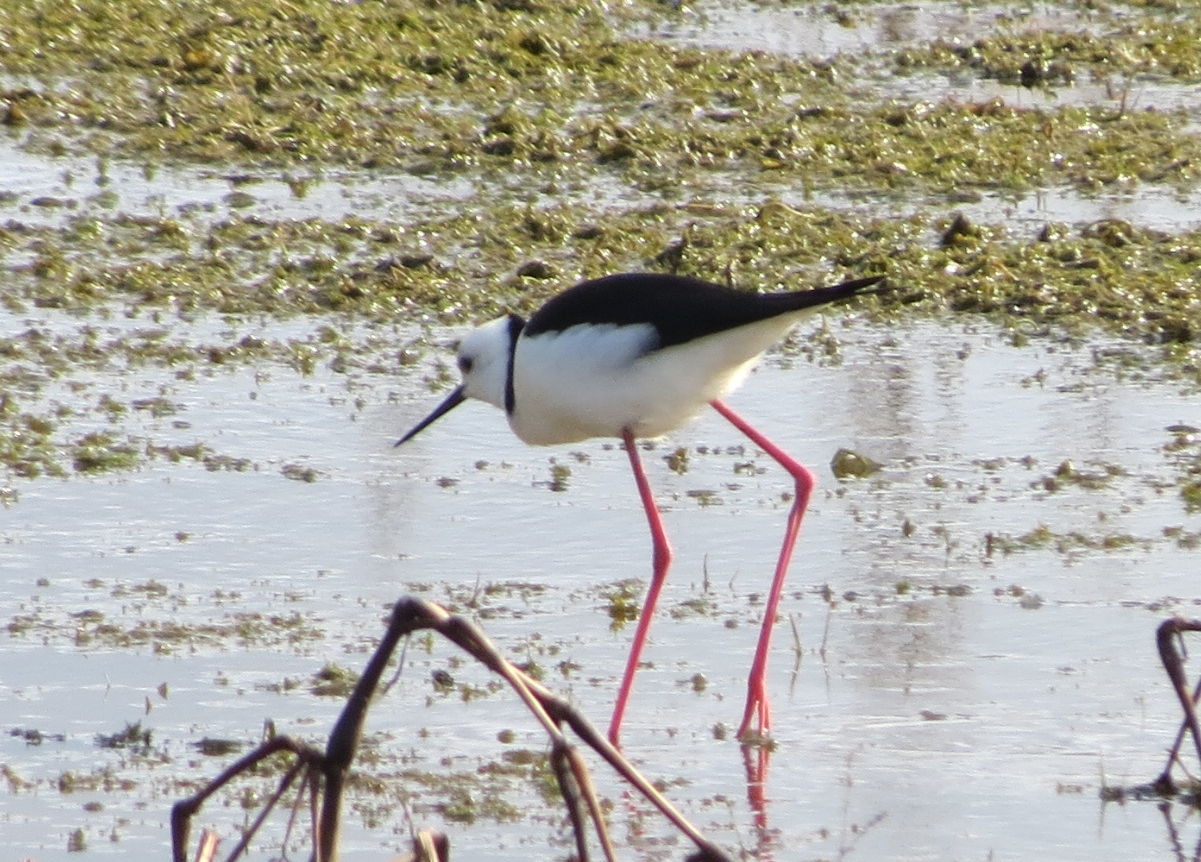
Black-winged Stilt - 20 June 2014

Black-winged Stilt Himantopus himantopus

Once a magnificent body of water large enough for boating, the lagoon has been drained for agricultural and other purposes since the turn of the century. The lagoon was partially restored as Guyra’s Bicentennial project and is once again home to a wide range of aquatic birds. Nests of black swans and a host of other water birds can be seen from the viewing platform or by walking around the bank of the reserve area.

The golf course follows its contours and the two meld comfortably into the unique landscape of Guyra. Picnic tables and toilet facilities are available next to the entrance and information stand. The lagoon is the source of Sandy/Laura creek which is known for its trout fishing.”

White-faced Heron - 20 June 2014

White-faced Heron Egretta novaehollandiae

Guyra Online

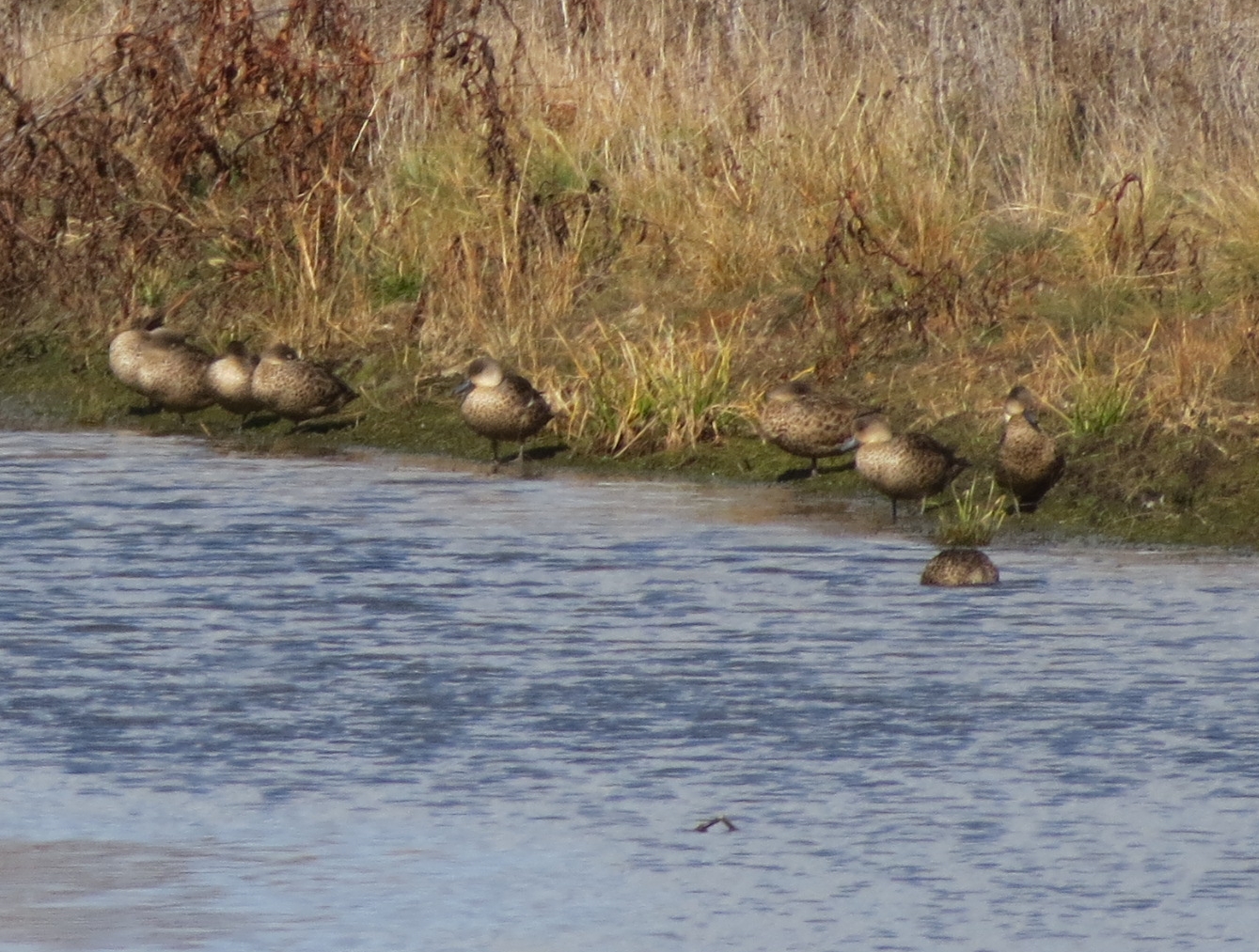
We only stopped for fifteen minutes and in that time saw a flight of what we think were White-winged Choughs Corcorax melanorhamphosIt was fascinating to watch the flock wheel over then settle in waves. We were also visited by a Yellow-billed Spoonbill Platalea flavipesBlack-winged Stilts Himantopus himantopus, White-faced Heron Egretta novaehollandiae and Grey Teal Anas gracilis.

A great spot to stop for a picnic or afternoon tea. Only a couple of minutes  off the highway but a peaceful world away from traffic and trucks.

Grey Teal - Mother of Ducks Lagoon - 20 June 2014

Grey Teal Anas gracilis

IMG_6358a

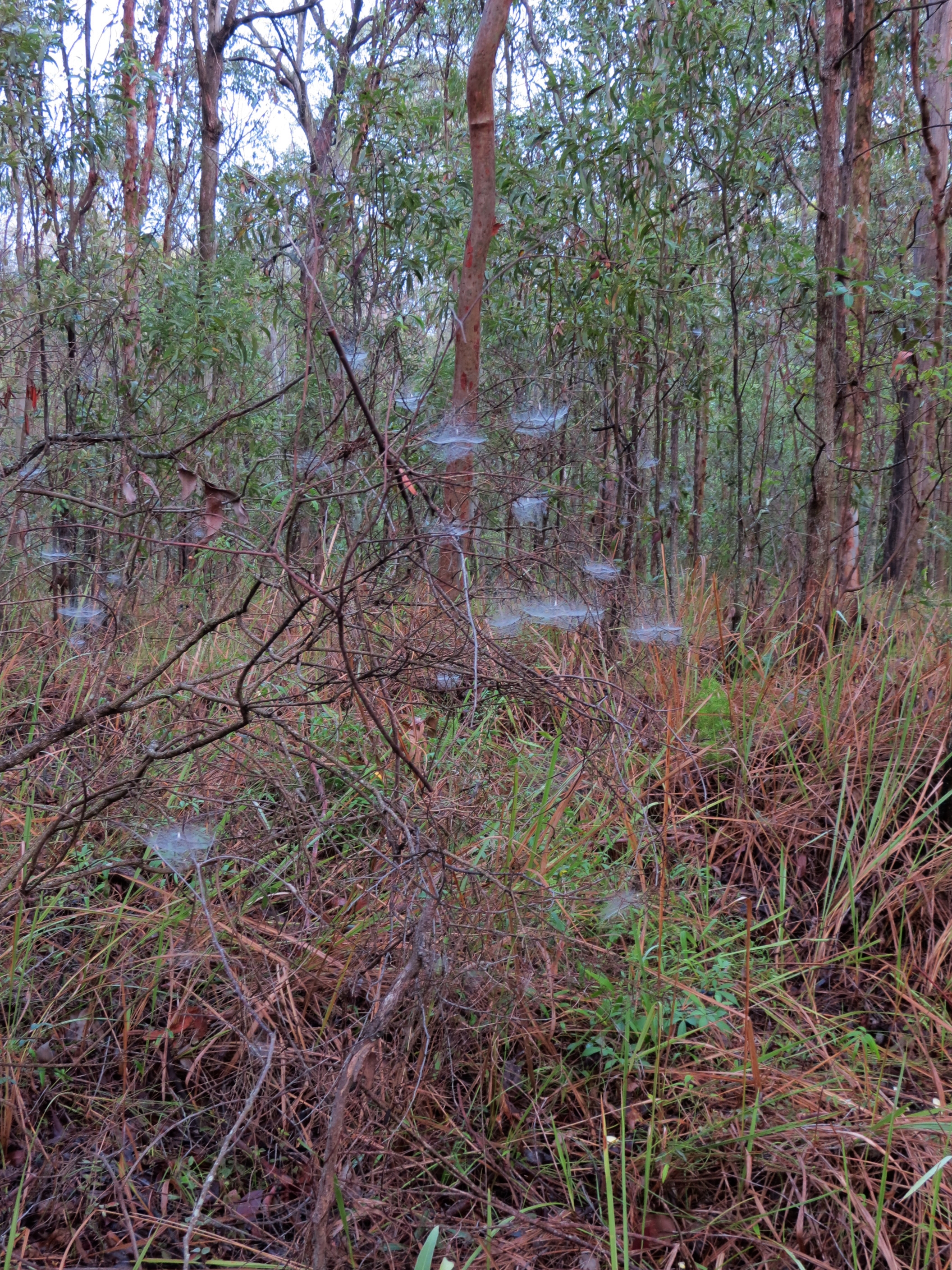
Tent spider webs covered in morning dew Photo: J. Fox

By: Michael Fox

I have spent thousands of hours walking and working in Mt Gravatt Conservation Reserve and I am still seeing things I have never noticed before. The misty mornings air this morning showed dozens of small tent spider webs in communities in the shrubs. The moisture on the webs this morning made for great photography. When I just checked this afternoon these webs are all but invisible.

d

d

d

d

Dome Tent Spider - 29 March 2014

Dome Tent Spider web Photo: J. Fox

d

d

d

I could not find any spiders to photograph however these webs are almost certainly made by Dome Tent Spiders Cyrtophora moluccensis which I have found in the Reserve. This larger web shows the amazing structure with a collection of something, possibly eggs, at the peak.

d

d

d

Dome Tent Spider - close - 29 March 2014

Close up of Tent Spider Web Photo: J. Fox

d

d

d

d

A close up photo shows the neat matrix of thread and the tension cables holding the shape just like a circus bigtop.

d

d

d

d

d

Cyrtophora moluccensis - Jan10

Dome Tent Spider – Photo: M. Fox

d

d

d

Dome Tent Spider I photographed at Mt Gravatt Campus in 2010.

d

Garden Orb Weaver web - 29 March 2014

Garden Orb Weaver web Photo: J. Fox

d

 d

d

d

d

d

We also found this huge beautifully made web, of the Garden Orb Weaver Eriophora transmarina, stretched out between two trees. Another Garden Orb web had stretched right across the track earlier in the week but without the dew droplets it was virtually invisible and didn’t survive as I walked straight into it.

d

d

Gardern Orb Weaver - 29 March 2014

Garden Orb Weaver Photo: M.Fox

d

d

d

d

d

Garden Orb Weaver females build these huge webs as night and usually consume them again in the morning before hiding in a retreat of leaves and twigs. So it was a bit of a surprise to not only find the web still in place this afternoon but also find the owner sitting in the centre. The web had also caught dozens of flying ants during the day.

d

Spider web - 29 March 2014

Mysterious web on ground Photo: M. Fox

d

d

d

d

Another first for me is finding a large number of these webs on the ground which must be there everyday but only noticeable with the heavy dew. These webs are very fine with multiple layers which makes them look like very fine muslin fabric.

d

d

d

Spider web - hole - 29 March 2014

Entry hole in web Photo: M. Fox

d

d

d

I was not able to get a photo of the tiny spiders living in these webs as they quickly disappeared into the hole built into each web.

Any ideas on what spider species makes these fascinating webs?


Grey Huntsman egg sac - 25 March 2014

Grey Huntsman egg sac – Photo: A Moore

By: Michael Fox

“What is this white thing that looks like a tea bag” Alan asked, leading me to a dead tree beside the Farm Fire Trail through Fox Gully Bushcare.

The “tea bag” is actually an egg sac of a Grey Huntsman Spider Heteropoda immanis.

d

d

d

d

d

d

Holconia immanis - Feb10

Grey Huntsman Heteropoda immanis

d

d

d

d

A fearsome looking creature these spiders can inflict a painful but not poisonous bite. Generally timid the females will strongly maternal and will protect egg sac. http://www.arachne.org.au

d

d

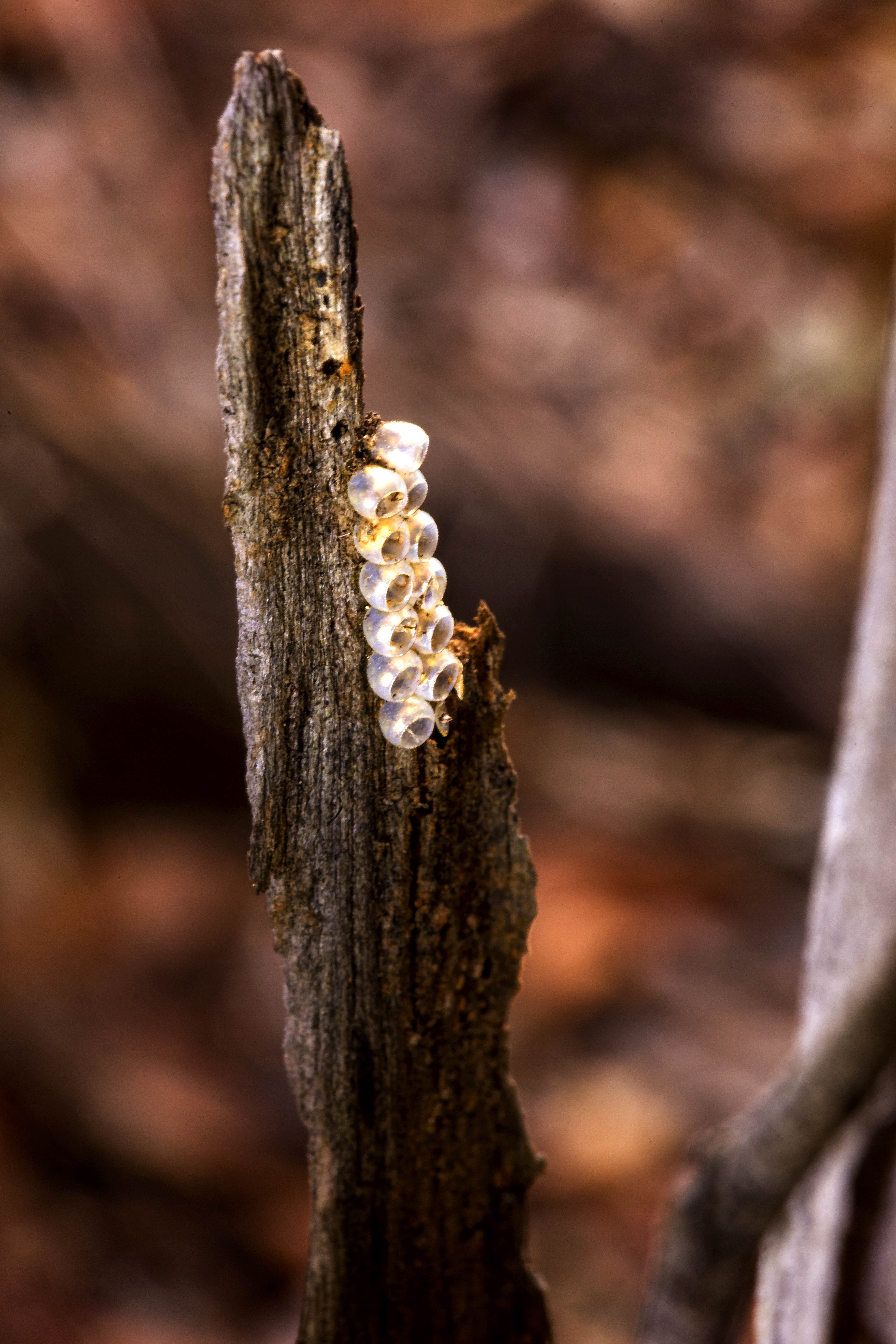
Common Gum Tree Shield Bug - egg capsules - 24 March 2014

Egg capsules – Photo: A. Moore

d

d

d

Having found the spider eggs Alan explored the dead tree to see what else is living in this unexpected habitat. Macro photography of empty egg capsules show that the tree is also home to shield bugs, probably the Common Gum Tree Shield Bug.

We tend to assume a dead tree, or stag, is only useful for firewood. Alan’s photos show that this “dead” habitat is still alive with species that depend on it for breeding.

d

d

d

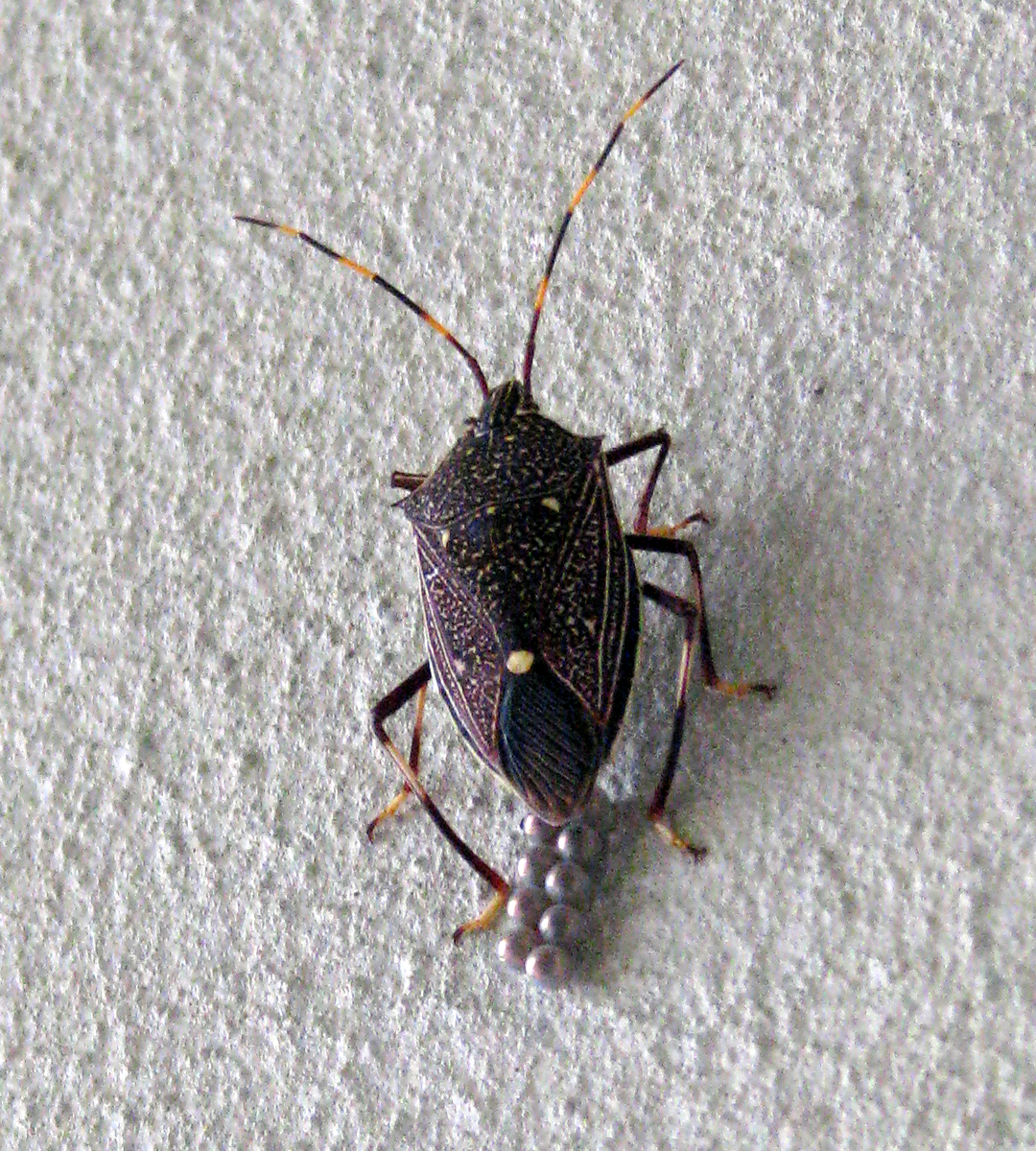
Poecilometis patruelis - eggs - Jan10

Common Gum Tree Shield Bug

d

d

I have photographed this Common Gum Tree Shield Bug Poecilometis patruelis laying her eggs in 2010.

d

d

d

d

d

d

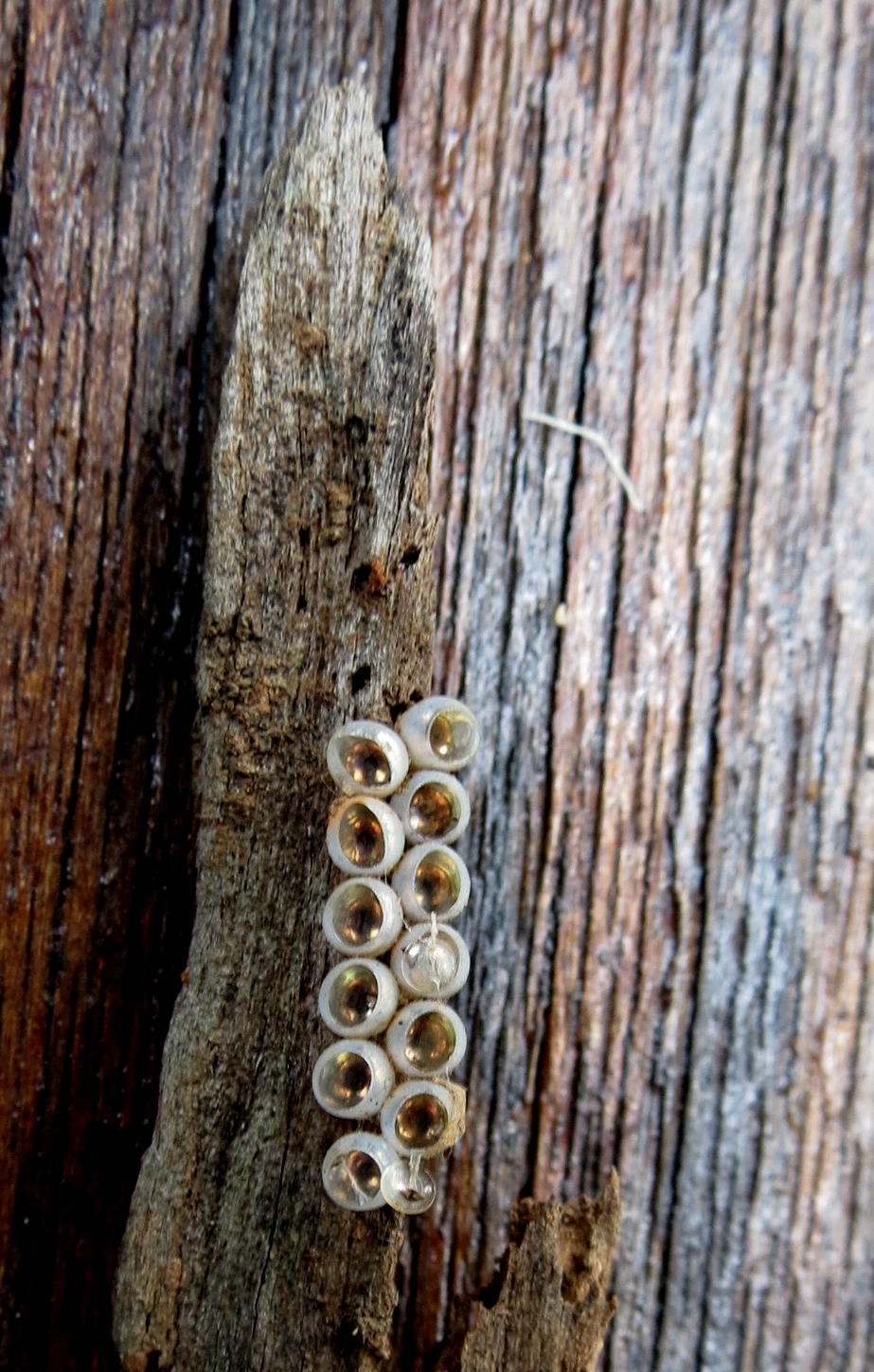
Common Gum Tree Shield Bug Egg sacs close - 25 Mar 2014

Perfectly formed egg capsule lids

d

d

Zooming in even closer we can see that these neat capsules also have perfectly formed lids that pop off as the bugs hatch out. Click on photo to expand and look at bottom right capsule.

d

d

d

d

d

Lacewing eggs - A. Moore - 25 March 2014

Lacewing eggs – Photo: A. Moore

d

d

d

d

d

Alan was also fascinated by the hundreds of tiny mushrooms growing on the tree. However, when I received Alan’s macro picture I realised these were Lacewing eggs each one mounted on an individual thin stalk.


IMG_4362

Alan “Photography lighting doesn’t have to be expensive.”

By: Michael Fox

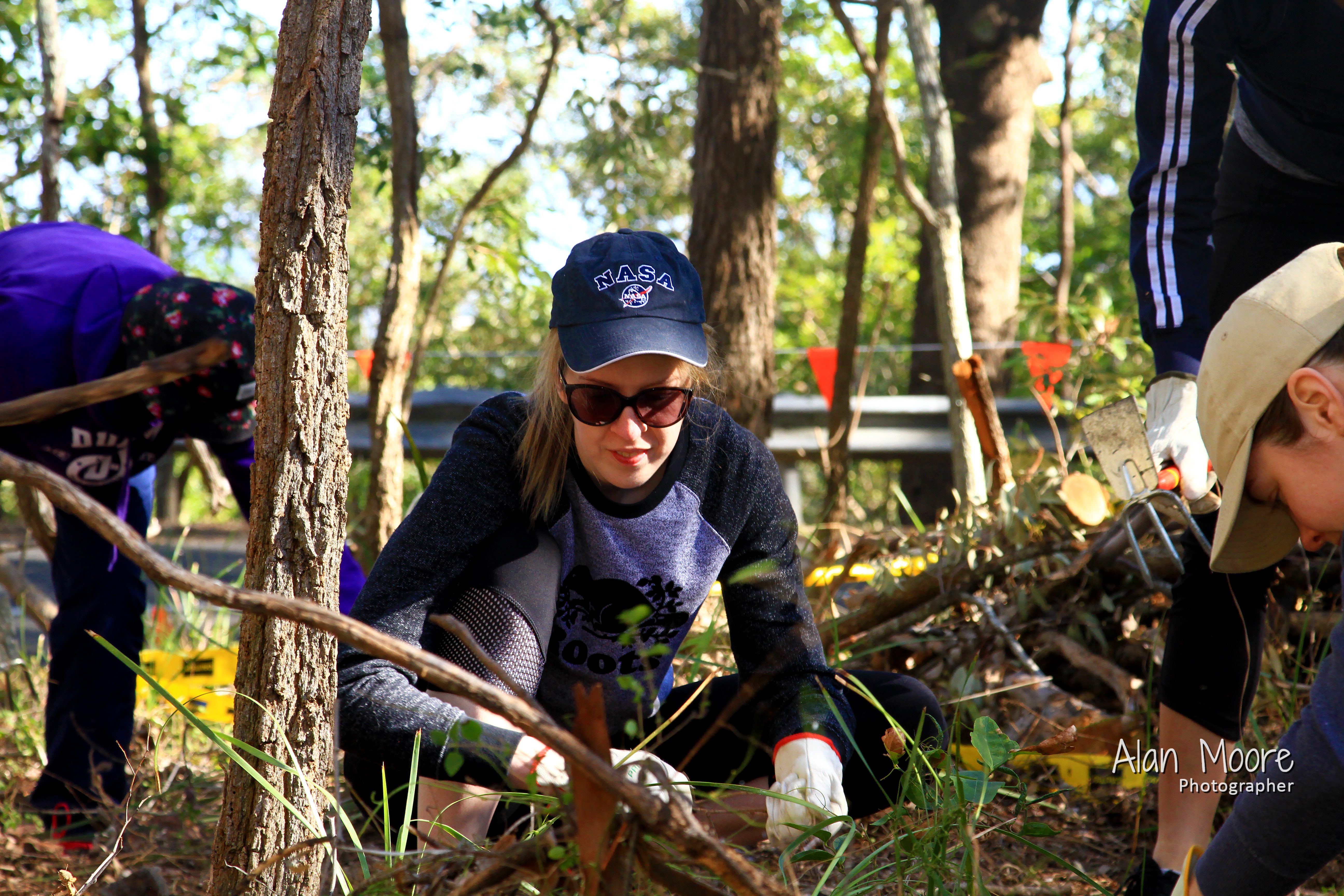
Alan Moore led our annual Photography Workshop again this year with seventeen participants learning to use their camera, differences between landscape and macro photography and even tips on low cost recycled photography lighting tools like this simple cardboard and aluminum foil reflector for macro photography.

The workshop venue was the Fox Gully Bushcare site with the marque set-up among the trees for a real photography in the bush experience. After learning the basics participants were sent on assignment to practice their skills. Over lunch Alan critiqued a selection of photos from each participant giving feedback on lighting, focus and composition. Read Alan’s review.

IMG_4382

Bush fashion in the bush

After lunch, a new feature of this year’s workshop was fashion shoot the inspiration of our our Co-President, Laurie Deacon. Alan presented the basics of photographing people before participants were again sent on assignment into the bush, this time for a fashion shoot.

d

IMG_4389

Fashion and nature

ng

d

The bush themed fashions, creations of Jolanta Szymczyk, had just been featured in a fashion parade at the Ekka. The models, Liliana, Georgina, Diana and Maria generously gave their afternoon to model Jolanta’s fashions and Alan organised lighting in the most unlikely venue.

Congratulations to all participants for the amazing photography and Alan, Jolanta, Liliana, Georgina, Diana and Maria for your generous support.


IMG_8873

November 2011

By: Michael Fox

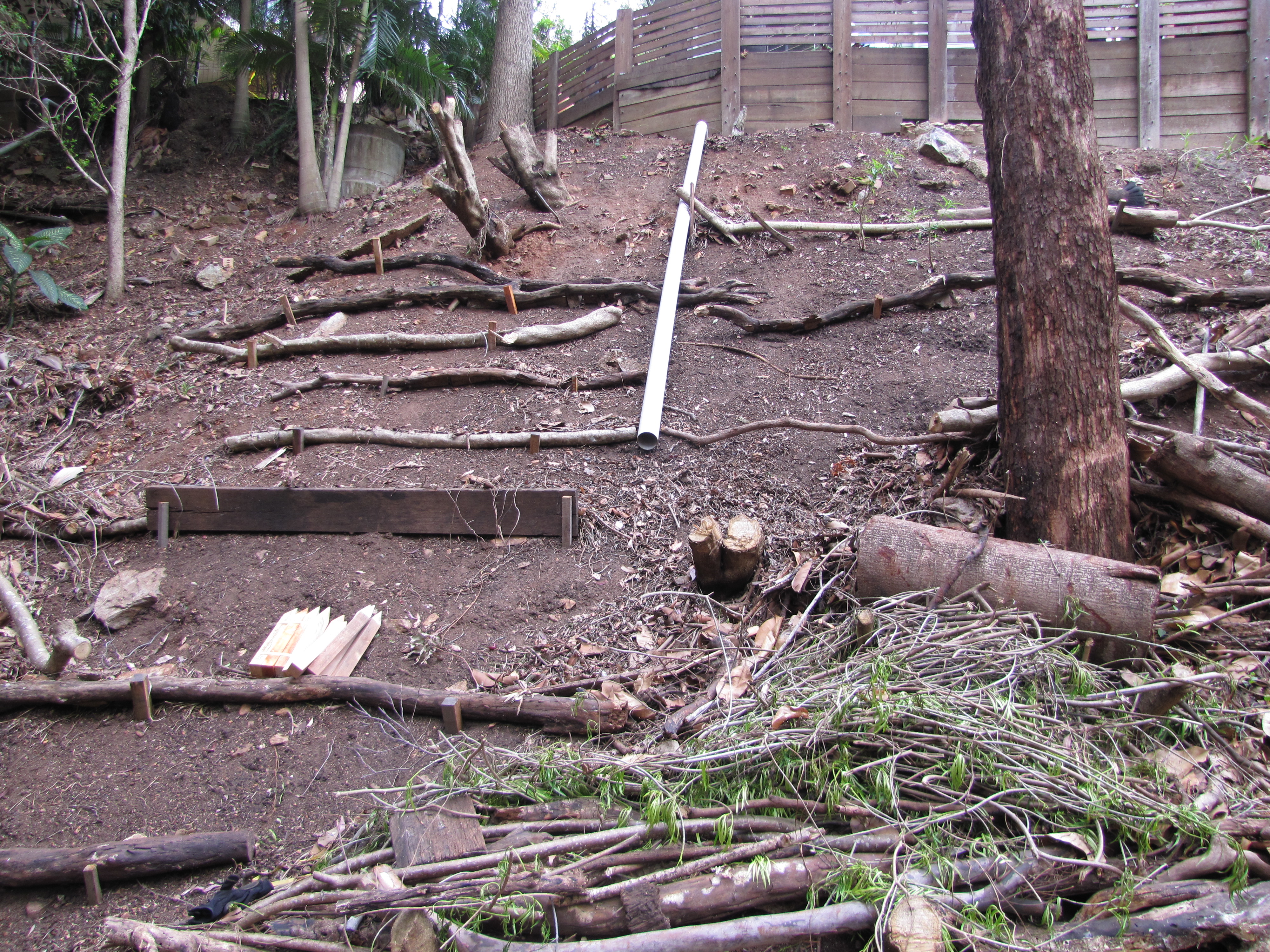
2011 Our first Community Gully Day, two years ago, saw the removal of six cubic metres of rubbish, poisonous Yellow Oleander Thevetia peruviana and Madeira Vine Anredera cordifolia, stabilised the banks with logs leaving the ground bare and storm water pipes a visual blight.
IMG_0872

November 2012

d

d

d

d

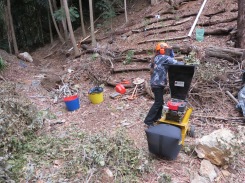
2012 Between Gully Days restoration work continues with regular Tuesday Bushcare events. Mirandha, Griffith University Bushcare Club, feeds Chinese Elm branches into out chipper.
IMG_4190

August 2013

d

d

d

d

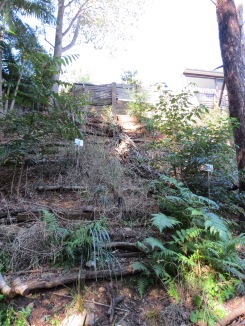
Coin-spot Treeferns Cyathea cooperi are thriving, bush foods like Native Mulberry Pipturus argenteus will growing and the storm water pipes are disappearing under branches creating ideal habitat for lizards and improving visual amenity.

d

d

Living mulch - 11 Aug 2013

Living Mulch reducing erosion and creating mico-habitat

d

d

d

d

d

d

d

2013 8am The team getting to work, Scott, Barry, Carol, Don and Marshal in background, with Matt and myself delivering hollow logs for habitat.

IMG_1048

November 2012

Note the amazing mico-habitat created by the Living Mulch of native grasses – Rainforest Grass Oplismenus aemulus, Graceful Grass Ottochloa gracillima, and self-sown herbs like Native Hawksbeard Youngia japonica.

Even without the tree cover this area was several degrees cooler than the area just a little down the gully.

d
Marshal Carol Scott removing weeds - 11 Aug 2013

Clearing weed regrowth

d

d

d

d

A huge change from November 2012 when the gully was still bare.

d

d
Madeira Vine tuba - 5 Mar 13

Madeira Vine tuba removed from gully

d

d

d

d

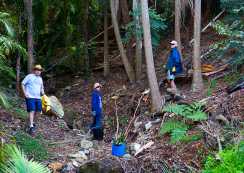
8:30am Scott, Carol and Marshal have been busy clearing Mother-in-law’s Tongue Sansevieria trifasciata and Madeira Vine regrowth.

Matt Mike hollow log (low) - 11 Aug 2013

Matt and I install habitat log

Matt Russ Shawn placing logs 2 - 11 Aug 2013

Matt, Russ and Shawn positioning logs

d

d

d

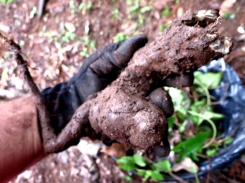
Eradicating Madeira Vine in the gully is a long term project. The most effective removal approach for this fast growing invasive weed is simply digging out and immediately bagging the tubers. Madeira produced hundreds of tubers along the vine. Those tubers are viable for a long time and sprout like potatoes when they land in a suitable environment. The size of these tubers mean that using poison is often not an effective particularly in a vulnerable water course.

d

d

9am Matt and I install one of the hollow logs donated by Scott at Tree Bracers (eco-friendly) Tree Removal Specialists.  Scott contacted me asking if we could use the logs as he did not want to simply chip this valuable habitat resource. Roger Medland and I collected the logs in Rogers ute.
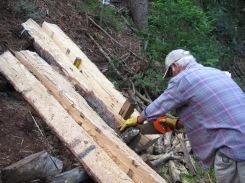
Marshal splitting logs - 16 Jul 2013

Marshal splitting logs for stablising banks

Hollow logs are valuable habitat for wildlife and installing these logs will provide Possums and Gliders safe escape from Foxes and cats.

d

d

d

d

d

d

9:30am Matt, Russ and Shawn are positioning logs on the bank further down the gully. Logs reduce erosion, allow mulch and leaves to collect retaining water and keeping weeds down. Restoration work is also much faster and safer as the logs create a working platform for removing weeds and planting grasses, vines and trees.

d

d

d

d

d

d

The logs were recycled from a tree removed after the January storms. Dale from Climb n Grind returned to safely remove the tree leaving the trunk cut to useful lengths. Marshal and I then used a chainsaw and steel wedges to split the logs into manageable quarters ready for the Gully Day.

IMG_3660

Len Kann with Stingless Bee hive

d

d

d

10:30am Time for a break. Genevieve has organised a sausage sizzle, coffee, tea, cake and fruit … mmmm.

IMG_0839 (1)

Teddy Bear and Blue Banded native bees

While we eat, native bee expert and Mt Gravatt Environment Group member, Len Kann shares his passion for this fascinating wildlife we can bring to our backyards to pollinate our Queensland Nut trees and vegetables.

d

d

Stingless bee hive (low) - 11 Aug 2013

Inside the hive – Stingless Bees

Len explained that there are over 2,000 native bee species in Australia with many providing farmers with unique pollination services not provided by European Honey bees.

IMG_0837 (1)

Rebecca planting

Len has put together a bee presentation box using one of his own empty hive boxes, specimen boxes with Blue Banded and Teddy Bear bees that we have collected in the Reserve, and excellent macro photos taken by member Alan Moore.

Len has generously provided one of his Stingless Bee hives on secondment in the gully and for his talk he bought along a hive he could open to let us see inside. For an ex-beekeeper like me it was fascinating to see the very different structure for storing honey and pollen, and, yes, it is nice not to collect the dozen of stings I received when robbing my European bee hives.

d

11am Rebecca is back to work planting the bank behind her property.

I am proud to live in a community that can come together on a long term project like this. Currently the owners of twenty properties are committed to restoration of their backyards as a wildlife corridor down Fox Gully and importantly work together to eradicate Madeira Vine.

We had twenty people participate in the 2013 Community Gully Day including people like Marshal and Carol who live beside Firefly Gully, Nancy who has propagated most of the Lomandras in the gully and Len who shared his passion for native bees.

Three hundred grasses, herbs, vines, shrubs and trees have been planted this year. Save Our Waterways Now (SOWN) generously gifted $400 worth of plants with other plants and resources purchased with over $200 in tax deductible donations from neighbours.

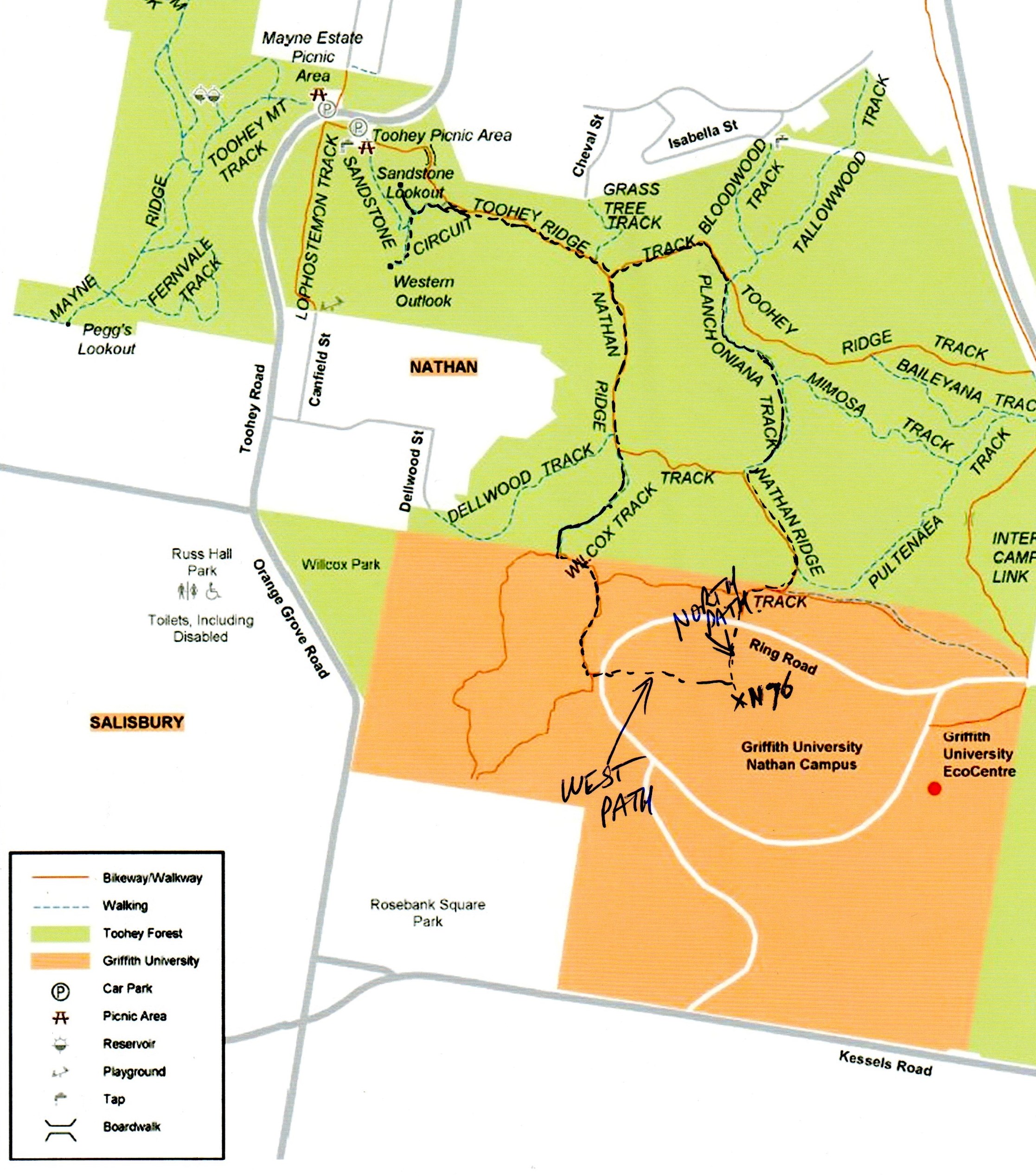
Griffith Mates Bushwalk - Map

Griffith Mates Bushwalk

By: Michael Fox

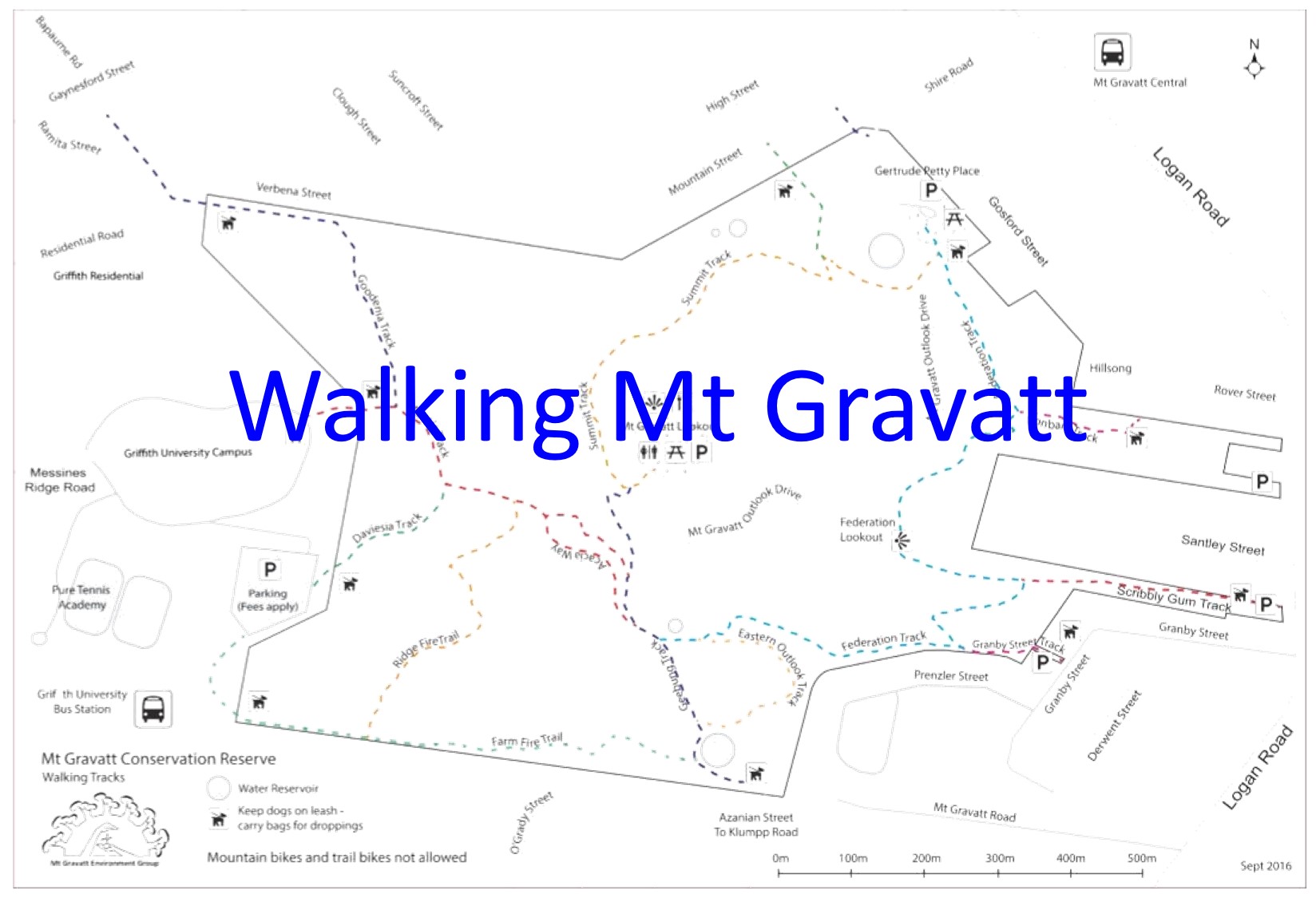
I joined neighbors Matt, Maya and Louie today for a walk to Sandstone Lookout, Toohey Forest.

As part of Orientation Week activities I am leading a walk-in-the-bush next Sunday for Griffith Mates. Griffith Mates are student volunteers who assist in orientation of  international by providing new students with a memorable first experience of life in Australia and at Griffith University.

IMG_4099

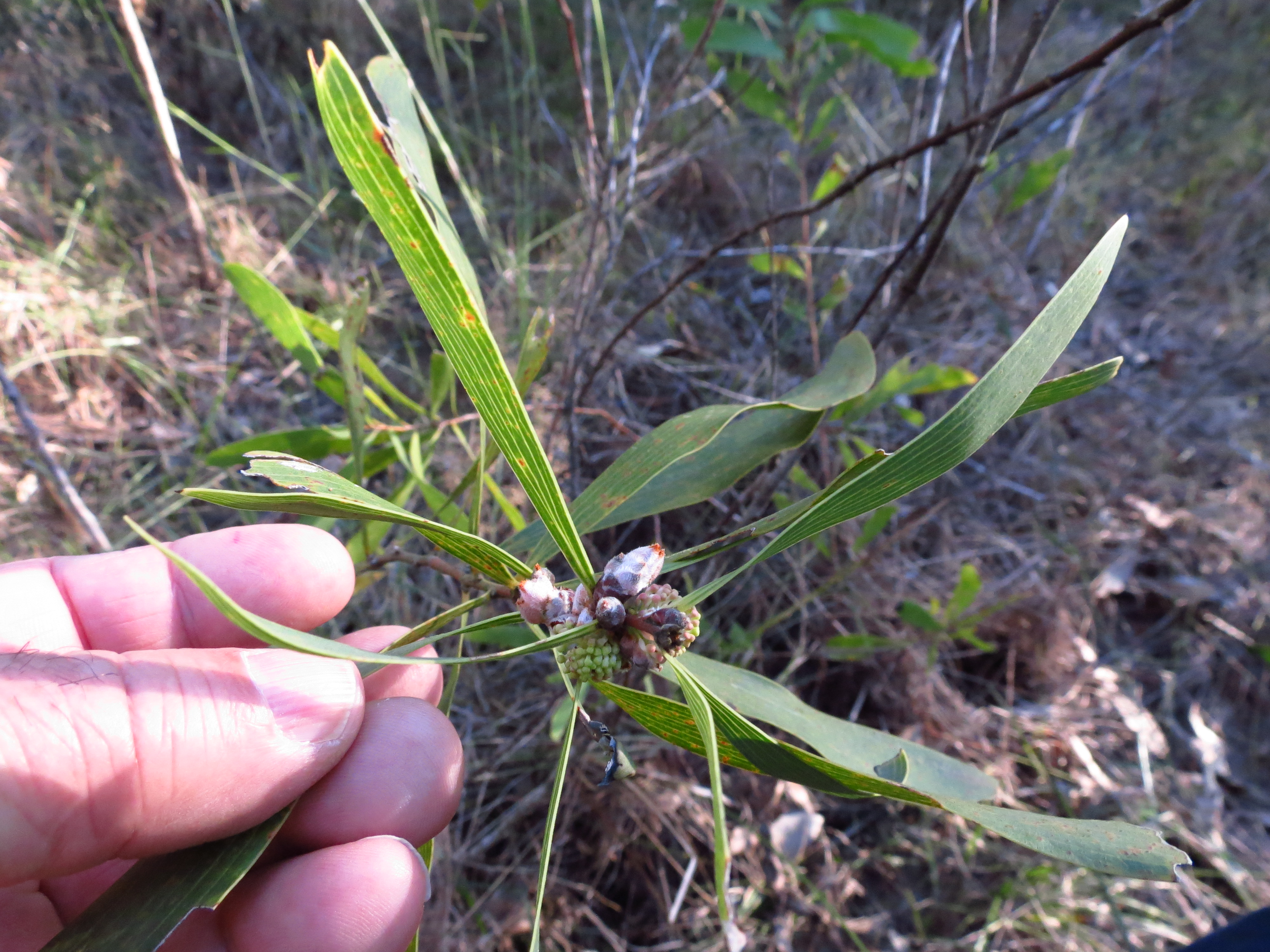
Hakea florulenta flower

The Nathan Ridge Track starts at the Ring Road opposite the North Path. The track has a high quality smooth bitumen surface ideal for young children on push-bikes.

d

IMG_4098

Hakea florulenta seed pods

d

We found an unexpected range of plants flowering even in mid-winter. An interesting example is the distinctive Hakea florulenta flowers, buds and seed pods. This species normally flowers in spring, around September/October so a winter flowering was unexpected.

d

d

d

The first time I found these plants I thought they must be wattles because of the leaf shape. However, the flowers and seed pods a very distinctive.

IMG_4078 close

Fan-tailed Cuckoo Cacomantis flabelliformis

d

d

d

d

We also saw a number of different bird species including Eastern Spinebill Acanthorhynchus tenuirostris and my first sighting of a very cute Fan-tailed Cuckoo Cacomantis flabelliformis.

d

s

s

IMG_4117

Koala scratches

s

s

s

The side track to Sandstone Lookout goes through a stand of eucalyptus with multiple Koala scratches.

d

d

IMG_4111

Matt

IMG_4115

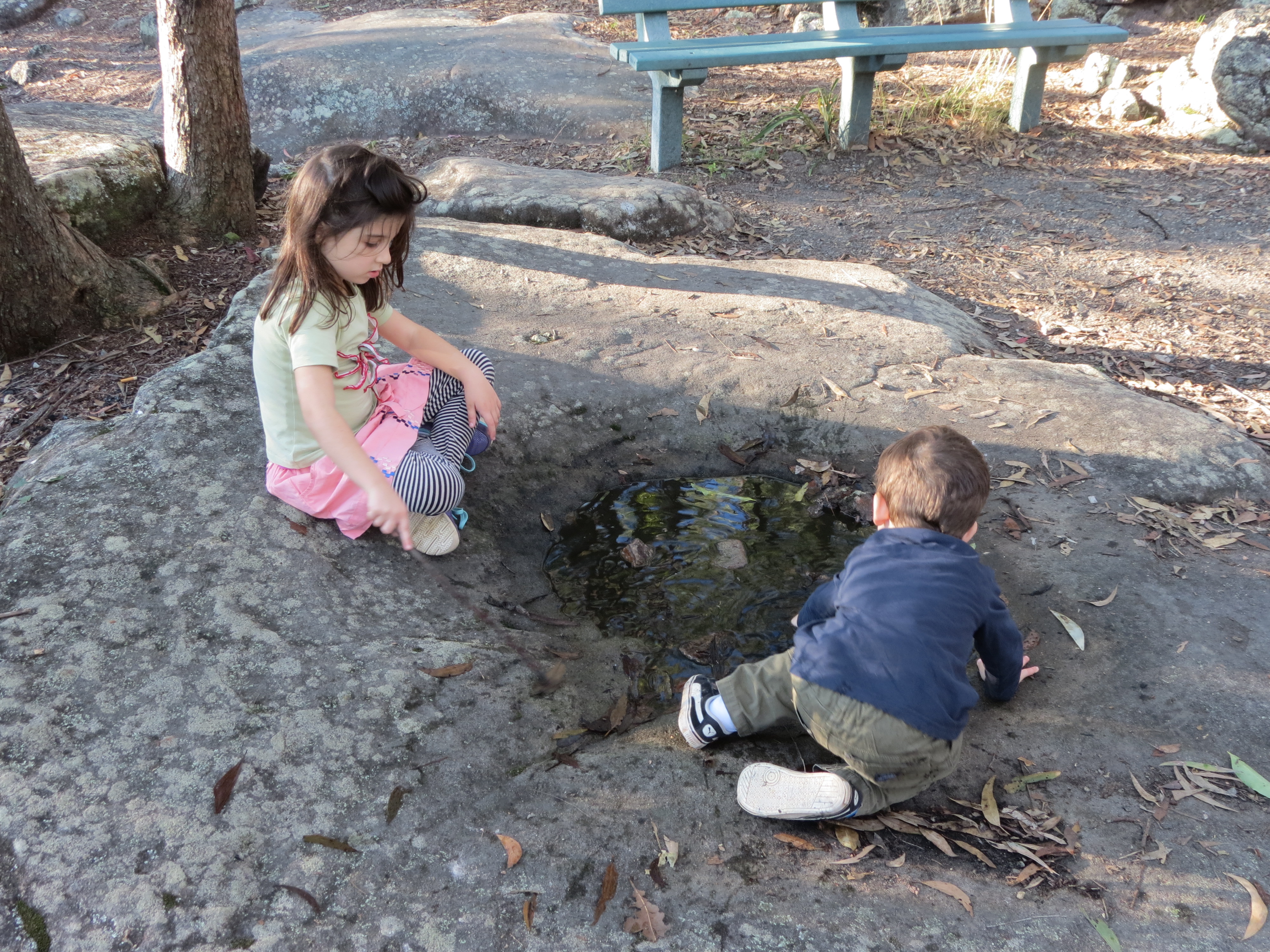
Maya and Louis – kids being kids

IMG_4120

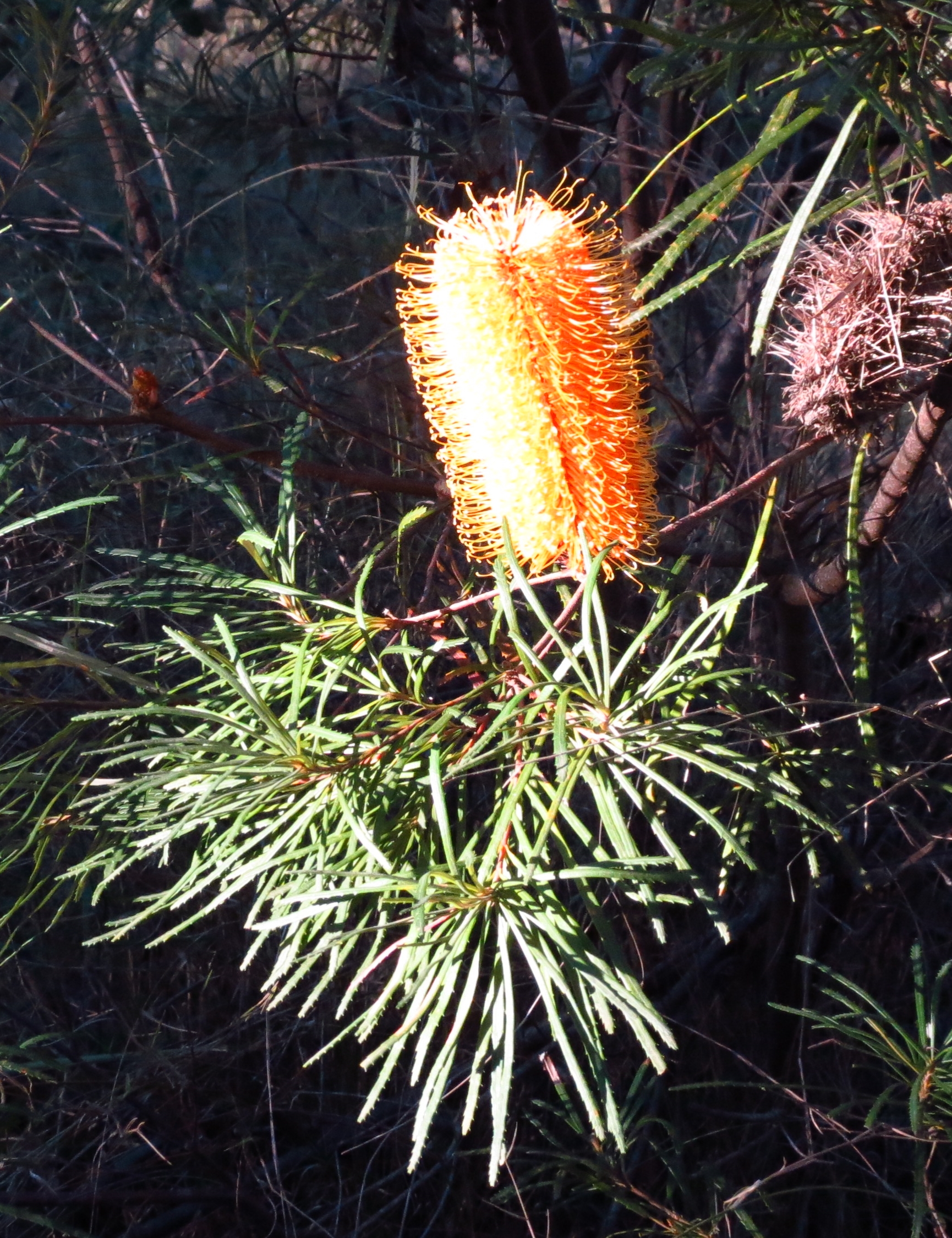
Hairpin Banksia Banksia spinulosa

d

a

a

Sandstone Lookout is one of my favorite places in Toohey Forest and an ideal place for kids to be kids.

d

c

c

c

c

c

c

c

c

c

c

c

c

c

c

c

d

On our return I could not pass up this photography opportunity presented when the afternoon light picked out this Hairpin Banksia Banksia spinulosa.

Snapshot - 3

Brushtail on patrol

By: Michael Fox

The new Aldi Maginon wildlife camera is helping us learn more about wildlife in Mt Gravatt Conservation Reserve. Currently the camera is monitoring a Brush-turkey Alectura lathami  building a nest mound.

The infrared camera is also monitoring nighttime activity like this Common Brushtail Possum Trichosurus vulpecula on patrol on two different nights.

Monitoring the movement and behaviour of our wildlife will help us learn how to protect and restore the habitat.

« Previous PageNext Page »