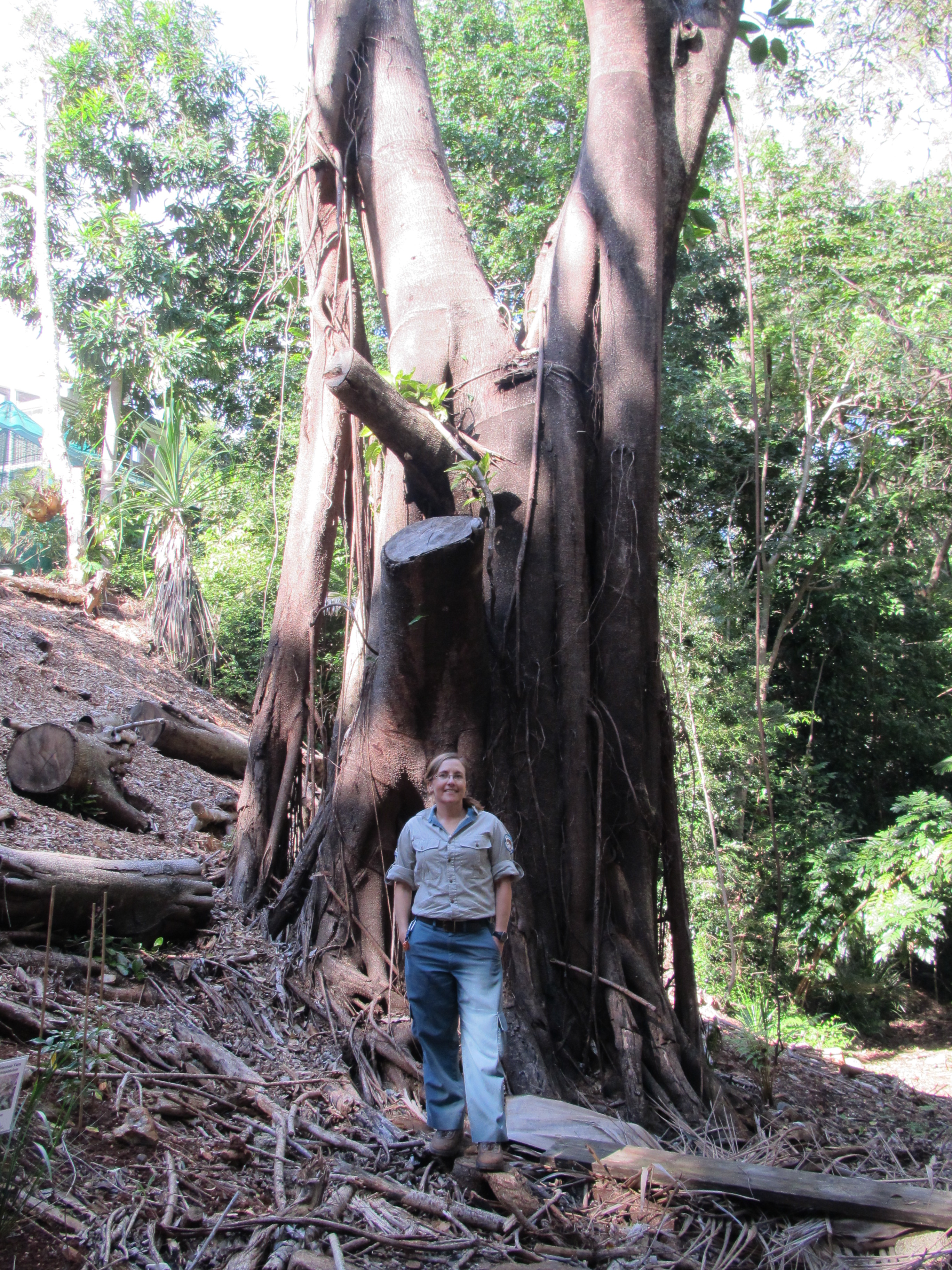
Kristen beside stump of Indian Rubber Tree

This week we were honoured with a visit to Fox Gully Bushcare by Kristen Collie, Ranger at Daisy Hill Koala Centre.

Mt Gravatt Environment Group is now sharing data on Koala sightings with the Koala Centre with intitial data suggesting that our furry friends a quite active in surrounding streets.

One fact that really stands out is the number of Koalas injured by dog attacks in backyards or hit by cars on the roads.

The Koala Centre, which comes under the new Department of Environment and Heritage Protection, operates the Koala Ambulance during business hours. Rangers take injured and dead Koalas to the Moggill Koala Hospital and record details locations.

Brisbane City Council also operates a 24 Hour Animal Ambulancecall 07 3403 8888 for any sick or injured wildlife – even Blue Tongue Lizards.

Kristen was also impress by our community’s commitment to habitat restoration and restoring wildlife corridors. We visited Zone 13 where our Tuesday Bushcare group have removed a huge area of Fishbone/Sword Fern Nephrolepis cordifolia.

We then moved onto inspect the restoration where the wildlife corridor cuts through private properties to Klumpp Road. Standing beside the stump of the huge Indian Rubber Tree and seeing water trickling down the gully from the restored spring, really demonstrated the community commitment to our wildlife.

Our 2012 Community Gully Day is planned for Sunday August 5th and will concentrate on replanting the area cleaned up in 2011.


By: Susan Jones

Female Koala at Gertrude Petty Place
Photo by Susan Jones

This afternoon about 4pm we stopped clearing weeds and sat down at Gertrude Petty Place for a cool drink and something to eat.

To my amazement, a female koala jumped to the ground from a sapling gum a few metres away and headed out onto the grass.  I squatted with the camera to take a shot, not realising that the Tallowwood gum I was hiding behind was the koala’s next destination!  It shot up the Tallowwood, only stopping once to look back disdainfully at me.

People sometimes forget that Mt Gravatt Conservation Reserve is an enviromental park where visitors share the habitat with koalas, echidnas and many other species.

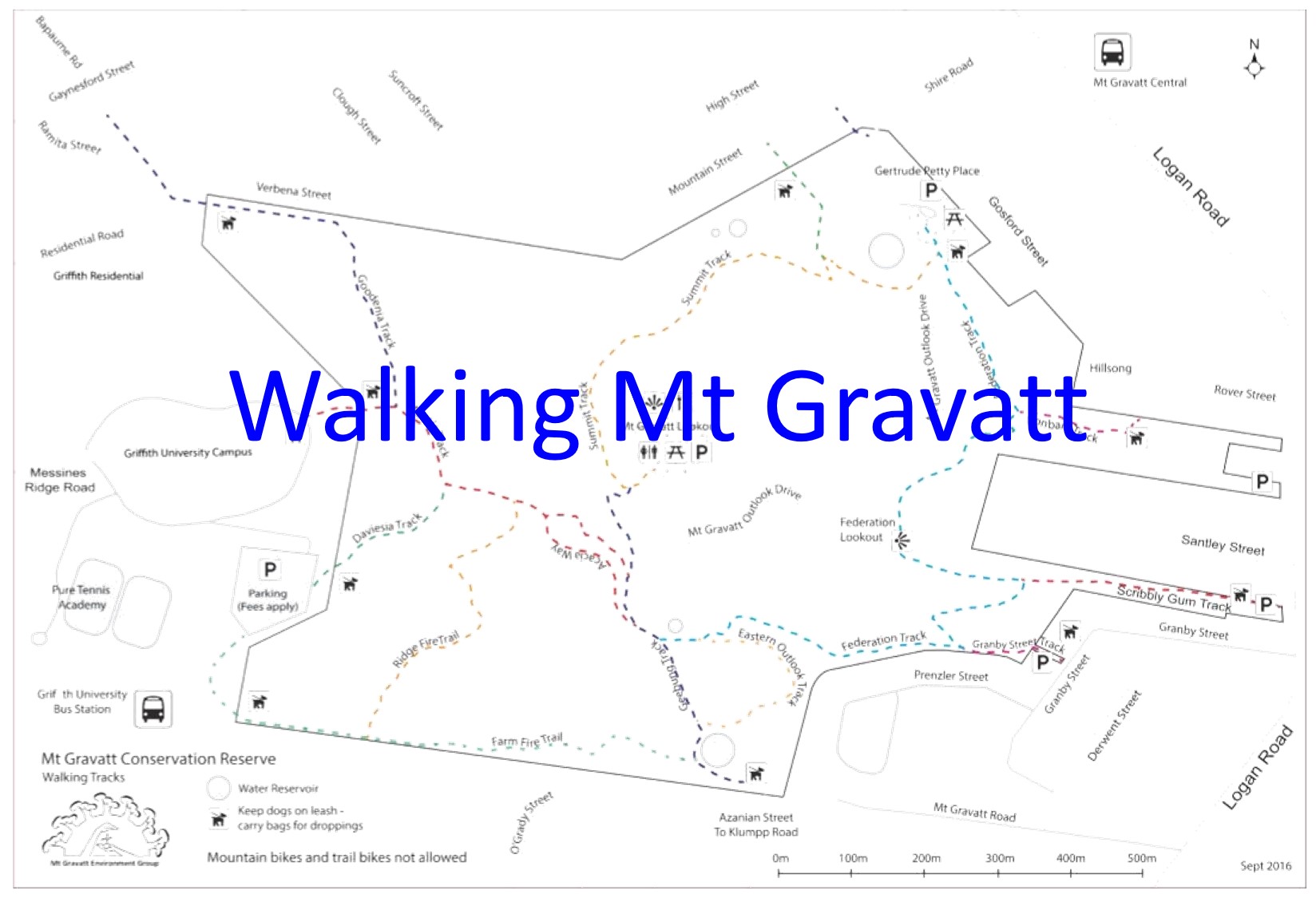
It is wonderful to see people enjoying the Summit and Federation Outlook tracks, particularly with the increasing sightings of koalas.  However, many people parking at Gertrude Petty Place then go walking dogs off-leash in our conservation reserve.

The presence of this  koala at Gertrude Petty Place today, is a very good reason why we should be encouraging dog owners to keep their animals on-leash in the Reserve.

Your dog wants to play off-leash? Visit Abbeville Street Park.

By Melindi Robertson

Mt Gravatt Kindergarten is collecting specially marked Pauls Collecta Caps from milk bottle containers (2 litre and above) for a fund raising project to provide new homes for gliders.

As the land next door to the kindergarten was cleared for the new unit development on Shire Rd (going up to the Mt Gravatt Lookout); Brushtail Possums Trichosurus vulpecula, birds and possibly gliders lost their trees and therefore hollows for nesting in, and we found dead possum joeys in the playground most likely as a result of territorial disputes as their habitat suddenly shrank.

We have been collecting the milk caps since last year, to purchase and install nesting Boxes from Hollow Log Homes.  Kindergarten families are donating their caps, but if anyone else from the  local community would like to donate theirs to our association, we would be very grateful.

The entrance to the kindergarten is next to 23 Gosford St, Mt Gravatt.

With thanks from Melindi Robertson & Sue Lewin (CoDirectors)

Editor’s Note:

Melindi told me about the fund raising project when I joined a nestbox monitoring trip organised by Queensland Glider Network

Mt Gravatt Kindergarten is a valued Mountain neighbour sharing a boundary with our Gertrude Petty Place Bushcare site.

Mt Gravatt Environment Group is proud to promote this fundraising initiative which aims to restore vital nest hollows for wildlife. Most trees of Mt Gravatt Reserve are relatively young having suffered from farming and tree felling. Nest hollows typically start forming once trees are 100 years old so there is s critical shortage of hollows within the habitat.

Thanks to cartoonist and naturalist Edd Cross for the glider drawing.

Michael Fox

By: Susan Jones

Clearing jungle of weeds

Lions’ refurbishment of the Roly Chapman Reserve native gardens is steaming ahead.

A  thick jungle of garden escapees, including Purple Succulent Callisia fragrans, Corky Passion Vine Passiflora suberosa, Chinese Elm Celtis sinensis, Cobblers Pegs Bidens pilosa and Cocos Palms Syagrus romanizoffiana, confronted  the volunteers when they arrived.

Innovative weed removal technique

Lions Team (l-r) Steve, Baska, Kevin, Glen & Shan Ju

The Cobblers Pegs were over a metre high and covered in seeds, requiring careful removal. The Purple Succulent also required careful handling to ensure all fleshy stems and roots were lifted, or they’d resprout. Baska and Kevin hit on the idea of using a small tarp onto which the weeds were loaded, and then lifted off the beds. Meanwhile, the rest of the crew were kept busy pulling weeds for removal.

Perfect weather, plus a great team produced an excellent morning’s work.  Well done, MacGregor Lions and neighbour Liz!

Next working bee:

Midweek – Thursday 17th May from 3 – 5 pm

Monthly – Saturday, 2nd June from 8 – 10 am

Meet on the concrete pathway at the third garden from Hoad Street end.

For details: email – Macgregor.Lions.Secretary@gmail.com or contact John Spriggs on 3849 6479.

Mai enjoys her first Aussie bushcare experience

By: Susan Jones

Persistence pays off … for several weeks now, on Wednesday afternoons,  students from Griffith Uni have been helping Mt Gravatt Environment Group eradicate Creeping Lantana Lantana montevidensis from an area to be planted out on National Tree Day 2012.

Sheamus, Jonny & Mirandha do a sweep looking for Lantana regrowth

It has been a long and tedious job, but finally, the end is in sight!   What was once a thick weed mat is now clean and native grasses, lilies, lomandras and ferns  are reappearing of their own accord. The chemical action of Lantana species appears to surpress growth of native plants so removal allows natural regeneration of the plants indigenous to the mountain.

Group Leader, Jonny, has been the backbone of the GU student group, and we say a big thank you to him and all the students for the volunteer hours they are contributing to improve our bushland.

Sheamus, Tekee, Jonny, Mai & Mirandha enjoy a well-earned muffin break.

Well done everyone!

By Michael Fox

I am always learning something new about our extraordinary local environment. Until recently I had never heard of Finger Lime Citrus australasica or any of the other native citrus.

Finger Lime surprise capsules

I discovered these fascinating plants when researching species for use in building Pollinator Links through our suburbs. Finger Limes are native to rainforests in south-east Queensland and northern New South Wales, where they typically grow as an understory plant.

White Chocolate Finger Lime Cheesecake

Finger Limes have come out of the rainforest and into commercial orchards growing in the full sun. Chris Bourke of Tamborine Native Citrus can supply Finger Limes grafted onto commercial citrus root stock which will promote rapid growth and produce smaller trees suited to backyards. Finger Limes can also be successfully grown in pots so even unit dwellers can join in the fun. What colour will you grow?

Orchard Swallowtail laying her eggs
Photographer – Jude Fox

The lime juice comes in tiny surprise packs that stay intact when cooked in a cheesecake, ready to explode in your mouth as you eat. If you would like to make your own bush tucker cheesecake you can find the recipe at Marvick Native Farms. Substitute Finger Lime for Desert Lime and of course use Queensland Nut Macadamia integrifolia instead of Hazelnuts. Don’t whiz all the limes. Fold some juice capsules into the mix before pouring into the cake tin.

Better still you can grow your own Finger Limes and bring beautiful Orchard Swallowtail butterflies to your backyard. Be patient with the butterfly caterpillars, they will do very little damage to your lime tree. Eating the citrus leaves allows the caterpillars store toxins that transfer through to the butterflies making them taste unpleasant to bird predators.


Proposed Telstra Mobile Tower

Cr Krista Adams has received information that Telstra is proposing to build a mobile phone tower at the back corner of the Klumpp Road Park & Ride, right beside Mimosa Creek. Krista Adams letter

I have updated the Mimosa Creek Precinct Landscape Plan – ver 2.2 with proposed tower location and access. Based on current information this proposal will not impact on development the Firefly Gully wildlife corridor however the safety issues are less clear.

Telstra almost certainly complies with the safety standards set by Australian Radiation Protection & Nuclear Safety Agency (ARPNSA) however we have an opportunity to comment on the proposed tower installation in our community.

Please come to the Telstra Information Session:

Mt Gravatt Hawks Soccer Club  – Wednesday 18 April – 5pm to 7:30pm

The science on the long-term health effects of using mobiles and/or spending time near mobile phone towers is very unclear. As shown by these extracts from the ARPNSA fact sheets on electromagnetic energy (EME).

My personal experience is that these types of radiation are powerful and almost certainly dangerous. The issue is the level of exposure which is a combination of transmission power and distance from the source.

My first experience was in the early 70s when as a trainee PMG technician I visited the Bald Hills radio transmission tower. When you see a bare fluorescent bulb burst into light just by being held near the transmitter, then go into the field and see a two-inch spark drawn from the heavily insulated guy wires which is then tuned so you can listen to ABC radio.

400 metre coverage area

My latest experience is with my iPhone. I routinely carried my phone in my pocket with the touch screen against my leg. Over time I found that my skin in that area became hot even when the phone was removed. I have since changed how I carry my phone and the problem has disappeared.

Telstra mobile towers are low power however distance is still an important safety factor. The question is: What is a safe distance? EM Watch suggests a 400 metres as clear safe distance.

What do we want for our community? Come along on Wednesday and have your say.

“I remember seeing Koalas in the trees near the creek when I attended St Bernard’s primary school in the ’80s.” I talking with a volunteer at today’s BCC Community Tree Planting at Sunnybank. My informant was pleased to see the new signs on Klumpp Road and hear that Koalas are breeding on the mountain.

Cr Krista Adams organised installation of the signs after the death of a Koala hit by a car on Klumpp Road in December.

Our submission to Cr Adams was supported by our ongoing monitoring of Koalas on the mountain. We are now receiving regular reports from neighbours and people using the walking tracks. Edd and Hazel provided our latest report of a male, female and joey – read Hazel’s Brisbane Adventures for an amazing photo of mother and joey.

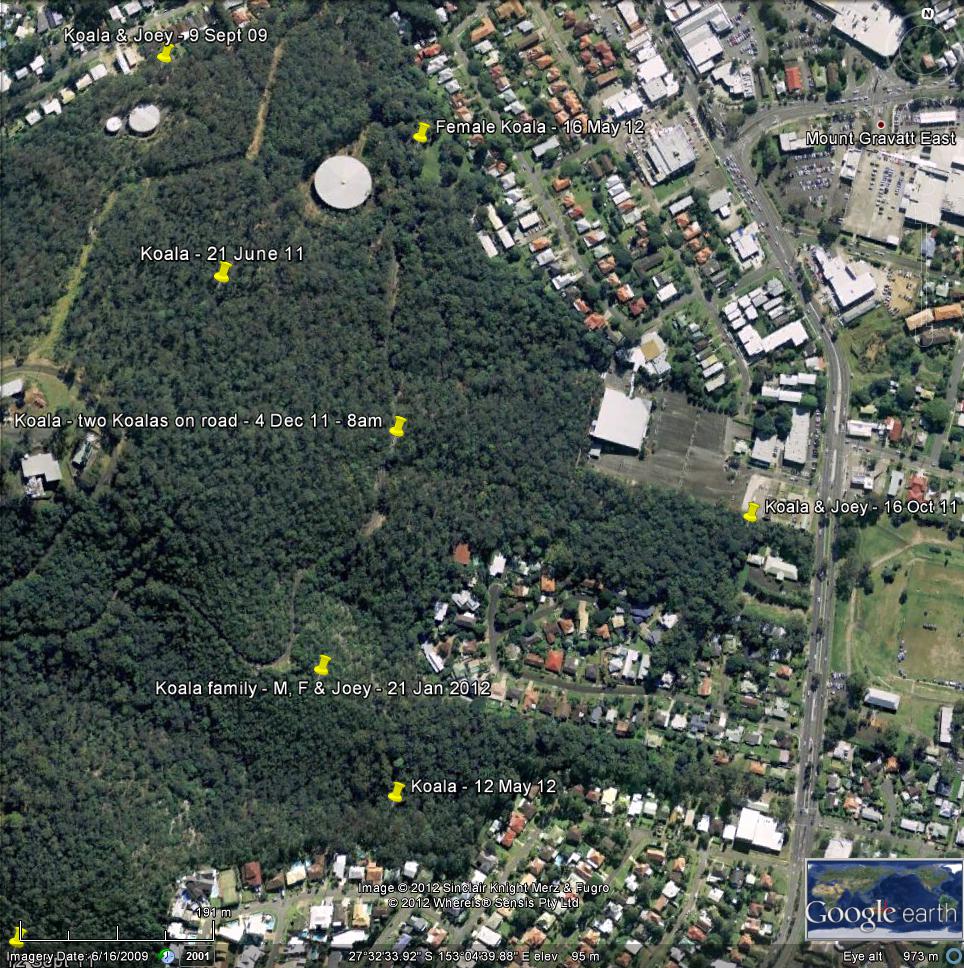
We use Google Maps to record sightings to help us understand their movements and argue for government support for our restoration work. We are also working with Griffith University researchers like Cathryn Dexter – see Koalas returning to Mt Gravatt in Koalas on Mt Gravatt: Who’d have thought it?

Koala Sightings Mimosa Creek Precinct - March 2012

By Susan Jones

Tekee and Jonny

We are pleased to welcome back Griffith Uni students to our Wednesday afternoon working bees where they are providing such great support in our bushland restoration work.

We continue clearing Queensland Class 3 weed, Creeping Lantana Lantana montevidensis.  It has grown into thick ‘carpets’ through much of our local bushland, suffocating native vegetation as it takes over.  It reproduces by seed that are dispersed by birds and other animals as they eat the fleshy red/purple fruit or it can become established in bushland from dumped garden waste.  It spreads across the ground laterally, sometimes rooting at stem joints, forming a carpet smothering native plants.

Jonny, Shasha, Tekee, Sheamus, Susan and Maria-Dolores celebrate their efforts

Rather than poison these weed ‘carpets’ we are digging them out preserving the surviving native plants while allowing the native seed bank space to germinate and grow.  Later, this option will save a lot of effort replanting and watering.

Tekee took on a particularly thick infestation and, with Jonny’s help, was able to roll up the ‘carpet’ and move it into a heap, where it will break down into mulch.   Shasha and Maria-Dolores didn’t let the guys take all the credit though:  they created their own huge weed piles.

Great teamwork everyone … thanks!


Turembold coming to grips with Lantana

By Susan Jones

As usual, Sheamus arrived first with his sleeves rolled up to work.  Next on the job were a team of Griffith University national and international students: Mardol, Mirandha, Tumenbold, Jonny, Emilia and Jaime.  An added bonus was the arrival of Peter a newcomer to Brisbane.

Today’s  volunteers took on the tedious task of removing Creeping Lantana Lantana montevidensis and everyone pulled their weight (and weeds) magnificently.

Huge compost pile of weeds - excellent work!

Emilia busied herself collecting and piling up the weeds as they were pulled. The end result was a  huge compost heap that will break down and eventually be spread as mulch.

Preparation of this area is now well underway for the second July ‘National Tree Day’ planting with volunteers from Mt Gravatt State High School.

Thanks to everyone who worked today – it was a great team effort!