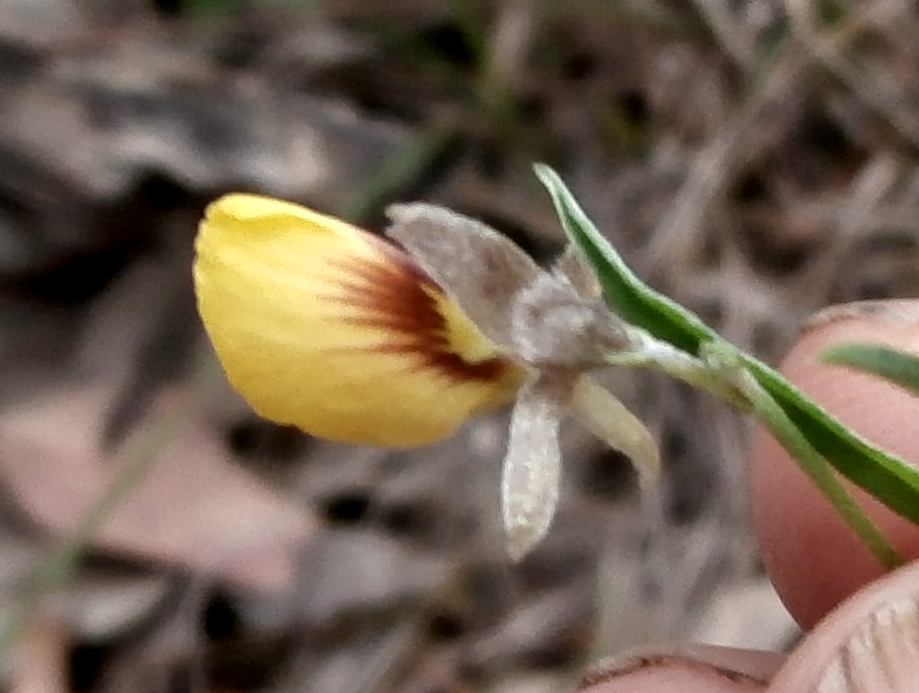
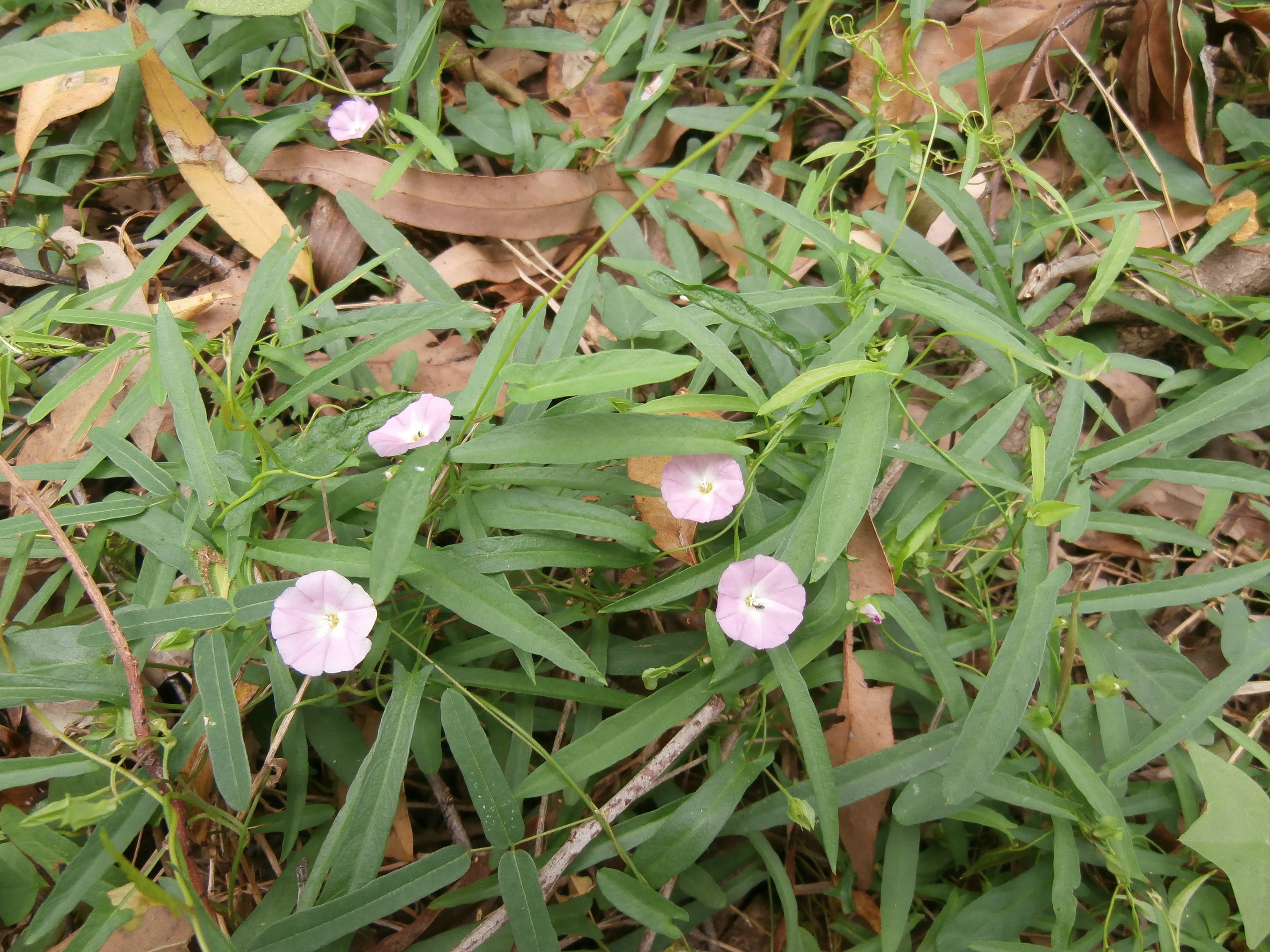
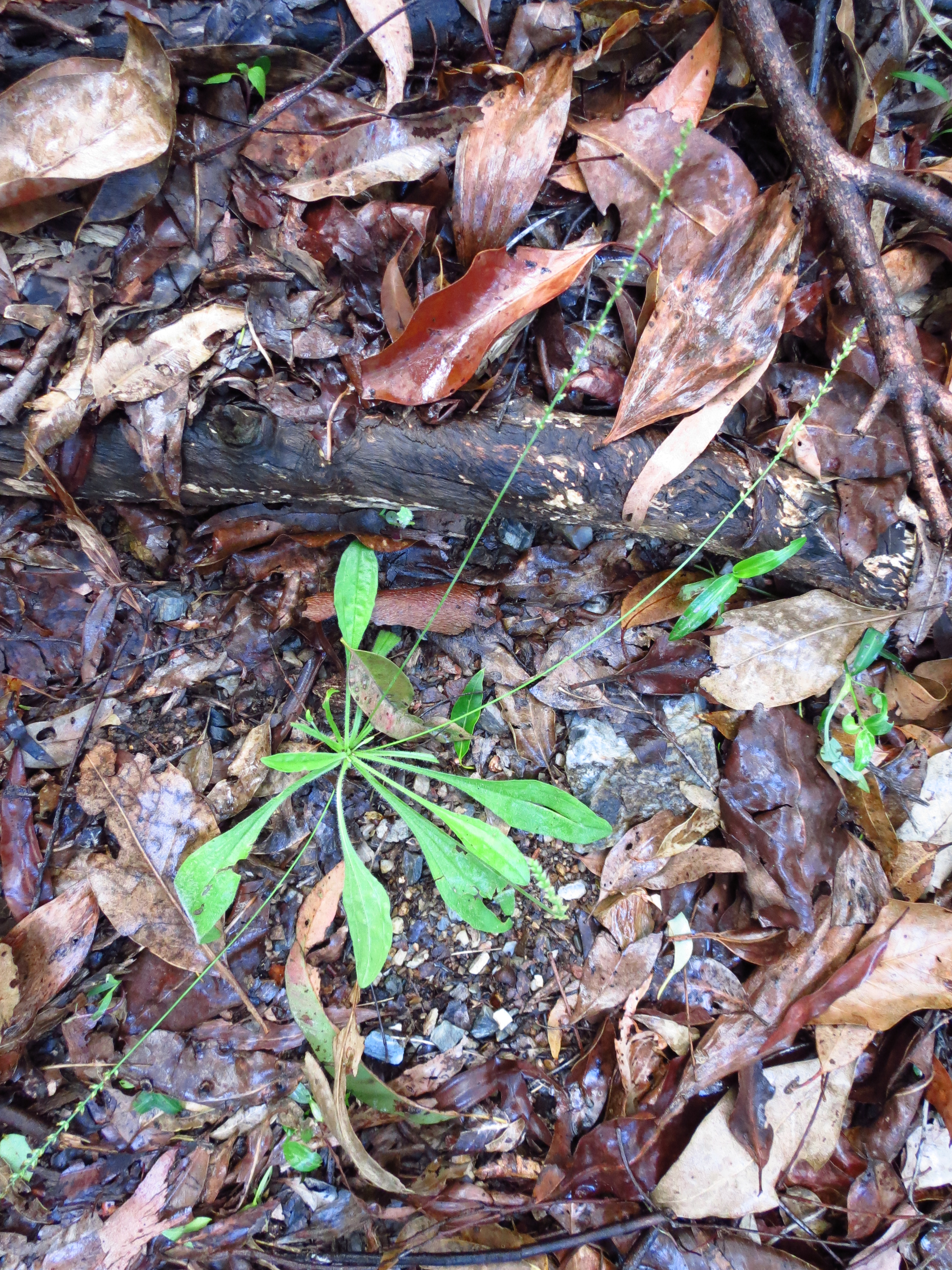
We have updated Flora & Fauna of Mt Gravatt Conservation Reserve with three new native plants – Isotropis filicaulis a rare/threatened shrub of the Fabaceae family, Swamp/Slender Bindweed Polymeria calycina a delicate vine with tiny pale pink flowers and Plantago debilis a native herb. This brings the count of indigenous plants species found in the Reserve to two hundred and sixty-eight.
A new native snail – Fraser’s Land Snail Sphaerospira fraseri has been added thanks to a young naturalist neighbour, Ethan Morris.
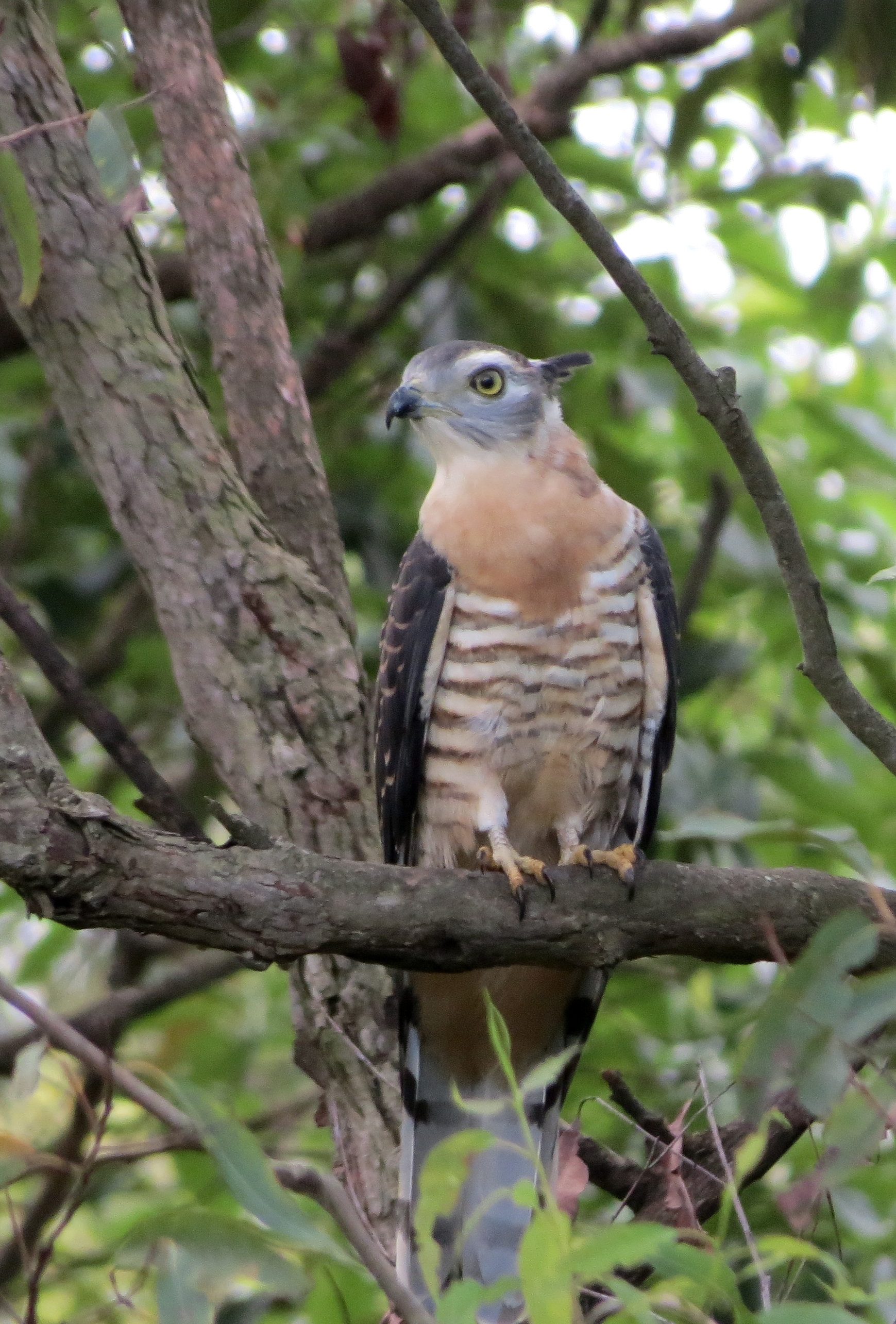
New photos and video of the Pacific BazaAviceda subcristata has been added. In March we had a family of three Bazas in Fox Gully over a period of two weeks. I watched as one Baza hunted a large Stick Insect in a young Tallowwood planted in our 2008 Fox Gully Bushcare Community Planting and now supporting food for birds.
Flora species list and other research.
The rain is frustrating when we have to cancel Bushcare events, however, it is also bringing the forest alive with three new plant species added in one week.
Susan Jones has found that removal of weeds and restoration at the Gertrude Petty Place Bushcare site has allowed natural regeneration of a number of plant species including this rare/threatened Fabaceae species Isotropis filicaulis.
Polymeria calycina
d
Swamp Bindweed Polymeria calycina a delicate creeper with pink flowers.
d
d
d
d
d
Plantago debilis
d
d
Plantago debilis a small native herb that provides seeds for native birds. Addition of these three new species means we now have 268 native plant species in Mt Gravatt Conservation Reserve.
Thanks to Ann Moran, Jaeger-Moran Environmental, for help with identification.
a
a
On the other side of the mountain Alan Moore got this amazing close-up of an Eastern Bearded Dragon with its beard on display in Fox Gully Bushcare.
Imperial Hairstreak butterfly on Early Black Wattle
By: Michael Fox
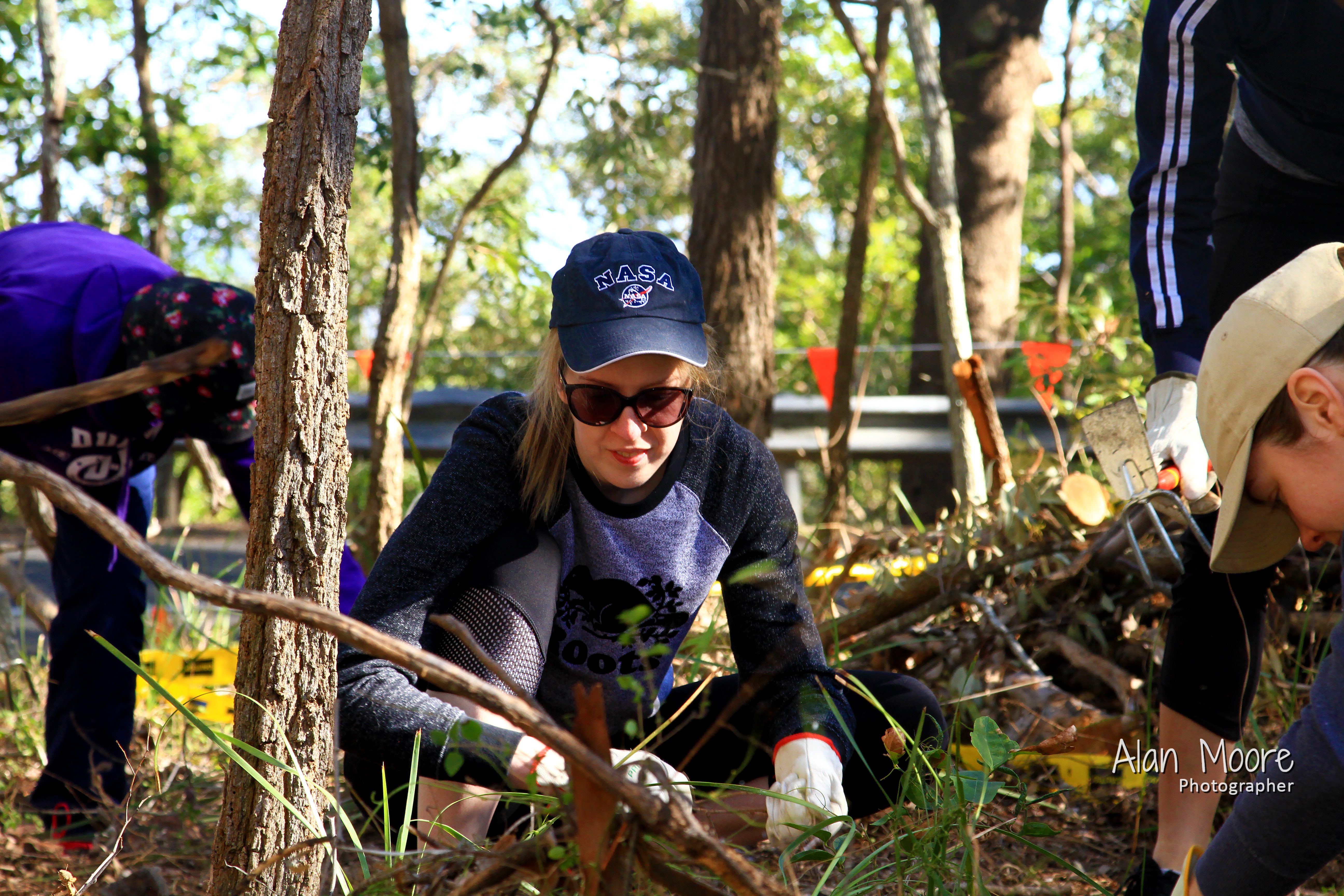
We welcomed the Griffith Uni Bushcare Team back to Fox Gully on the Saturday before Easter.
Mind you, it took a while to get them onsite as we found some Imperial Hairstreak butterflies, Jalmenus evagoras, beside the track. It is always a pleasure to find someone else who can be totally fascinated by a few of butterflies, caterpillars and ants.
Imperial Hairstreak chrysalis protected by Small Meat Ants
Silt 100mm deep behind mulch filter
Imperial Hairstreak butterfly caterpillars and chrysalis are protected by native Small Meat Ants Iridomyrmex sp. referred to as Kropotkin ants. Read my article in Southside Community News.
The Early Black Wattle Acacia leiocalyx are interesting with their distinctive triangular stems.
d
d
d
d
d
The main project for the day was restoration and improvement of the “mulch filters” that keep silt from the dirt maintenance road flowing into the gully. The filters have proved very effective in reducing erosion and keeping the water in the gully clean.
Mirandha and Sheamus installing mulch filter
The mulch filter is designed to slow the water flow at key runoff points on the track, allowing the silt to settle out. Silt is already 100mm deep behind one filters and starting to support natural regeneration of native grass.
d
d
The original filters were made by simply mounding mulch at the runoff points as an experiment. Now that the effectiveness has been established logs are being installed to make the filters more permanent and allow mulch to be piled higher.
k
ka
k
Bush food snack
kj
Of course after all the hard work a snack is in order. Mirandha try out the sweet roots of Blady Grass Imperata cylindrica.
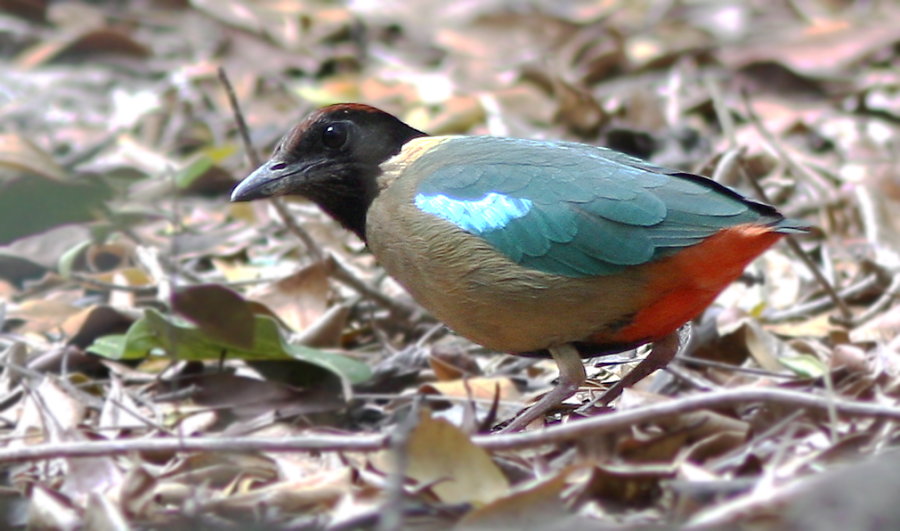
Mt Gravatt Conservation Reserve is full of surprises. Koalas, Echidnas, Gliders and now a Noisy Pitta Pitta versicolour has been sighted.
Noisy Pittas, one of my favorite birds, are normally found in rainforest areas like Lamington National Park so it is great to have a sighting right here in our backyard.
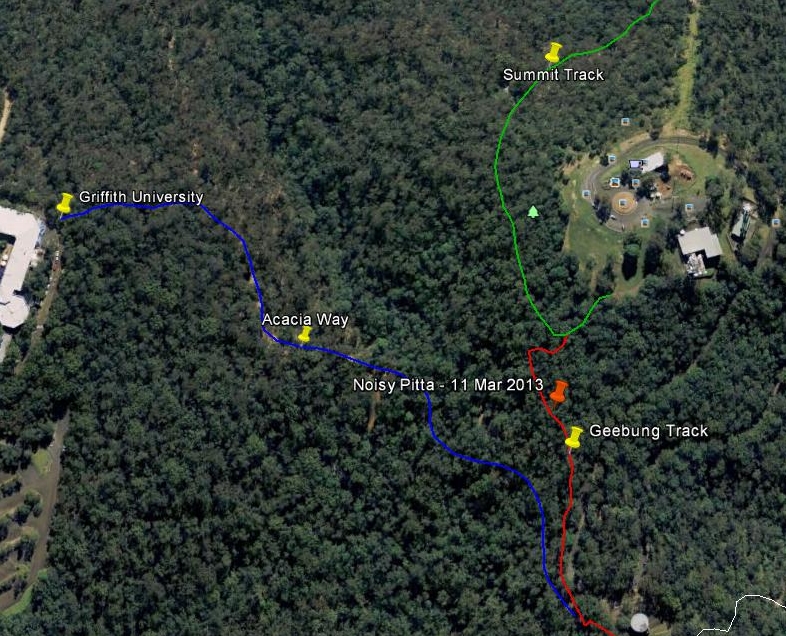
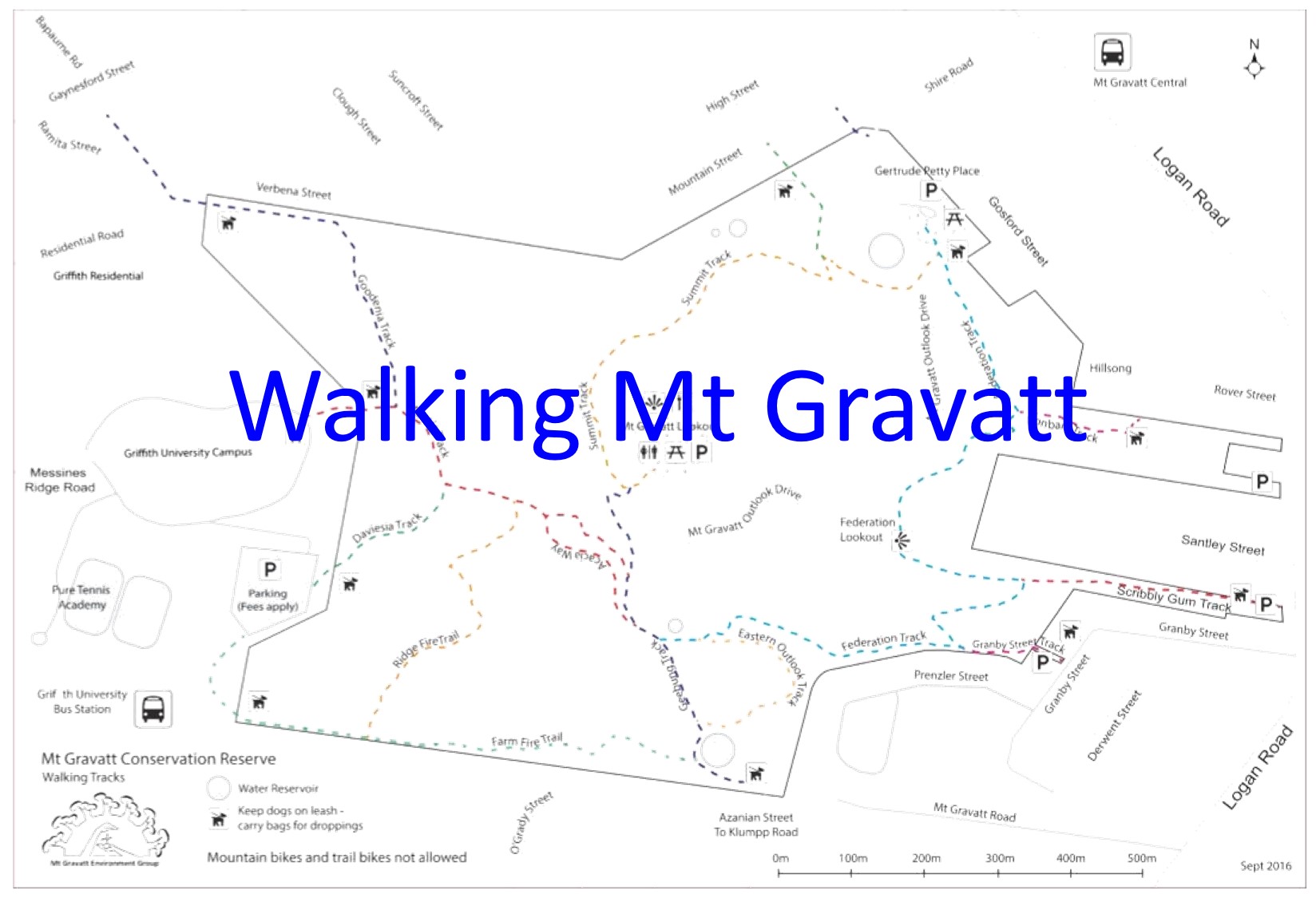
Pieter saw the Noisy Pitta on the Geebung Track just before the junction with the Summit Track (click to enlarge map). Pieter knew Pittas are a very shy so he approached very carefully and was able to observe the bird doing a “broken wing display“, used to distract you away from a nest.
Noisy Pitta sighting – Google Earth
Local BCC Ranger, Craig, reports that he has only seen two Noisy Pittas in twenty years of being a Ranger in the area.
So please keep an eye out, and camera ready, when you are walking because it would be great to get more reports of these beautiful birds in the Reserve.
You always know when a Pacific Baza Aviceda subcristata is around because all the other birds kick up a fuss although they don’t seem to be a direct threat, being more interested in stick insects.
The Pacific Baza’s favorite prey is large insects, particularly stick insects and mantids, and frogs. They sometimes eat fruit as well. Bazzas will move through the canopy, or perch and watch, then make short dives, with feet extended, to snatch prey from the foliage or from the air. Birds in Backyards
Three of these magnificent birds have been visiting various parts of Fox Gully over the past week. While I was watching one of the Bazas flew into the trees planted in the Zone 8 restoration then landed back on the same branch to eat something long and green. I was too far away to photograph but I suspect it was a stick insect.
Much of our work in restoring habitat in the Reserve is cleaning up damage done by easy to avoid action, like people dumping their garden waste in the bush when they could often simply put it into their wheelie bin.
Keeping our family cats inside at night takes a bit of effort. However it is still a relatively simple action that has huge benefits for our nocturnal wildlife like gliders and possums.
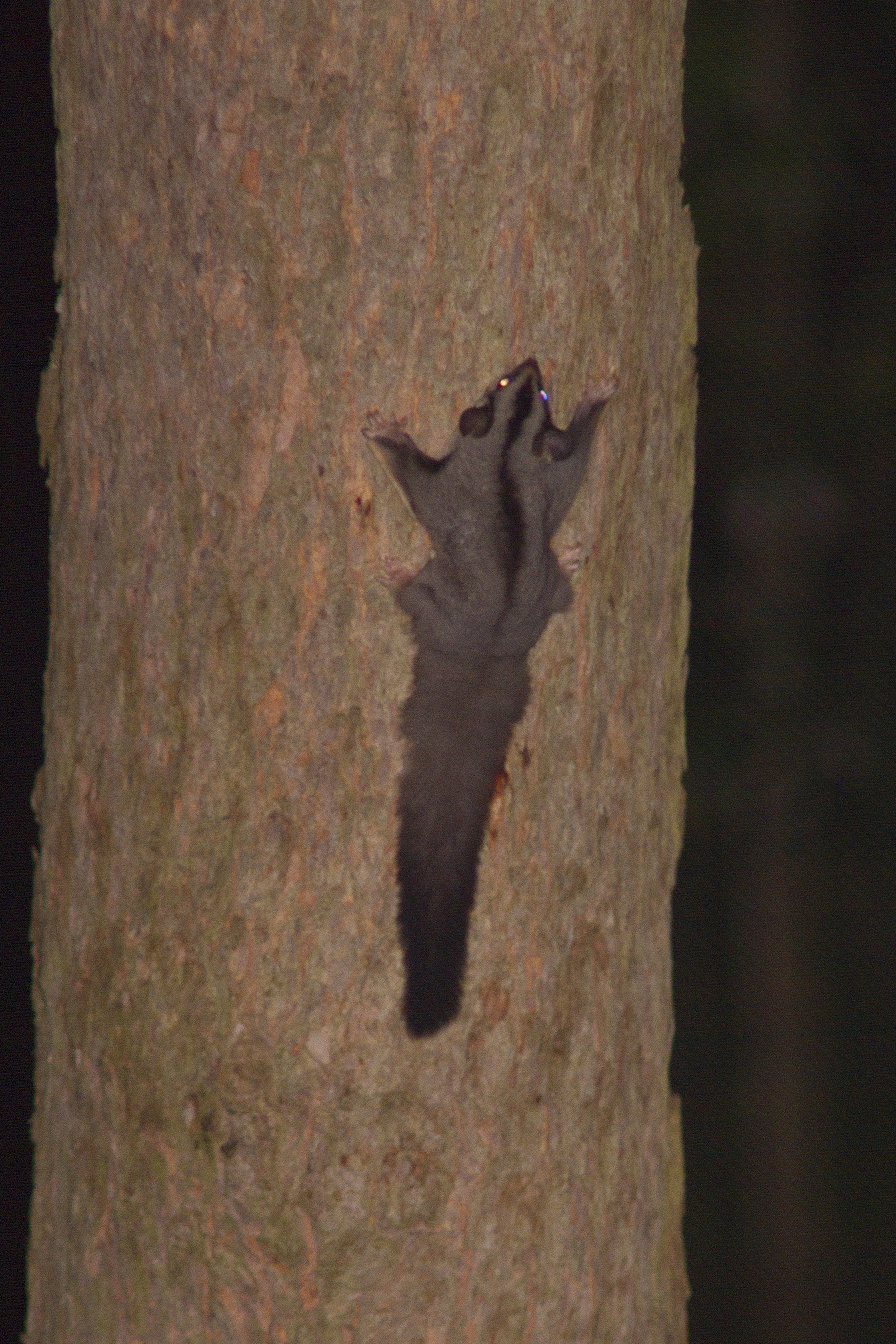
Gliders are one of the cutest of our Australian native animals. Sugar Gliders Petaurus breviceps and Squirrel Gliders Petaurus norfolcensis are found in Mt Gravatt Conservation Reserve. Restoration work at Fox Gully Bushcare site includes installation of nest-boxes to provide habitat for hollow dwelling animals like gliders, possums and birds.
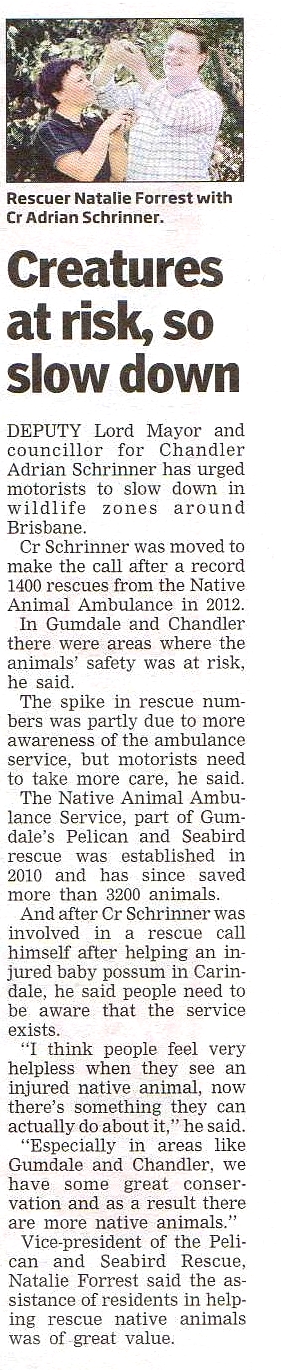
Southern Star – 20 Feb 2013 – page 8
So it was heart breaking to see the remains of a glider attacked by a domestic cat.
Sharing the story with the Southern Star is one way to help people think about doing things differently.
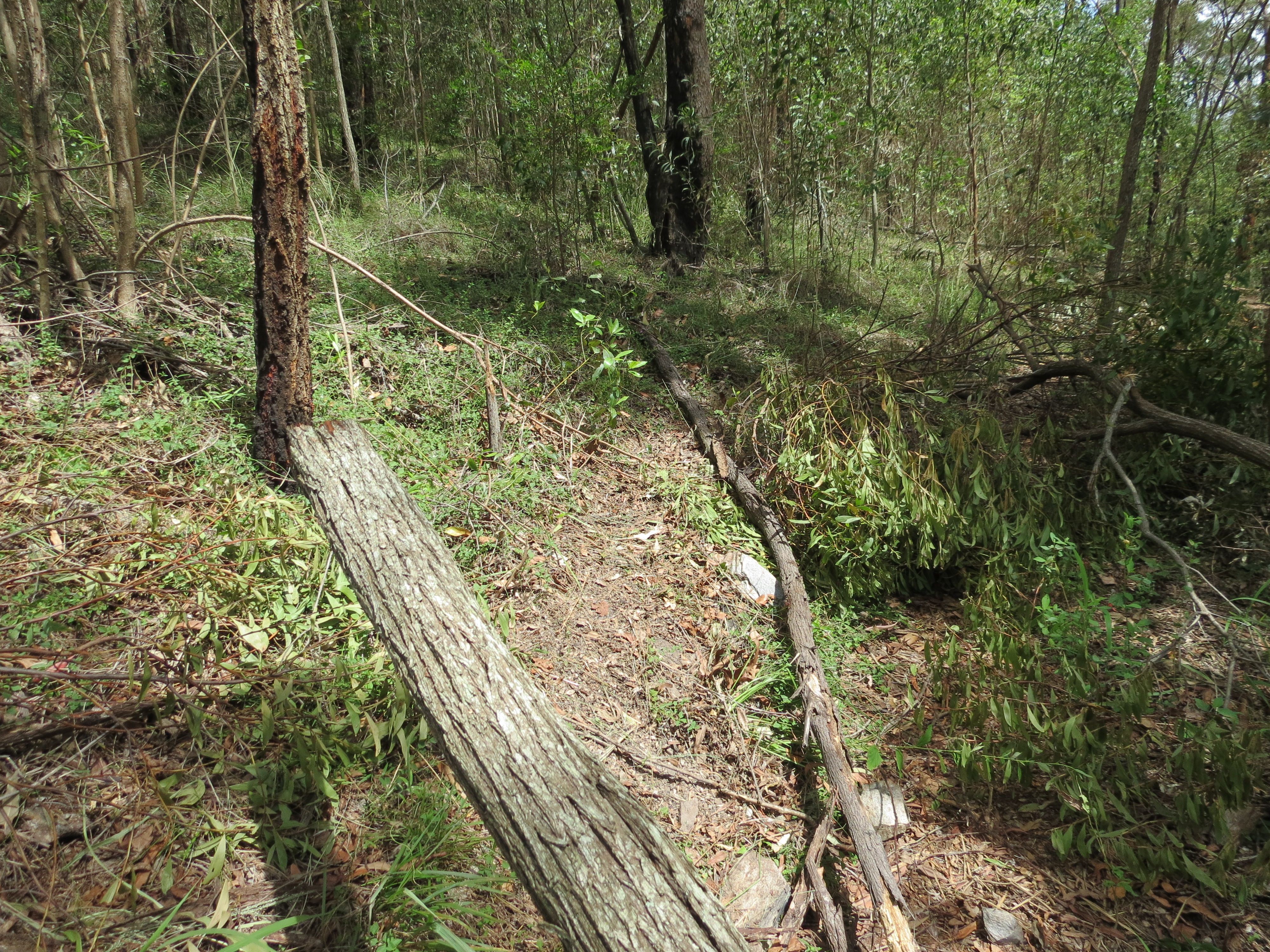
Over the last two days I have walked the tracks in the Reserve to see what damage was done by last week’s storm. Being a mountain flooding is not a problem however we have lost a significant number of large eucalypts, a number of Casuarinas and a significant number of dead old trees (stags) which are often important habitat because of their nest hollows. A number tracks are blocked by fallen trees which will take time to clear as the Council teams prioritise clean up work.
Storm block illegal mountain bike tracks
However, the storm has created some unexpected benefits for the habitat as fallen trees have blocked tracks used by illegal downhill mountain bike riders. We have had a number of reports that mountain bike riders have been seen in the Reserve so I also walked the areas that have been damaged illegal riding. I found some evidence of bike riding including clearing of logs placed by Council contractors to block tracks and minimise further erosion. So I was pleased to find a number of tracks blocked by large branches broken in the storm.
Red-browed Finch – click to enlarge
I am also heartened by seeing wildlife thriving in the post storm environment.
… and a previously unrecorded dragonfly – Blue-spotted Hawker Adversaeschna brevistyla on the Summit Track. Thanks to Graham McDonald for the id. You can see more info on this and other dragonflies at Brisbane Insects.
g
d
d
d
gf
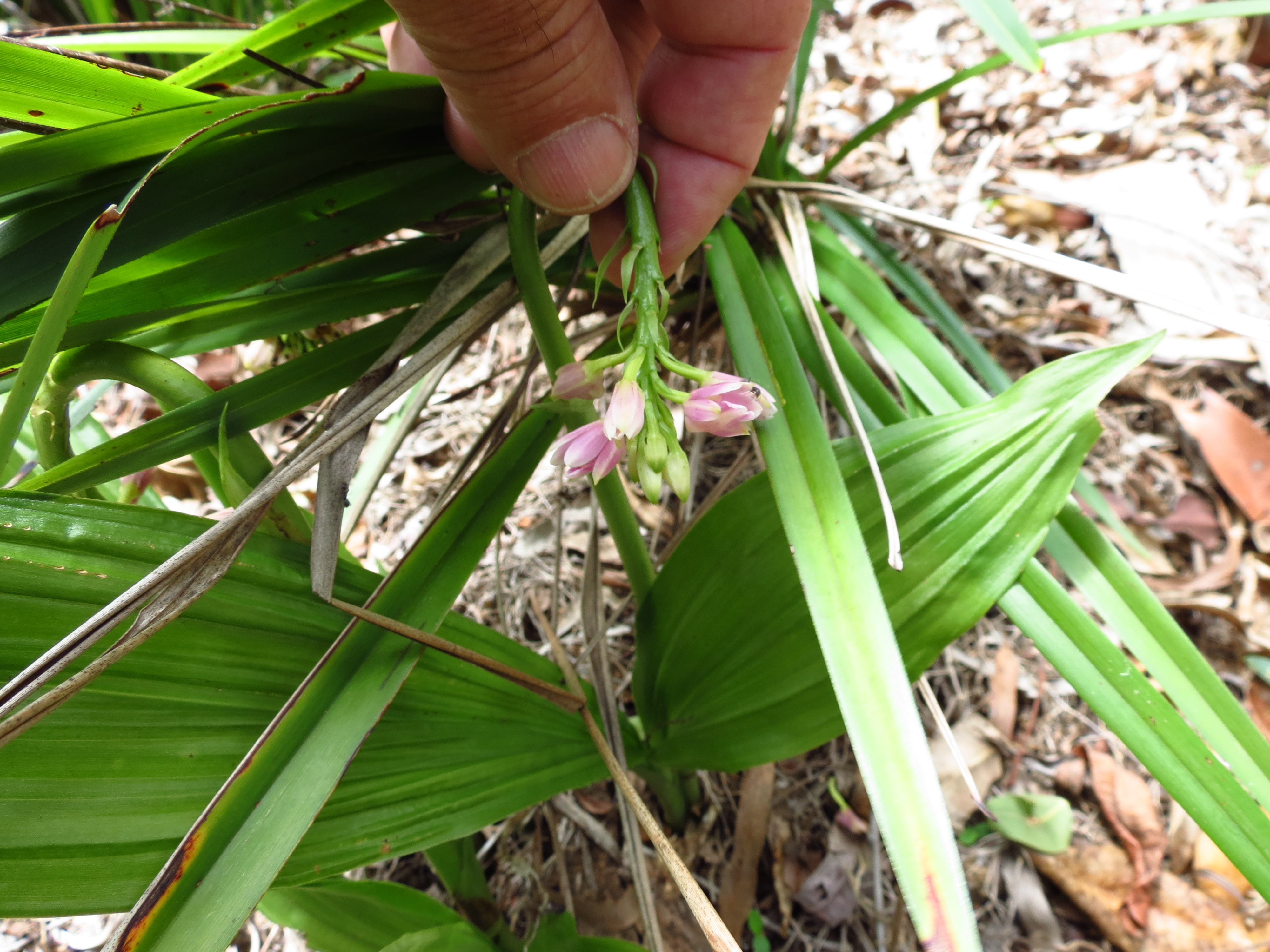
Shepherd’s Crook Orchid
I also found the Shepherd’s Crook Orchid flowering again at the Fox Gully Bushcare site. This is particularly important as this beautiful native orchid has been returned to the Reserve as a result of restoration work undertaken at the Fox Gully site.
Then on Friday night Matt Hill heard a scratching noise in the trees behind his deck. Thinking it was probably a possum he investigated with with torch picking up the glint of four eyes in the trees. He was delighted to find a Koala mum with her Joey comfortably nestled in her arms while she munched on leaves.
Koala sightings Fox Gully wildlife corridor
Matt and his family have been active supporters of our Fox Gully Bushcare restoration work and has been controlling weed trees, like Camphor Laurel, on his gully property. So, in December, he was proud to show me what looked like Koala scratches on a tree restored to the habitat only five years ago. This was an exciting find and now with this weeks photos we have confirmation that Koalas are not only active in the wildlife corridor but also breeding successfully. We also received another report this week of a Koala sighted high in a tree beside the footpath to the Griffith University Bus Station.
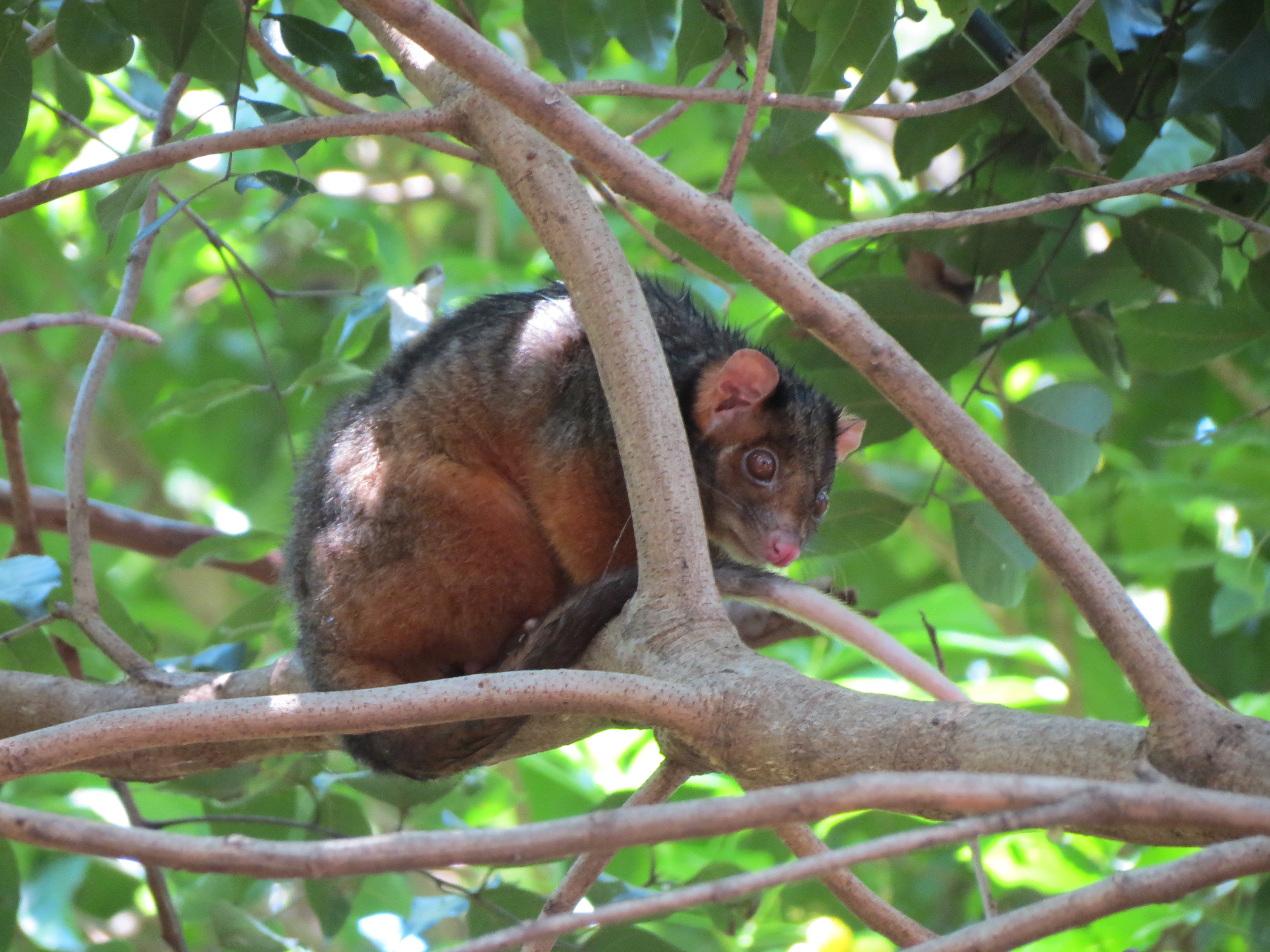
Ringtail Possum Pseudocheirus pereginus
Restoration of this key wildlife corridor is now supported by seventeen property owners whose backyards include the gully and community members committed to restoring habitat for Koalas, birds, butterflies, frogs and native bees.
Restoration of the of the wildlife corridor is having a positive effect as shown by the number of Koala sighting as well as increasing other wildlife. At the top end of the gully, Roger and Margaret have a family of Ringtail Possums Pseudocheirus pereginus living in the top of staghorn ferns. Just before Christmas a mother with two babies on her back was sighted and Friday Margaret called to say the father had been disturbed from his staghorn nest when Roger was hosing.
Note his spiky hair and spiky attitude as he cleans water off his coat.
Please be patient with these cute creatures if they eat some of your fruit. During the 1950’s Common Ringtail Possum populations severely declined in numbers. Currently populations seem to have recovered but they are at risk of attack by cats loose at night.
Unlike Brushtail Possums Trichosurus vulpecula, Ringtails tend to avoid house ceilings, preferring to nest in trees or the tops of staghorns, so they are not considered pests in suburban areas.d
We host international students at times and today we received a note from the Japanese student who will be living with us during February. One thing she was very clear about: “I want to see a Koala.” With latest sighting, reported this week, of a Koala in a tree beside the footpath leading to Griffith University Bus Station there is an increasing chance that she will see a Koala on the way to university.
It really is fun to watch international students/visitors when they see a Koala just sitting (usually sleeping) in a tree or an Echidna walking across the track … and not a zoo keeper in sight. The most amazing experience though was watching Jian, an international student from Shanghai, when he came face to face with a Koala right on our back deck.
Southern Star – January 16, 2013
You can get involved with bush restoration, reporting any Koala sightings on Koala Tracker or simply slowing down and reporting sick or injured wildlife to 1300 ANIMAL 24/7.
The Southern Star interview with Adrian Schrinner and Natalie Forrest is very valuable in building community awareness. However, it is not only out at Gumdale and Chandler that we need to be increasing careful if we want to have Koalas living in our backyards. We have had one Koala killed on Klumpp Road and another rescued on Creek Road after a car strike.
The outlook for Mt Gravatt Conservation Reserve is looking good with good rain forecast through to February which will greatly enhance the habitat restoration at our Bushcare sites.
Rainbow Lorikeet chicks – click on photo to see colour of new feathers
When we first confirmed the chicks had hatched we were not sure that they were Rainbows but one week on there is now no doubt as their colours develop. Click on the photo to enlarge.
We have also had another Koala report this week from Ramita Street near Ekibin Creek.





















 Mount Gravatt Environment Group
